As the British Museum opens its blockbuster Bayeux Tapestry exhibition on Thursday, there is one thing those eager to see the 11th-century embroidery will struggle to come by: tickets to see it. The exhibition, which runs through July 11, has sold out through the end of the year.
Yet for anyone desperate to set eyes on the tapestry’s imagery, there are several replicas around the world that are often free — and available — to view.
One acclaimed replica is a short train ride from the British Museum. Another is at the University of North Georgia in the United States. Others are in Denmark and New Zealand, illustrating how the tapestry — a 220-foot-long illustration of William the Conqueror’s 1066 invasion of England — attracts international fascination despite depicting a very British story.
Here’s where to see those replicas, and why each of them is special.
A Prudish Version That’s Been Shown Internationally
The best-known replica, at Reading Museum, is just a short public transit journey from the British Museum.
The work, dating to the 19th century, was the idea of Elizabeth Wardle, the founder of the Leek Embroidery Society in Staffordshire, England. In 1885, Wardle, the wife of a textile magnate, wanted England to have its own copy, so she borrowed hand-colored photographs of the original from what is now the Victoria and Albert Museum in London. At least 37 women then worked on creating the replica.
Once completed, the Leek Society’s tapestry became its own tourist draw and was even exhibited in New York in 1886.
Whereas the women who embroidered the original tapestry are unknown, the Leek embroiderers stitched their names into the replica for all to see.
In Britain, those women have often been considered prudes because their tapestry doesn’t include some of the male genitalia depicted in the original. But Matthew Williams, Reading Museum’s manager, said in an interview that was a misunderstanding.
Because Wardle and her colleagues based their work on the hand-colored photographs, it was instead the artists who made those who were prudish, Williams said. Besides, Williams added, the women did embroider numerous horse penises onto the replica, so they couldn’t have been too appalled by nakedness.
Given the widespread interest in the British Museum’s Bayeux Tapestry exhibition, Reading Museum has had an uptick in visitor numbers, and its guided tours of the replica are almost fully booked through the end of the year.
A Hand-Painted Replica Around a Basketball Court
The United States is home to several versions of the Bayeux Tapestry, including a lace version over 30 feet long in the textile collection of the Smithsonian’s National Museum of American History. (It isn’t on display but can be seen via tours of the lace collection.)
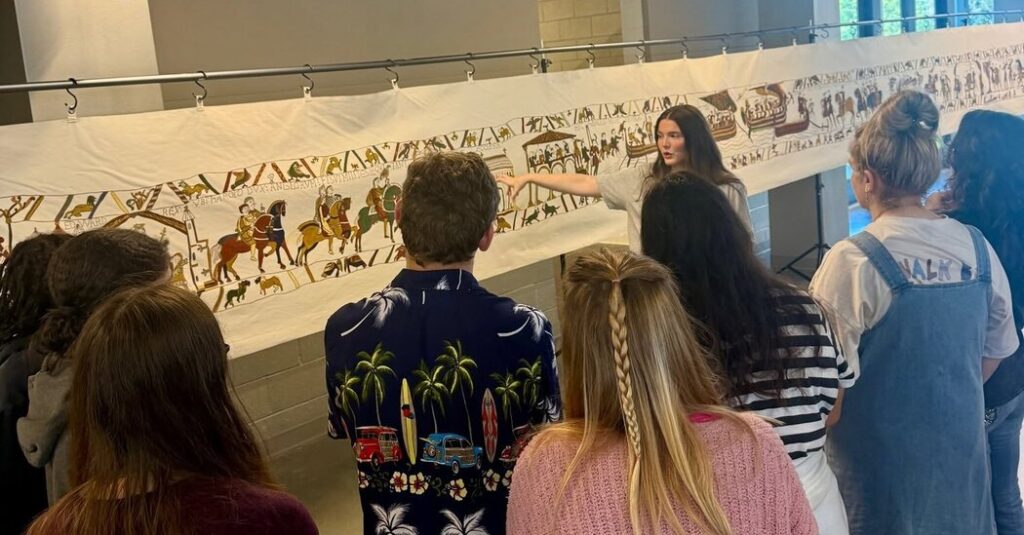
Yet there appears to be only one full-scale replica, held by the University of North Georgia, which plans to exhibit its hand-painted version from this Saturday to Tuesday in the concourse of its basketball arena.
Ana Pozzi, an art history professor at the university, said in an interview that Edd Wheeler, a local judge, had commissioned the artist Margaret ReVille to paint a replica in the mid-1980s. “It was the craziest idea,” Pozzi said.
Wheeler hoped the work, an acrylic on cotton canvas, would tour the United States and make a profit. But when his moneymaking scheme failed, he eventually donated the tapestry to the university, which now displays it annually and uses it to teach students about art and world history.
At the British Museum, visitors may have limited time with the tapestry. At the university, Pozzi said, visitors can linger on the scenes for as long as they like.
In a Danish Abbey, a Version With a New Ending
The original Bayeux Tapestry has one major area of damage: its climax. Its final scene depicts Norman cavalry charging at fleeing English soldiers, but historians think the story originally continued onward, perhaps showing William the Conqueror’s coronation as king of England.
Those scenes potentially wore away during the many years when the tapestry was kept on a spindle in Bayeux, France, and unwound for admirers to view.
To imagine what the tapestry might have looked like before it suffered such damage, the curious can head to Borglum Abbey in northern Denmark, which houses a replica made by nine embroiderers that features an imagined ending.
Gitte Pedersen, a retired nurse and one of those embroiders, said the artists who created it were all members of a local Viking history group who usually made costumes and tents. In 2000, they decided they needed a bigger project and then spent 14 years making this tapestry.
Their tapestry’s ending, which is based on numerous history books, features William the Conqueror’s forces ransacking the port of Dubris, modern-day Dover, England, and the new monarch’s coronation in London.
A Puzzle-Filled Replica in New Zealand
Many tapestry replicas are kept behind lock and key in private homes and studios, including one carved out of wood in Norfolk, England, and another soon-to-be-finished replica in Cambridgeshire. Yet one unique example can be seen by visitors to the home of Michael Linton, a former textile designer who lives in the remote Peel Forest area of New Zealand.
About four decades ago, Linton worked for a textile company that each year threw away thousands of steel discs used in industrial knitting machines. He said in a recent interview that he hadn’t wanted those discs to go to waste, so he began breaking off the tiny steel teeth that surrounded them and then fit them together to form a sort of canvas that he could paint.
At first, Linton recalled, he painted soldiers onto those metal sheets. Then he thought of recreating the tapestry, an artifact that he had become fascinated by after seeing a photo of it in National Geographic when he was 12. “It looked like a giant cartoon,” said Linton. He spent 20 years making his replica, which holds the Guinness World Record for the largest steel mosaic (it features three million pieces of steel).
A lover of games, Linton said his replica also contained a puzzle running through the design with encoded numbers and letters that only one person has ever solved.
His tapestry toured Britain in the 2010s but is now kept at his home, and he said he’d happily show it off to anyone who came by. “If I’m in,” he said.
The post How to See a Bayeux Tapestry — Without Going to the British Museum appeared first on New York Times.