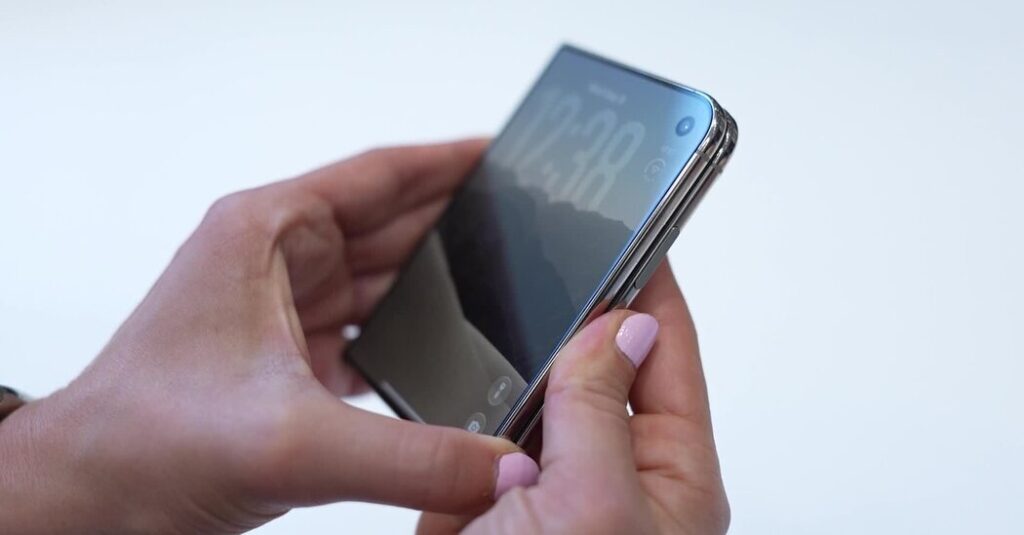
Apple on Wednesday unveiled the iPhone Duo, its first foldable smartphone with a 7.6-inch glass screen that is capable of bending countless times without breaking.
The Duo is not the first foldable phone; Google, Samsung and Motorola have all released devices with displays that bend. But in his pitch for the Duo, Apple’s new chief executive, John Ternus, said the company’s latest offering “will redesign the experience of using a foldable phone.”
The screens of foldable phones are a triumph of materials science and microengineering. No single breakthrough or industrial secret makes them possible; rather, a series of complementary feats makes a display flexible enough to bend many thousands of times without snapping yet strong enough to survive drops and other abuse.
Glass — the brittle, breakable kind — is what scientists call an “amorphous solid.” It looks and acts like a solid, but glass atoms are actually frozen in a liquid-like state. Everyday glass shatters when bent because those atoms lie in a rigid matrix that, when thick, leads to extreme tension on the outer edge of the curved surface.
But glass becomes flexible if it’s thin. The average human hair is between 50 and 100 micrometers thick. The super-thin layer of glass in a foldable iPhone is reportedly less than 30 micrometers thick, or much finer than a human hair. At this step of miniaturization, the strain on the outer edge becomes so low that the glass tends to curve rather than break.
Added to that, chemists found that alternative glass formulas could enhance the flexibility. Everyday glass is made of silicon dioxide, which comes from melted sand. But boron trioxide, used mainly in laboratory glassware that expands and contracts very little when heated and cooled, has an atomic matrix that’s amorphous rather than rigid and crystalline. Lab testing showed that, when thin, it bent more easily than regular glass.
Another extremely thin layer in a foldable screen is made of ultra-durable, highly transparent plastic that’s engineered to endure hundreds of thousands of fold cycles without clouding or warping.
Finally, the many layers of a foldable screen are bonded together with what the industry calls optically clear adhesives. Viscous and elastic, they act like a gel, holding the layers together firmly but under the stress of a bend still allow the layers to glide past each other.
The post Glass Thinner Than a Human Hair: How the New iPhone Bends but Doesn’t Break appeared first on New York Times.