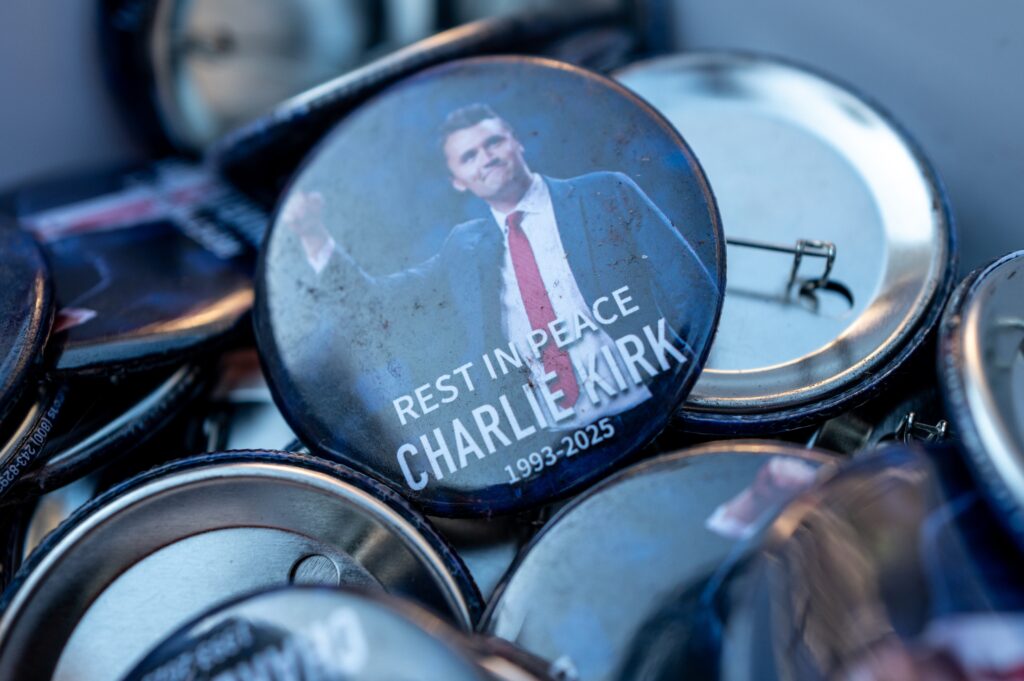
The fatal shooting of Charlie Kirk shocked the country on Sept. 10, 2025, reverberating far beyond the Utah university where thousands had gathered to hear the conservative activist speak.
Many mourned the 31-year-old founder of Turning Point USA as a hero. They started new chapters of Kirk’s group and vowed his movement would emerge stronger.
More than 600 were suspended, investigated or fired for their comments on a man whose views on gender, race and sexuality they detested.
The killing jolted a nation already on edge about political violence and affected people in deeply personal ways. A lawyer in Virginia became a Christian. A volunteer at Kirk’s event in Utah became a target of baseless conspiracy theories.
One year on, here are the stories of six people whose lives changed after Kirk’s death, told in their own words. Their interviews are edited for length and clarity.
Damon Ferrara
Ferrara, 40, is a lawyer in Falls Church, Virginia.
I wasn’t raised in a Christian household. My dad is very philosophical and maybe he would call himself a deist. I think his position is “I don’t know,” but he’s not a believer in Jesus Christ. And neither was I until I was 39. I just rejected it on its face. It seemed kind of ludicrous.
I didn’t really know much about Charlie Kirk. I had seen clips of him. I thought he was probably fine, maybe a little bit annoying. He seemed to advocate for American values, which I was very fond of.
I was at a desk working, and I got a text message saying Charlie Kirk was shot. I immediately prayed to God just instinctively. I said, “God, I know you have a plan, but please if you can, will you save him?” It was just a reflex in the moment. My eyes started to well up.
For a few days, I saw clips online of Charlie Kirk, more than I’d ever seen. He was on a podcast with these young women who were in the pornography industry and one of the girls said you’ve been one of the more respectful counterparts we’ve ever had in a conversation. He said, “I can tell you it’s not me. If it was me, I’d be yelling and screaming. It’s the Holy Spirit.”
I didn’t know what that was, but I thought, “Even if that’s not true, boy, would I like to be able to control myself when I feel angry.”
Two days later, I was running and I couldn’t shake this sadness that I felt. I just stopped, and I looked up and thought, “What do you want from me? Just tell me.” And I asked, “Is Jesus real?” I couldn’t believe it. He gave me four signs at once. This feeling came over me. It’s not really easy to describe. I just felt like this thundering presence. It was like a gong being struck.
There was nothing really wrong with my life. I had a very nice job that was well paying and respected. I had a lot of friends. I had an amazing family. But there was a weird sadness that I felt. But after that day, the sadness that I felt was gone.
My life now, I pray daily. Jesus Christ is the most important thing to me in the world. Charlie’s death is what caused me to ask questions and eventually find Jesus. From what I understand from other accounts, I’m not the only person that that happened to. I think it happened to a lot of people.
— As told to Casey Parks
Caleb Chilcutt
Chilcutt, 24, was the chapter president for Turning Point USA at Utah Valley University when Kirk was shot there. Now he is a field representative for the organization. The UVU chapter grew after Kirk’s death, Chilcutt said, amid a burst of interest nationwide. TPUSA says it had 3,500 high school clubs and 1,500 college chapters this past school year — up significantly from the year before.
It’s still a blur, but also so clear in my mind.
We came to school really early in the morning to set up. People were already there in the crowd getting ready. People had been waiting for like five hours.
Charlie was running a little late. But he finally pulled up, and then I got a solo picture with him before I had to run off to introduce him to the crowd. The crowd was huge. It was incredible.
My wife and I … got stuck talking to someone inside one of the hallways. Then we heard what sounded like a pop. Or someone dropped something heavy. To me, it sounded like someone dropped an instrument. Then the screaming happened. People started running. I heard a student run down the hall saying, “Active shooter, active shooter, get to safety.”
I called my field rep at the time, and I was like, “Hey, what’s going on? Like, what the heck?” And all she said was, “Charlie’s been shot. Just get to safety. We’re taking him to the hospital right now.”
It was President Trump’s statement that [said] Charlie had been ultimately killed. I was still on campus at that time. I think a friend sent it to me.
I had a feeling just in the back of my head that was like, “We need to keep marching forward.”
A lot of students were scared. Obviously. A lot of students left the chapter saying that they feared for their safety, feared for their lives. But I just remember telling so many people, “Hey, this is exactly what whoever shot Charlie wanted. They wanted to silence his message. They wanted to silence him, and we have to let them know, we have to let UVU know that we’re not silencing, we’re not backing down. We’re going to continue Charlie’s message. We’re going to continue to push forward and be the same chapter, but even louder than before.”
The intensity of the rush has definitely cooled down, but we’re still getting a lot of new members across the country.
It took me … seven more months to kind of actually write down this op-ed, because my thoughts were kind of all over the place: Charlie Kirk was not killed over a policy disagreement. He was murdered because too many people were conditioned to see him not as a fellow American or neighbor, but as an ideology. This is the deadly logic of dehumanization.
Whenever I would have debates on campus, if we found just one thing in common … it creates a base of humanity between each other where we can have all those difficult conversations. We can have the sort of aggressive back-and-forth, but we walk away peaceful. It could be as simple as, we both breathe the same air.
— As told to Hannah Knowles
Karen Leader
Karen Leader, an art history professor at Florida Atlantic University in Boca Raton, was placed on administrative leave last year after a former aide for Gov. Ron DeSantis (R) flagged posts Leader made on X about Kirk. Leader eventually returned to teaching, but she has received death threats and other “terrorizing” messages in the year since.
He wasn’t even announced dead and people were already posting glowing things about him. It felt like a coordinated whitewashing of who Charlie Kirk was.
I saw other people started collecting video and audio of what Charlie Kirk was very comfortable saying. Mostly what I did is retweet them. Very often, all I added was “This was Charlie Kirk.”
I never retweeted anything that said he deserved to die. I never said good riddance. I never communicated anything to the effect of “Yay, he is gone.” I went back later and counted 48 of those reposts across several days.
Jordan Chamberlain, a former staff person for Governor Ron DeSantis, collected screenshots of my posts and started tagging my university that Friday. People were doing this all across the country.
On Saturday, I was put on administrative leave. And I sort of understood it. I thought, “I’ll wait this out until the next thing explodes on Twitter and this becomes old news.” But our [university] president, within that same hour, made a public statement and said an FAU professor has been put on administrative leave for posting about Charlie Kirk’s murder. That was a misstatement. I never posted about his murder. I posted about who he was in life.
That post didn’t name me, but it didn’t matter. People were immediately able to figure out who he was talking about.
By Sunday morning, I had eight death threats in my email, in addition to vulgar messages in the DMs of all my social media accounts and on my school voicemail. Someone doxed my home address.
I didn’t leave the house for three weeks.
There was a lot of trauma and there still is, but once I saw this wasn’t going away anytime soon, I started appearing at small political gatherings like our local Indivisible group. Fascism scares you into shutting up and going along.
I was terrorized and I was threatened, and I was terrified for my students because everyone knew where the campus was. But I have a ton of privilege. I have tenure. I’m White. I’m middle class. I’m old enough to get Medicare. I have dual citizenship in Ireland. I don’t have children. A lot of people who don’t speak up, it’s because they don’t have that kind of privilege. I do, so I will speak out for those who can’t.
The university hired an outside law firm. The report they submitted said I was to be reinstated, that it was protected speech, and I should not be disciplined. But the legal process exonerating me does not mean I was not censored.
Now I’m fully back. I have trauma around going back into the class. The one thing I would never be able to get over is if any student was harmed because of this. I could never survive that. And I do worry. Is there one crazed person who is still stewing about this, still hunting me?
— As told to Casey Parks
Chris Rich
Rich, 48, runs the risk-mitigation and security firm Hawque Protection Group in Atlanta. His company has grown dramatically since the Kirk shooting. Five years ago, it had three employees. Now, it has 120.
I was not planning on having a security company. Nine years ago, me and my wife lived in Tampa, and we had an attempted home invasion. Back then, we were living in a bubble. I was doing mergers and acquisitions, and I was not very plugged in with the community at all. That woke us up. When we moved to Atlanta, I was like, “We have to get involved. There are other communities being victimized. How can we help?” And then it turned into a business.
Historically, people weren’t proactive about security. They would wait until something happened to them or their assets, then they would call people in.
I first started to see the industry shift a little bit when the United [Healthcare] CEO shooting happened. I got invited to speak in front of security leaders from hospital systems about what they should do for their C-suite staff. If you lose a CEO, it affects your staff, it affects culture, everything.
I had a feeling after the Charlie Kirk shooting that something was going to boil over. We started getting more calls. People from both political parties became very alert. They were terrified. They wanted to know: Are more going to follow? Are they safe? Is their family safe when they travel?
Every politician wanted personal protection. Everybody wanted secure transportation, threat assessments for their homes. If we were working with a political group who was planning a rally, they wanted more security, more police, more security consulting. If you look at what’s going on in all these communities with data centers, people are very angry, and now even city council people and small-municipality mayors want secure drivers.
We definitely have grown exponentially, but I think it’s unfortunate to grow from fear and chaos.
For me, emotionally, it was heavy. I was sad to think about where things have gone as a country. It made me worry for my daughter, who is 10 years old, and is being raised in this new environment. After Charlie happened, I stopped doing protection work personally. I’ll do it if a high-profile person or politician or a presidential family member really wants me to be part of the team, but I’ve stopped because my family’s terrified of how the environment has changed.
I do worry about the rest of the year. I feel like there’s a recipe brewing for more violence in this country. The security requests for the midterm elections this year have increased dramatically. We have political clients who are running for every position you can think of here in Georgia, and everybody’s worried about the voting stations, local fundraisers, political rallies. And they didn’t used to be.
— As told to Casey Parks
Jeb Jacobi
Jacobi, 23, was volunteering for Turning Point at the UVU event where Kirk was killed, and later found himself caught up in the baseless conspiracy theories about Kirk’s death that soon proliferated.
I had been a volunteer with Turning Point since 2024. I grabbed fliers and I started passing them out, and I ended up going down like second to third row from the bottom and I’m about 10 feet away from [Kirk]. For about 10 to 15 minutes, it’s just a normal conversation.
Then just crack — loudest thing that I’d ever heard — and everyone just got down. I see Charlie fall out of his seat. I see him slump over and collapse in his chair. People are running in all directions. People are screaming.
I ended up getting back to my apartment and I was just sobbing. I never sobbed that hard before.
There was a video that went viral of me. I was filmed by one of [former state representative] Phil Lyman’s [staff]. They asked me to give my explanation of what happened. That was right after.
It started very quickly. There were people that were like, “This kid’s reaction is fake” or “Why is he being contacted by all these news outlets?” And every single day I go on X, there’s always new footage of me in that moment. People are like, “Oh, well, he’s acting or he’s faking.” There was this podcaster — his name was Baron Coleman — who’s known for doing conspiracy theory videos, and he did a 15-minute segment on me.
Here’s a couple of the running theories. Number one, Jeb Jacobi is a plant. He was an actor. There’s the microphone-is-an-exploding-mic [theory], and then that Israel was involved somehow. That Turning Point was behind it, they purposely wanted to knock Charlie off.
That’s ridiculous.
I think [Kirk] will be remembered as someone who stood up for what he believed in and died for what he believed in.
They treat him as a joke — people that disagree with him, you know, think that his murder was funny.
I don’t think that’s very funny. I watched him die.
— As told to Hannah Knowles
Debbi Rollo
Rollo, 60, went to see Kirk speak at UVU the day he was shot.
I followed Charlie Kirk. I really liked him. I found out he was going to be doing the debate and speaking at UVU, so I decided I would just go.
I told my husband before I left that I’m kind of nervous because things happen at these types of things sometimes, but I’m going to go anyway. I don’t want to let fear stand in my way.
If I look back, the main picture that comes to me is starting to run with everybody. That adrenaline and that fear and the thing of not knowing if other shots would come, and you’re just running through the building, in the parking lot, down across the grass — as far away as you can get.
I’ve been reluctant to show up at political events. You think, “I’m not going to let it stop me, they’re not going to win,” that kind of an idea. Because that’s what they want. But it kind of does have an effect.
I can’t really think of a political event that I’ve gone to since [the shooting].
The home show was at UVU, and I chose not to go to that — the home show that they do every year.
I did go to my son’s graduation there. It was in May. I was so excited about the graduation, I think I didn’t let it get to me. But especially as we were just pulling up and I was walking in UVU … flashbacks.
It’s just kind of out of nowhere. I’ll just picture me being up there and watching that happening and running with everybody.
As I drive past UVU, I just get this feeling, this sad triggering kind of feeling. It’s not extreme, but it’s sad. Because my kids went there. I love that school. I’ve gone to events. And now my association with UVU is the day I witnessed Charlie Kirk being killed there.
— As told to Hannah Knowles
The post Charlie Kirk’s killing a year ago reshaped lives. 6 people share their stories. appeared first on Washington Post.