Over Labor Day weekend, Tristan Buckmaster, a mathematician at New York University, felt as if he had been rolled over by one of the biggest and most powerful companies in the world — because of a math problem.
Over the course of August, Dr. Buckmaster and another mathematician had made significant progress on a longstanding puzzle involving the Navier-Stokes equations, which describe the flow of fluids like water and air.
But then OpenAI, the artificial intelligence behemoth, jumped into the fray.
Rumors that their archrival, Anthropic, had solved one or two of math’s “Millennium Prize problems” spurred OpenAI leaders to tackle the same list of problems, which offers $1 million for the first proof that passes a rigorous review.
The list includes the Navier-Stokes puzzle, and in less than a week, OpenAI beat Dr. Buckmaster and all of the world’s other human mathematicians, announcing on Tuesday that it had found the answer.
Over the past couple of days, a firestorm has ignited across the social media universe: perceived threats, dangled prize money and suggestions that OpenAI’s A.I. agents had somehow found and incorporated Dr. Buckmaster’s recent work into the company’s proof.
On Wednesday evening, in response to questions from The Times, OpenAI said in a statement that it was “categorically” impossible for its A.I. system to have been influenced by anything Dr. Buckmaster had done in the past two months.
Dr. Buckmaster said he did not care about the $1 million or even winning the race to come up with the answer. “I love math, and I just wanted to be part of the story,” he said during a two-hour recounting of the events in his N.Y.U. office on Tuesday afternoon.
He is now part of a different story: the acrimonious rivalry between OpenAI and Anthropic, which was founded in 2021 by former OpenAI leaders who said OpenAI had become cavalier about the dangers of artificial intelligence.
“When they are two of the biggest companies in the world, they need to get over it,” Dr. Buckmaster said. “I am just a bystander in these petty games.”
The tension between Dr. Buckmaster and OpenAI also reflects a chasm of distrust between the swashbuckling culture of high-flying, high-tech start-ups and the usually cordial and communal collaboration of mathematicians, who nonetheless increasingly rely on the tools of A.I.
Both Dr. Buckmaster and OpenAI officials largely agree on what the two sides discussed over the weekend.
On Sunday, even though OpenAI had completed a proof of Navier-Stokes and Dr. Buckmaster had not, Sébastien Bubeck, the leader of the OpenAI effort, made what would seem to be enticing offers to Dr. Buckmaster: Dr. Buckmaster could publish his results first. He could also serve as the lead author of an OpenAI paper describing the proof or get ample computing resources from OpenAI to further his work. The company would also suggest that Dr. Buckmaster and his collaborator deserved to collect the $1 million prize.
The snag was that his collaborator is Levent Alpöge, a mathematician who works at Anthropic. Although this was a personal side project of Dr. Alpöge, not an Anthropic initiative, Dr. Bubeck was wary.
Dr. Buckmaster said since he and Dr. Alpöge had used both OpenAI and Anthropic tools, the best resolution would have been for the two companies to collaborate in this instance.
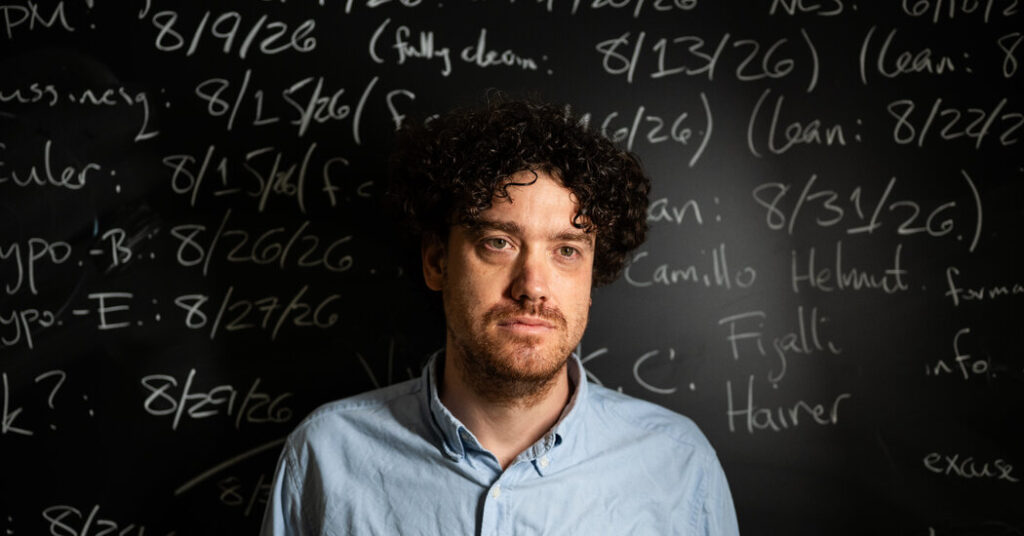
“The big sticking point was that they didn’t want Levent on the paper,” Dr. Buckmaster said as he sat in his spartan university office.
Behind him, on the blackboard, was a chronology of their progress on the problem; several chairs were set out nearby. This had served as what he called his “war room,” where he had discussed with N.Y.U. colleagues what he should do.
(The New York Times has sued OpenAI and Microsoft, which is a major investor in OpenAI, claiming copyright infringement of news content related to A.I. systems. The two companies have denied the suit’s claims.)
In 2000, the Clay Mathematics Institute set forth the Millennium Prize problems — what it regarded as the seven grandest unsolved problems in the field — and offered $1 million bounties as additional incentive.
One of the Millennium problems involves the Navier-Stokes equations, which are named after the scientists who wrote them down in the 19th century to capture the behavior of fluid flow. These equations are of immense use to weather forecasters and aircraft designers, but to mathematicians, they remain mysterious.
A simple question they could not answer: Could the Navier-Stokes equations sometimes produce nonsensical answers in which the liquid accelerates to infinite speeds?
With help from artificial intelligence models, Dr. Buckmaster and Dr. Alpöge had solved that for simpler equations.
But now OpenAI had the grand prize. For the Navier-Stokes equations, at least in some circumstances, the answer is yes.
And Dr. Bubeck was inviting Dr. Buckmaster to join the winning team.
“They couldn’t understand why I wouldn’t take this bargain — why I wouldn’t throw Levent under the bus,” Dr. Buckmaster said.
He also had a troubling suspicion that OpenAI’s multitude of A.I. agents had, perhaps unintentionally and inadvertently, built their proof based on Dr. Buckmaster’s and Dr. Alpöge’s work. Although they had not yet publicly revealed their work, Dr. Buckmaster used an OpenAI tool called Codex, typically used to write and manage computer code, to help clean up and simplify the often messy mathematical ramblings produced by artificial intelligence.
Since OpenAI, like other A.I. companies, includes user data to help train its models, could the OpenAI agents have constructed their solution based on what Dr. Buckmaster had supplied to Codex?
“There’s no proof that they did that,” he said, but the approach in the OpenAI proof and the timeline of events “is highly suggestive that that’s exactly what happened.”
Dr. Buckmaster felt that OpenAI was trying to buy him off. He said no.
Frustrated, Dr. Buckmaster said he might take the dispute public. He said Dr. Bubeck of OpenAI replied, “Why would you ruin your career?”
Dr. Buckmaster said that when he asked how that would ruin the life of an academic researcher, Dr. Bubeck replied, “If you don’t want me to be nice, then I don’t have to be nice.”
In an interview, Dr. Bubeck disputed the tone and intent of what he had said. The offers, he said, were meant to help Dr. Buckmaster, either providing the computing resources for him to complete his proof or allowing him to take over the writing of the paper describing OpenAI’s proof.
Dr. Bubeck said OpenAI had struck similar deals with other mathematicians after earlier OpenAI math proofs. “So I was a little bit shocked by the reaction on the other side, which was not cooperative,” he said.
He said OpenAI wanted to leave Dr. Alpöge off the final paper, because “from our perspective, how can we have an internal OpenAI project with an Anthropic employee?”
He dismissed Dr. Buckmaster’s concerns that the Codex prompts had been used as part of the training for the OpenAI model.
The Wednesday evening statement from OpenAI was more emphatic: “We can say categorically that it is impossible for Dr. Buckmaster’s Codex prompts over the last two months to have influenced the system in any way, including training.”
The statement added, “After investigating, we can say with full confidence that no user inputs past July 3rd could have influenced this system in any way.”
Dr. Bubeck also said that he had not been threatening Dr. Buckmaster. “Quite the opposite,” he said. “I was trying to say: ‘Let’s try to work together. Let’s make this something good.’”
Peter Sarnak, a mathematician at the Institute for Advanced Study in Princeton, was among those whom Dr. Buckmaster phoned on Sunday. “This kind of bargaining I’ve never heard of,” Dr. Sarnak said. “I admire him for behaving the way mathematicians behave.”
On Monday night, just before midnight, Dr. Buckmaster posted three papers on the internet describing the results he and Dr. Alpöge had completed. He also posted an 1,870-word treatise describing the history of the research and apologizing that he had not had time to polish the manuscripts up to his usual standards. And then he recounted in detail his interactions with OpenAI over the previous few days.
At 2:30 a.m., he finally left his office and went home. On Tuesday afternoon, OpenAI announced it had the Navier-Stokes proof.
Dr. Buckmaster said he was worried about what would happen next. “To go against a trillion-dollar company is super scary and frightening,” he said. “We are all scared of OpenAI.”
What has been lost in the fracas, Dr. Buckmaster says, is recognition and appreciation of what human mathematicians brought to the problem.
He points not to himself and Dr. Alpöge but to Diego Córdoba and Luis Martínez-Zoroa, two Spanish mathematicians who a couple of years ago came up with a new strategy for attacking problems related to Navier-Stokes, designing a series of kicks that could knock fluid into flowing at impossibly infinite speeds.
“The main intellectual credit has to go to Luis and Diego,” Dr. Buckmaster said.
Most partial differential equations, which include Navier-Stokes, are notoriously difficult — often impossible — to solve exactly. Mathematicians typically take a step-by-step approach, tackling a series of ever more difficult versions to reach their ultimate goal.
In the era before artificial intelligence, Dr. Córdoba and Dr. Martínez-Zoroa would have had the luxury of years to follow through on their initial ideas. “Other people will come in and contribute ideas, and maybe we solve the Millennium Prize problem in 10 years without A.I.,” Dr. Buckmaster said.
But now A.I. has upended everything. In their collaboration, Dr. Buckmaster set up the problem, and then Dr. Alpöge fed that into an A.I. model at Anthropic. Based on what came out, they provided further input and repeated the steps.
The process worked well, but for Dr. Buckmaster, it became discouraging. “On one side it’s, like, super exciting to be part of this,” he said. “On the other side, this is frightening, because I felt like the A.I. had overtaken me.”
Was he now an interpreter of A.I. slop and no longer the discoverer of new mathematical insights?
“What’s the human part of it?” he said.
The next chapter of A.I.’s ascendancy in cutting-edge mathematics may come soon.
In its Wednesday night statement, OpenAI said: “In addition, since the completion of Navier-Stokes, we have made substantial progress on another Millennium Prize problem. We are working through how to share these results thoughtfully.”
The post An N.Y.U. Mathematician Clashed With OpenAI Over a $1 Million Proof appeared first on New York Times.