For years, U.S. lawmakers have pushed for more flights out of Reagan National Airport, sometimes to make traveling home more convenient for them. But now, two senators are ramping up their fight for the opposite.
Sens. Tim Kaine (D-Virginia) and Mark Warner (D-Virginia) are set to introduce a bill next week that would restrict flights at National, also known as DCA, in an effort to make Washington’s chronically congested airspace safer following the deadly 2025 plane crash near the airport.
Kaine said he understands why it’s more convenient for lawmakers to fly in and out of National, which is in Arlington, Virginia, and is a roughly 15 minute drive from the U.S. Capitol. “But the convenience of 535 members of Congress can’t outweigh the safety of 25 million people who use that airport,” he said in an interview.
If passed, the DCA Air Safety Act would reduce the number of planes that can fly into National each hour and require them to be spread out over that time.
In January 2025, an Army helicopter collided with an American Airlines regional jet over the Potomac River, killing 67 people in what was the deadliest domestic plane crash in over two decades.
Following the crash, the Federal Aviation Administration reduced National’s arrival rate — the number of planes arriving per hour — from 36 to 26, according to a spokesperson. The agency then gradually increased the arrival rate to 30, where it remains today, the spokesperson said, “after determining that uptick could be handled safely.”
The bill would require the FAA to reduce the arrival rate to no more than 28 aircraft per hour at National.
“The risks are now painfully clear, and Congress cannot wait for another tragedy to act,” Warner said in a statement.
Michael McCormick, coordinator of the Air Traffic Management program at Embry-Riddle Aeronautical University, said he thinks National was over capacity when 36 aircraft were arriving every hour. “That is an extraordinary effort,” he said.
Jeff Guzzetti, a former accident investigator at the FAA and the National Transportation Safety Board (NTSB), said he was concerned that 30 arrivals per hour was still too many.
“There is way too much airline traffic allowed in and out of the airport, and I think it needs to be reduced. It’s just too much traffic for too small of an airport in a congested area like Washington, D.C.,” he said.
Still, Guzzetti said he wasn’t sure what the right number would be. “It’s a balancing act between safety and the convenience and efficiency of aviation transportation,” he said.
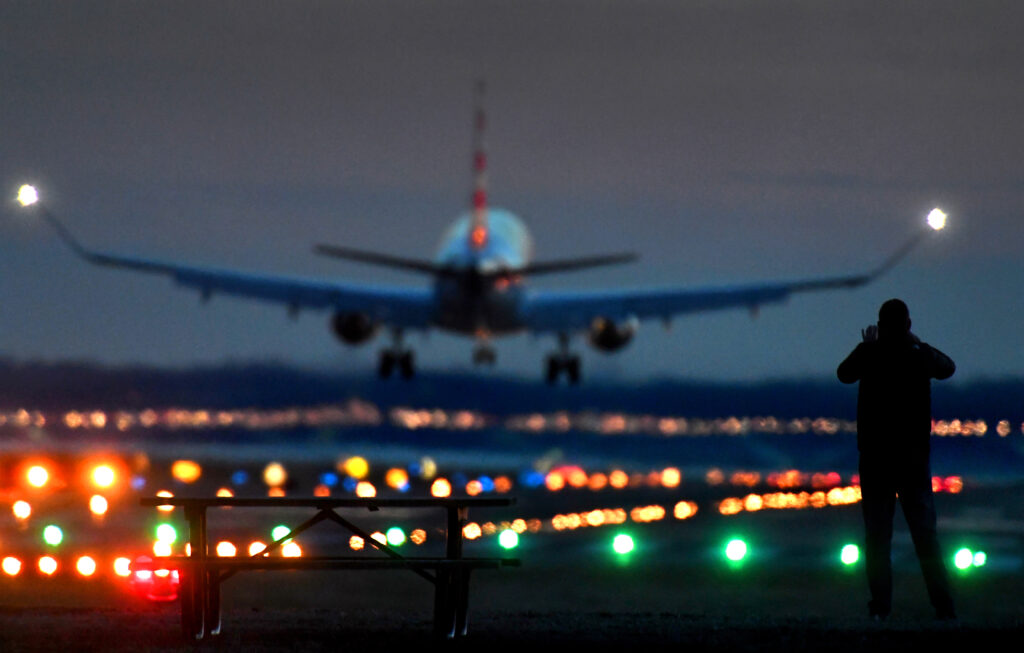
Despite being the smallest of three major airports serving the D.C. area, National averaged more than 800 daily takeoffs and landings on its main runway as of 2023, making it the busiest runway in the United States, according to the Metropolitan Washington Airports Authority (MWAA), which runs National and Washington Dulles International Airport.
“DCA operates at full capacity, with a takeoff or landing every minute, for much of the day,” MWAA CEO Jack Potter said in 2023.
National is one of a handful of especially busy airports in the U.S. that use “slots” to control congestion. Since 2000, despite strong opposition from MWAA, Congress has added 64 slot exemptions per day at the airport, according to the authority.
A slot is an authorization for either a take-off or a landing at an airport at a specific time. The government can offer slot exemptions, which bypass slot limits or other rules affecting flights.
The bill would eliminate 30 slots in phases from 2028 to 2032, which would mean 15 fewer arrivals and 15 fewer departures per day.
Besides benefiting lawmakers who don’t want to trek to Dulles, McCormick said airlines also have a commercial interest in slot exemptions because they mean more flights. But the current number of slot exemptions “is exceeding the capacity of the airport, and it’s creating too much demand,” McCormick said. He added that he supports reducing slot exemptions at National.
It’s not lost on Kaine that his commute home — a roughly two-hour drive to Richmond — is easier than the commutes of many of his colleagues. He said he expects some pushback to his proposals.
“I have sympathy for my colleagues who have to travel across the country to do this job. I understand how challenging it is. So the convenience rationale is not a minor thing,” he said. But he thinks safety is more important. “When you put the pluses and minuses on the scale, I think the pluses dramatically outweigh the minuses,” he said.
After the 2025 collision, the NTSB determined that between 2021 and 2024 near National there were 85 times when aircraft were less than 1,500 feet apart and with a vertical separation within 200 feet.
The NTSB issued 52 recommendations following the crash aimed at making aviation safer, covering everything from mandating advanced-location receiving equipment for aircraft to developing new visual-separation training. But most of the recommendations remain open.
“We are no closer today to addressing many of the serious safety gaps that contributed to this terrible tragedy,” NTSB Chairwoman Jennifer Homendy said in a July statement.
For months, the Senate and House of Representatives have been in a stalemate over two bills — the Rotor Act and the Alert Act — which aim to improve aviation safety in different ways.
The Rotor Act, which unanimously passed the Senate but failed in the House, mandates advanced-location receiving equipment for all aircraft, including military aircraft. The technology allows planes to receive information from other aircraft to identify their locations in the sky. Compared to the Rotor Act, the Alert Act has more lax requirements for that equipment. In August, a Senate Commerce Committee spokesperson said “work to conference the two bills continues.”
A lot of changes, as outlined by the NTSB, are needed to make aviation safer in the U.S., according to Kaine. “But for this airport in particular, there’s no effective solution without also imposing some meaningful controls over the volume of traffic into DCA,” Kaine said.
Problems have persisted after the crash, including as recently as August.
Last month, the NTSB determined that White House construction was a factor in a safety incident involving Marine One and National in early August. President Donald Trump’s helicopter took off from a temporary location at the Ellipse, leading to communication problems with air traffic controllers at National and a momentary loss of separation between the helicopter and a commercial jet. Air traffic control procedures are designed to minimize risks by keeping planes and other aircraft safely separated. The White House said Trump was never in harm’s way.
On the same day the NTSB released those findings, another communication issue took place between Marine One and air traffic controllers at National, according to air traffic control recordings. The air traffic controller could not hear Marine One and instead asked other helicopter pilots in the area for help, according to a recording of the communications.
Trump officials said Wednesday that they expect to submit Trump’s planned triumphal arch for final approval from a federal panel in November, The Washington Post reported. The 250-foot-tall arch would sit directly in the paths of flights in and out of National.
“Construction of that kind, right in the flight path toward the landing area at DCA, is the last thing the nation needs,” Kaine said. “It turns my stomach even to think about it.”
A preliminary feasibility study by the FAA determined there would be no adverse impacts to operations at National and that the arch would require red, blinking obstruction lights on the top of the structure, an FAA spokesperson said.
The post After DCA collision, Virginia senators to introduce bill restricting flights appeared first on Washington Post.