Twenty five years ago, Osama bin Laden led the planning of Al Qaeda’s attacks on Sept. 11, 2001, from a Taliban stronghold in Afghanistan, where he lived as their guest.
Now, the Taliban rule over Afghanistan once again, trying to present a more modern face to the world.
But despite the veneer, the Taliban have not changed their ideology, and armed groups, including dozens of Qaeda members, remain in Afghanistan. Many of the conditions that made the Sept. 11 attacks possible remain.
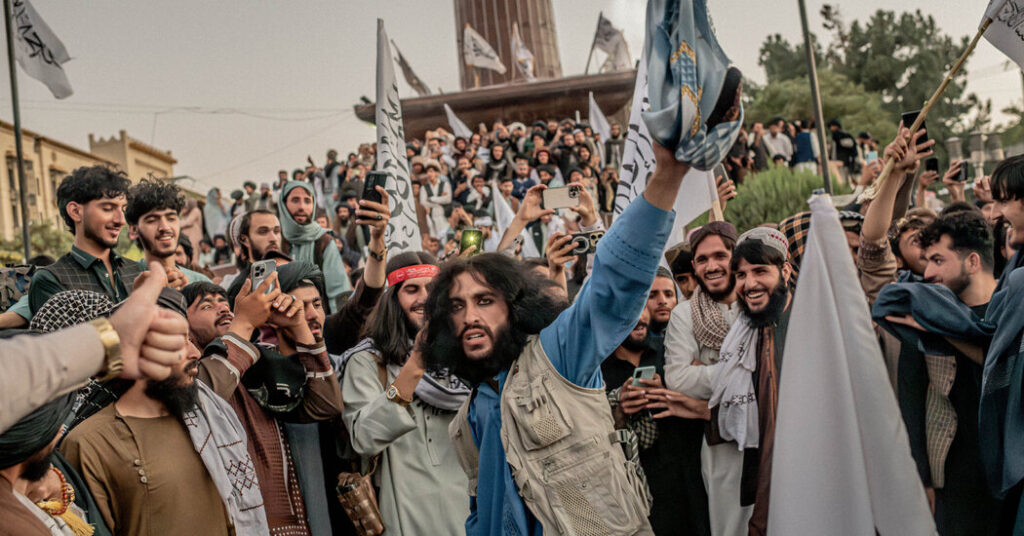
The Taliban outlasted the American war to oust them and are now ruling over 45 million Afghans. They use the latest iPhones to contact European and American diplomats. They travel to the Persian Gulf and Turkey, and promote trade with Uzbekistan and India. Their fighters now patrol Afghanistan’s cities, some using abandoned U.S. military gear.
And when Taliban officials receive foreign visitors in their gilded offices in Kabul, the capital, they insist that they want peaceful relations with the world. They repeat the commitments they made in 2020, during peace talks with the United States, not to allow another major attack to take root on Afghan soil.
“We consider the chapter of war to have come to an end,” Afghanistan’s foreign minister, Amir Khan Muttaqi, said in a recent interview in Kabul.
But the United States, the European Union and most other governments are not ready to trust them.
Their promises about security are similar to the ones Mullah Muhammad Omar, then the Taliban’s leader, made months before 9/11, when he told a journalist that bin Laden “does not operate against anyone from the soil of Afghanistan.”
Al Qaeda and other militant groups remain in Afghanistan, although without a leader as powerful as bin Laden and without their past influence over the Taliban.
And there is a troubling intelligence vacuum. Security officials and diplomats acknowledge that they lack the full picture of what is happening inside Afghanistan. It has again become a dark room where, they warn, new threats could emerge unnoticed.
What Security Means Now
In conversation, Afghans often describe life in their country by what it is no longer: at war. Roads are safe. Mining deals are welcome. The sound of gunfire is less common. Civilians are no longer in constant danger of being killed by drones or crossfire, though the threat from unexploded devices remains. Kabul has seen an influx of new money and new restaurants that mimic the glitter of Dubai.
That is the Taliban’s message: Calm, not chaos, permeates Afghanistan.
But that is only one part of the story. Extremist armed groups still have a home in Afghanistan, according to the United States, China, Russia and the United Nations.
The militant threat in Afghanistan is much less significant and visible than in the years leading up to 9/11, experts and security officials say, when up to 30,000 militants and fighters were in the country.
Still, United Nations experts estimate that 15,000 to 20,000 militants are scattered among about 20 groups in Afghanistan. Russia says they could number up to 23,000.
Al Qaeda has only a few dozen members, according to estimates from the United Nations and security experts, but some of them live freely in Kabul. The Afghan authorities have issued national identity cards to the leadership of Al Qaeda’s South Asian branch, according to the United Nations’ group of experts monitoring terrorist networks.
Thousands of Islamic State militants also roam the rugged borderlands between Afghanistan and Pakistan.
Most numerous are the thousands of militants from Tehrik-e-Taliban Pakistan, known as the Pakistani Taliban, or T.T.P., who navigate the porous border to stage attacks on Pakistani security forces. Security experts and officials attribute a sharp increase in attacks on Pakistan to the permissive environment provided by the Afghan Taliban since 2021.
Though in far lower numbers than in the 1990s, foreign fighters have also recently traveled to Afghanistan from Syria and Somalia.
The Taliban in Afghanistan deny backing the Pakistani Taliban but privately say that they could not rein in the group even if they wanted to.
Pakistan has been a close ally of the United States under President Trump, and the United States has accused the Taliban of breaking their counterterrorism promises. Even China, long a staunch supporter of pragmatic engagement with the Taliban, has urged the group to “resolutely eliminate all terrorist forces.” The European Union wants it “to do more to convince the world that Afghanistan is not a potential threat.”
Intelligence Diplomacy
The continued presence of thousands of militants is one of the main reasons for the Taliban’s continued isolation from the rest of the world. Most security analysts believe that they pose a threat mainly to the region, not the West, but Al Qaeda and the Islamic State still promote a global ideology.
The Taliban claim they work closely with foreign intelligence services to fend off the Islamic State’s regional affiliate, ISIS-K. A senior Afghan intelligence official, speaking on the condition of anonymity to discuss national security matters, called this “intelligence diplomacy.”
The two groups are enemies because ISIS-K adheres to an extremist jihadist ideology that views the Taliban as apostates for accommodating religious minorities and seeking international engagement. ISIS-K claimed responsibility for the attack near the Kabul airport during the U.S. withdrawal in August 2021 that killed 13 U.S. troops and more than 170 Afghan civilians. It has repeatedly targeted Shiite communities in Afghanistan and has claimed deadly attacks in Kabul and Islamabad, Pakistan’s capital, this year.
The Taliban have deployed special forces teams to infiltrate areas controlled by the Islamic State, according to Antonio Giustozzi, a senior research fellow at the Royal United Services Institute in London who follows militant groups in the region.
Experts and security officials say ISIS-K no longer has the capacity to mount a large-scale assault. They attribute this to the work of the Taliban and Pakistan, as well as a broader loss of momentum by the group.
“Kabul, to its credit, is waging a fierce armed struggle against Islamic State,” Sergei K. Shoigu, Russia’s former defense minister and now the secretary of its Security Council, said earlier this year.
The Taliban’s relationship with Al Qaeda is of another nature.
U.S. counterterrorism officials have in recent years called Afghanistan a “nursing home” for Al Qaeda’s senior members and defined the Qaeda threat from the country as being at its “lowest point” in decades.
But its influence persists.
Al Qaeda never abandoned the Taliban during their 20-year insurgency, and the Taliban have not abandoned Al Qaeda in power.
A few dozen Qaeda members remain in Kabul and along the Pakistani border, training the Pakistani Taliban, according to the United Nations’ monitoring group on terrorist networks.
(Bin Laden’s successor, Ayman al-Zawahri, was killed in a U.S. drone strike on his balcony in Kabul in 2022.)
“The exact role of Al Qaeda Afghanistan? It’s very hard to say,” said Colin Smith, the coordinator of the U.N. group, which collects information from more than 40 intelligence agencies for its biannual reports.
In April, Al Qaeda declared support for the Pakistani Taliban and renewed its endorsement of the Taliban government in Kabul, hailing the group as “a modern role model.” By backing the Taliban, Al Qaeda is buying time and space in Afghanistan, Mr. Giustozzi said.
Cumbersome Allies
The Taliban’s relationship with militant groups keeps alive a long-running debate: Are the Taliban an insurgent group engaged in statecraft; a state-ruling entity that hasn’t shed its insurgent past; or a mix of both?
That uncertainty reflects the balancing act at the heart of the Taliban’s survival. Allowing Afghanistan to serve as a launchpad for international terrorism is not in the Taliban’s interest — as they learned after 9/11. But out of hospitality, ideological zeal and a lack of resources, they have so far been unable, and in part unwilling, to expel them.
The Pakistani Taliban are forcing the Taliban to face the consequences. The two fought side by side during the U.S.-led war, and the Pakistani Taliban now expect a return on investment: support to establish a similar stronghold in Pakistan.
If the Taliban withdraw support to their Pakistani counterparts, they risk seeing more of their disgruntled fighters join the Pakistani Taliban. Most of the Taliban’s rank and file now control checkpoints and patrol cities. The Pakistani Taliban are offering a new jihad, right next door.
“We sacrificed our generation to bring peace,” said Farhad Sangari, the Taliban commander of a special forces unit in Kabul, on a recent evening as he led a traffic patrol. He added, “I miss the memories of jihad and the front line.”
Many experts and security officials also fear that the vast network of religious schools that has expanded across Afghanistan since the Taliban takeover is teaching a violent, expansionist agenda.
“How many hundreds of thousands of men have been exposed to the Taliban ideology glorifying jihad?” said Michael Semple, a longtime Afghanistan expert at Queen’s University Belfast.
Afghans are now living with a situation they haven’t faced in decades. They are somewhat safe at home, but Afghanistan is once again exporting insecurity.
The Return of Gunfire
Whatever its exact nature, the relationship between the Taliban and militant groups now threatens to destabilize Afghanistan.
Fed up with relentless attacks from the Pakistani Taliban, the Pakistani military has retaliated with dozens of airstrikes on Afghan security and civilian infrastructure this year, including in Kabul.
A senior Pakistani intelligence official, speaking on the condition of anonymity to discuss national security matters, said his country’s leadership had concluded Pakistan’s domestic security would not improve until it “sorted out” the Taliban. Over the past few months, Taliban officials have grown increasingly concerned about the possibility of a Pakistani-backed attempt at regime change in Afghanistan.
Anti-Taliban resistance groups waiting in the wings now see an opportunity. Three groups, led by former members of the U.S.-backed Afghan military, have claimed responsibility for more than 50 attacks on Taliban officials, checkpoints and buildings across Afghanistan since July.
The leader of one of them, speaking on the condition of anonymity to discuss the attacks, described them in an interview as targets of opportunity, aimed at cracking the veneer of security that the Taliban have so far maintained.
The scattered attacks do not yet pose a regime-ending threat, but at least two local officials have been killed by anti-Taliban forces in recent weeks.
They are another reminder that in Afghanistan, war is not yet a distant memory.
The post 25 Years After 9/11, Al Qaeda Still Has a Home in Afghanistan appeared first on New York Times.