When Britain announced sanctions on Tuesday against Israeli settlements in the occupied West Bank and said settlers there were taking part in the “ethnic cleansing” of Palestinians, the Israeli foreign minister accused his British counterpart of having acted for “domestic political reasons.”
The intensity of the Israeli response that followed could be chalked up to the exact same thing.
The foreign minister, Gideon Saar, lashed out at Ed Miliband, the British foreign secretary, in a news conference, saying his speech announcing the sanctions was based on “outrageous lies.” Mr. Saar ordered the swift closing of the British Consulate in Jerusalem, evicted British officials from an international center coordinating support for Gaza in southern Israel and barred from Israel a dozen British lawmakers and others he deemed anti-Israeli and antisemitic.
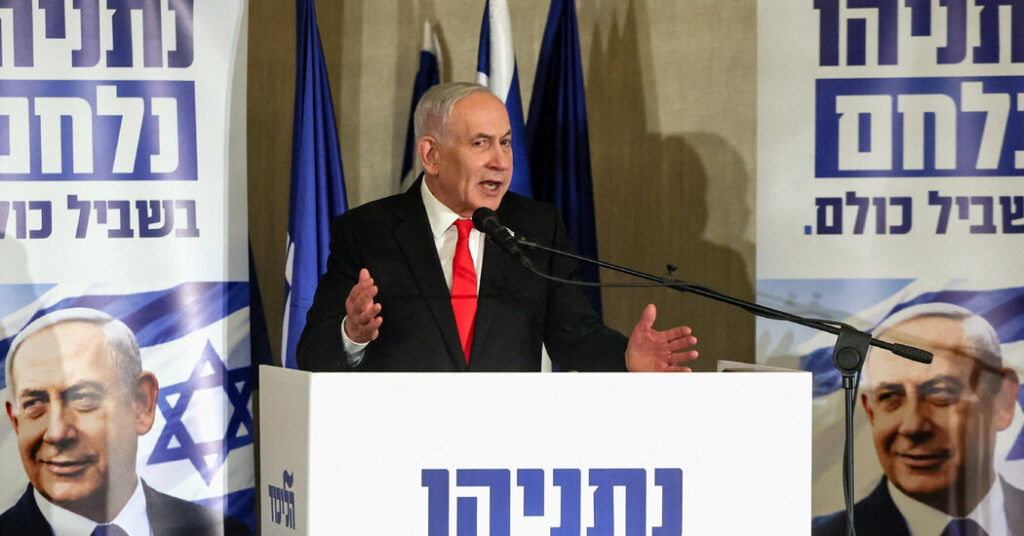
The robustness of that counterpunch cannot be disentangled from the fact that Prime Minister Benjamin Netanyahu’s government is up for re-election in less than seven weeks. In that sense, the British move may have played into the hands of the Israeli leader’s right-wing coalition, some analysts said.
Mr. Netanyahu, who was already on the defensive on a number of fronts and has struggled in the polls, has sought to wring political advantage from Israel’s military conflicts with several adversaries. He can now make the case to voters that the British diplomatic pressure is yet another reason to rally behind him.
“This is a government that relishes this idea that the world is against us,” said Alon Pinkas, a former Israeli diplomat and adviser to two of Mr. Netanyahu’s predecessors. “It’s a state of mind — that we’re the perpetual victim. And they think that they have to be the tough guy and show that we’re defiant and won’t succumb.”
Mr. Pinkas added that the ferocity of Mr. Saar’s response was an indication that Israel saw itself as fighting a rear-guard battle, especially after a dozen countries, including longtime allies like France and Canada, said on Tuesday that they supported the trade sanctions on the settlements.
“They are sensing a growing anti-Israeli tide all over the world, roughly since Oct. 7,” he said, “and they feel they have to stand up to it.”
Indeed, there is something of a competition underway within Mr. Netanyahu’s coalition cabinet to be the first and loudest to tell the rest of the world where it can go.
Itamar Ben-Gvir, the far-right security minister, who often stakes out extreme positions, publicly proposed that the government close the British Consulate in Jerusalem and seemed almost surprised when Mr. Saar went ahead and did it. Bezalel Smotrich, the far-right finance minister, went further and called for the British ambassador to be expelled.
Veteran Israeli diplomats said the government’s response also showed how far Israel had shifted away from even considering a two-state solution to the Israeli-Palestinian conflict, after the British government said its sanctions were largely designed to help preserve the possibility of one.
Years ago, Israeli officials would almost certainly have argued that encouraging negotiations with the Palestinians was the best way forward, not taking unilateral retaliatory moves, said Jeremy Issacharoff, a career diplomat who retired as Israel’s ambassador to Germany.
Not so now. “Where’s the diplomacy?” he said. “It doesn’t exist.”
While Mr. Saar complained in his news conference of Britain’s “one-sided, anti-Israel approach,” he said nothing of talks with the Palestinians about a political solution to the conflict. Rather, he repeatedly said that the Israeli public rejected the creation of a Palestinian state in the West Bank and “overwhelmingly” supported settlements in the territory — though they are considered illegal by much of the world because international law bars an occupying power from moving its citizens into captured land. And Mr. Saar warned that no amount of international pressure could dislodge the settlements.
“We did not return to our land after 2,000 years only to lose it under pressure from jihadists, Islamists, antisemites, far-leftists and wokes,” Mr. Saar said.
To Mr. Issacharoff, the conclusion to be drawn from Mr. Saar’s response was simple and bleak.
“What he’s basically saying is we want a one-state reality in which we control the whole of the land of Israel,” he said. That would mean Israel either grants Palestinians equal rights and ceases to be a Jewish state, or denies them equality and ceases to be a democracy.
Some on Israel’s political left welcomed the aggressive new British policy.
“I strongly believe that the Miliband measures are good for Israel,” said Nadav Tamir, a former diplomat who heads the Israeli office of J Street, a pro-Israel lobbying group in the United States that supports a two-state solution. “Any move to prevent annexation and ethnic cleansing in the West Bank,” he said, would “help us to be more secure and more moral.”
But others said they feared there could be unintended consequences: The sanctions could aid Mr. Netanyahu’s re-election campaign, and Britain, an important ally of Israel, may have squandered any leverage it possessed.
Mr. Miliband could have explicitly offered to revisit the sanctions program if a new Israeli government was elected and it curbed illegal settlement expansions. Instead, he said only that Britain would “continue to assess the government of Israel” in hopes of seeing “a new approach.”
That could mean that a new Israeli leader would be unwilling to spend precious political capital taking on the pro-settlement community, even to a limited degree, analysts said.
“I think there could’ve been some carrot put on the table that, once Israeli policy changes for the better, these sanctions could be withdrawn,” Mr. Issacharoff said.
The fact that the British sanctions will not take effect for six to nine months leaves some room for flexibility, however.
For right-wing Israelis, the idea that the new British policy was meant to encourage a two-state solution was belied by what they saw as its one-sidedness. Mr. Miliband made only the briefest mention of the need for the Palestinian Authority, which administers part of the West Bank, to “accelerate reform,” for example, and said nothing about terrorist acts committed by Palestinians in the territory.
Alan Baker, a former Israeli ambassador to Canada, said Britain appeared to have thrown in so squarely with the Palestinians that it had lost any claim to impartiality.
“The feeling toward the British,” he said, “is that the British Mandate ended in 1948, and the time when the British were able to tell Israel what to do ended then, too.”
The post Why Israel Reacted With Fury to U.K. Sanctions on West Bank Settlements appeared first on New York Times.