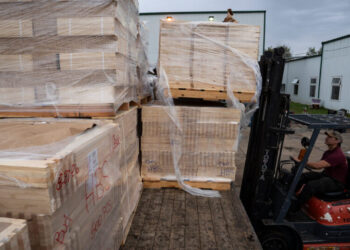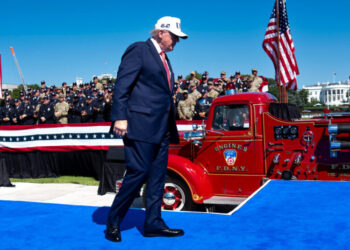
President Trump moved on Tuesday to ban a small set of imports from Canada, including some alcoholic beverages, dairy byproducts and molasses, in a drastic escalation of a bilateral trade war that risked economic blowback on both sides of the border.
The limited ban, which is set to take effect in late September, was part of a series of retaliatory measures that the White House announced in the hours after Canada imposed new tariffs up to 50 percent on a variety of U.S. goods.
While Mr. Trump’s move appeared to encompass only a small portion of trade between the countries, it amounted to a remarkable attempt to punish a close U.S. ally, mere weeks after trade talks between the two neighbors collapsed in acrimony.
It was not clear late Tuesday if, or how, Canada might respond to Mr. Trump’s latest retaliatory actions. Earlier in the day, the president also took steps to try to limit the federal government’s ability to buy Canadian goods. He wrote on social media that the policy would remain in place “unless Canada restores full and fair reciprocity for American Farmers and Companies.”
The list of Canadian imports that Mr. Trump has moved to ban is heavily weighted toward liquor and wine and also includes alcohol-free beer. A number of milk byproducts would also be shut out — particularly various forms of whey, which is used for protein supplements — as well as molasses. Under a series of orders signed by the president, the prohibitions would take effect Sept. 29.
In a briefing with reporters on Tuesday, a senior administration official sought to downplay the potential economic fallout from the import ban. The official said it was calibrated narrowly so it would not cause prices to rise for Americans at a time of elevated inflation.
But the policy, if carried out, could still unleash real damage — for the businesses in the United States and Canada that trade in the affected goods, and for the consumers that ultimately purchase the finished products.
The spat with Canada offered the latest evidence that Mr. Trump remains as committed as ever to his disruptive strategy of trade brinkmanship. Despite nearly two years of blistering court defeats, vicious international disputes and mounting domestic blowback, tariffs remain the president’s preferred tool to try to boost domestic manufacturing and broker better trade deals.
“This tit-for-tat retaliation is bad for Canadian businesses and consumers, and bad for American businesses and consumers,” said Brad Wood, the senior director for trade and innovation at the National Foreign Trade Council, a policy advocacy group whose board of directors includes Caterpillar, Exxon Mobil, Ford Motor and Walmart.
“Every escalation is one more layer of barriers that ultimately Canada and the United States need to resolve,” Mr. Wood added.
While he spars with Canada, Mr. Trump and his aides are also putting the final touches on a roster of new tariffs targeting dozens of additional countries that the administration has accused of engaging in unfair trade practices. The latest round is expected to be based on findings that other nations overproduced certain products — what the administration has called “excess capacity” — leading to large and persistent U.S. trade deficits with those nations.
Those taxes, which could arrive as soon as this week, are meant to replace some of the duties that the Supreme Court struck down in February.
Further inflaming tensions, Mr. Trump has even threatened to block all trade involving countries that export more to the United States than they import from it. Currently, the United States has a yawning trade deficit in goods and services involving dozens of trading partners, including many in Europe and Asia. A halt to imports could prove economically cataclysmic.
Each of those actions could create new financial pressures on American families and businesses. Tariffs are taxes on imports, meaning products from abroad can become more expensive. To that end, the president’s global trade war has only exacerbated policymakers’ yearslong fight with inflation, with the next report on consumer prices set to arrive this week.
The trade dispute between the United States and Canada exploded into public view in July, after Mr. Trump accused Canada of discriminating against U.S. industries. In response, he invoked a dormant, decades-old law to impose tariffs of 50 percent on select Canadian goods, unless the two sides could reach some sort of deal in 30 days.
Talks had proceeded for months, and at various points in August, Mr. Trump seemed confident that a resolution was within reach. But negotiations collapsed before his deadline, prompting both sides to blame each other for scuttling the negotiations with unreasonable, last-minute demands.
As a result, Washington imposed duties in August on hundreds of Canadian imports, including wine, cheese, clothing and hockey sticks. In response, Prime Minister Mark Carney and other Canadians immediately promised to retaliate with their own tariffs on similar products, which took effect as planned after Labor Day.
The move reflected Mr. Carney’s attempts to position himself as a bulwark against Mr. Trump’s trade aggression. The prime minister has described the relationship between the countries as being “at war,” and Canadian officials generally have pledged to respond “dollar for dollar” to any U.S. duties.
In Washington, meanwhile, Mr. Trump and his aides have repeatedly mocked their Canadian counterparts and the size of their ally’s economy and military. The president has matched the tough talk with a threat to impose duties on Canada’s auto industry while promising to block Bombardier, a plane manufacturer, from selling in the United States.
In announcing his retaliatory measures on Tuesday, Mr. Trump invoked a little-known, legally untested provision of the Tariff Act of 1930. Under Section 338, the president may impose tariffs in response to unfair trade practices, and in the event of retaliation, he may also exclude some goods from importation.
Mr. Trump became the first president to invoke the statute when he imposed the duties on Canadian goods last month. That raised familiar legal risks for the White House, which has faced repeated court challenges — and defeats — over its novel interpretation of trade authority.
As part of his series of orders on Tuesday, the president altered some of those tariff rates. Many aluminum products from Canada, for example, now face a 50 percent tariff, on top of the 25 percent tariff Mr. Trump imposed last year. At the same time, he removed the duties he had imposed on bedsheets, fishing rods and tissue used for toilet paper.
Separately, Mr. Trump posted on Tuesday that he had directed his administration to take steps to “REMOVE Canadian-origin products” from a key government procurement system that guides federal purchasing. The president said he was acting reciprocally, claiming that Canada had “banned American Small Businesses and Companies from selling into their Government Procurement Markets.”
Certain Canadian provinces, most notably Ontario, have barred provincial agencies from procuring goods or services from U.S. firms. Ontario, for example, withdrew last year from a contract with Starlink, the satellite company tied to Elon Musk.
The federal government of Canada has not put such a policy in place. But it has issued a request to all government-linked agencies to prefer Canadian goods and services for their contracts. That policy, known as “Buy Canadian,” was a sore point during trade talks last month: Officials from both countries said the United States had asked Canada to cancel the program preferring Canadian goods sooner than planned.
Matina Stevis-Gridneff contributed reporting from Toronto, and Ian Austen from Ottawa.
The post Trump Announces Ban on Some Canadian Imports appeared first on New York Times.