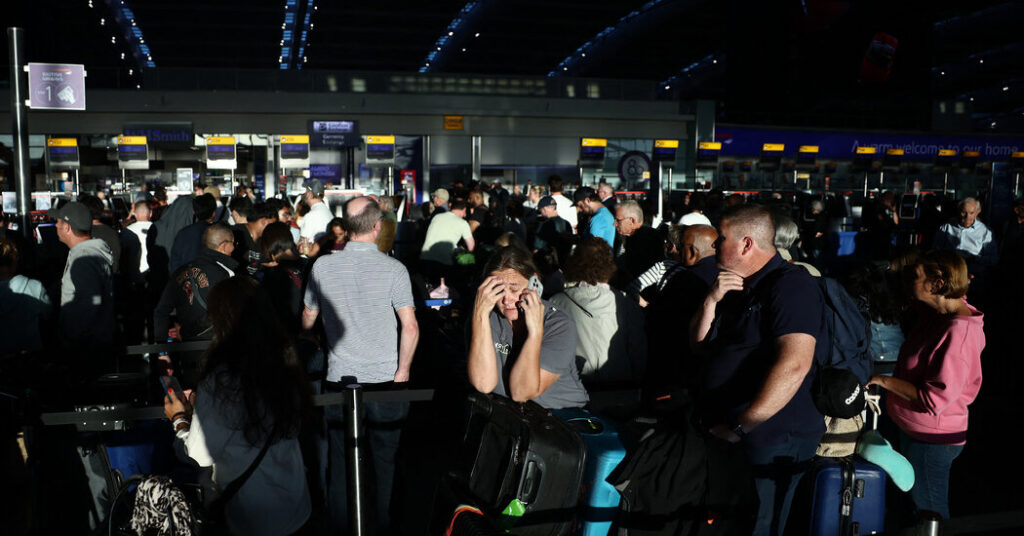
Hundreds more flights were canceled in Britain on Wednesday, a day after an air traffic control glitch disrupted more than 1,000 flights and ruined the plans of tens of thousands of travelers at major airports, including Heathrow Airport.
Britain’s National Air Traffic Services, a company that provides most of the country’s air traffic control services, said on Tuesday that there was an issue with one of its flight management computer systems. Its engineers eventually resolved the glitch, but passengers were warned that the widespread cancellations and delays would have knock-on effects.
“This has been a very complex recovery and has created difficulties for the whole aviation network, from which it will take time to recover,” said NATS, which has faced criticism from airlines over several high-profile disruptions in recent years.
Flightradar24, an aviation tracking firm, said 1,300 flights were canceled across Britain on Tuesday, including flights at Heathrow Airport and Gatwick Airport, both serving London. Flights at airports in Edinburgh and Manchester were also disrupted. Tens of thousands of travelers were affected, including many who were forced to wait inside aircraft during the air traffic control disruption.
Serious disruptions at a major airport such as Heathrow — one of the world’s busiest — are rarely limited as they can force changes in flight plans across continents. A United Airlines flight from Heathrow to Newark Liberty International Airport in New Jersey on Wednesday morning was canceled. Malaysia Airlines said its Wednesday flight from Heathrow to Kuala Lumpur was canceled because Tuesday’s inbound flight to London was diverted to Manchester.
“Large events like Tuesday’s can have effects days beyond the initial disruption as aircraft, crews, and passengers are out of place and schedules need to be reconfigured,” said Ian Petchenik, a Flightradar24 spokesman. “We expect Wednesday to have a significant number of cancellations and the rest of the week to see smaller effects as airlines normalize their schedules.”
About 256 flights were canceled across Britain on Wednesday, according to Flightradar24. Heathrow Airport said on Wednesday morning that while flights had resumed, some disruption would continue as airlines repositioned their aircraft and crews. Its website on Wednesday morning showed that flights to a number of destinations in Europe were canceled.
Gatwick Airport also said it would take time to return to normal operations.
Dublin Airport said that it planned to operate a full schedule of flights on Wednesday after airlines worked through the night to reposition their planes. The airport said on social media that it had remained open overnight to accommodate stranded passengers.
British Airways said that tens of thousands of its customers had been affected and that passengers should expect a “significant knock-on impact” even after the problem was resolved. Ryanair, Europe’s biggest airline, said in a statement on Tuesday that more than 65,000 of its passengers were affected and accused NATS and its leadership of failing travelers and airlines.
“Enough is enough, it’s time for the U.K. government to intervene,” Neal McMahon, Ryanair’s chief operations officer, said on social media.
“I am seeking assurances that lessons will be learned and systems that support aviation are up to the job,” Heidi Alexander, Britain’s transport secretary, wrote on social media late Tuesday.
Martin Rolfe, the chief executive of NATS, apologized for the disruption in an interview with the British broadcaster Sky News on Tuesday, adding that the company would investigate exactly what had gone wrong.
NATS has experienced multiple high-profile technical issues in recent years. In August 2023, an air traffic control failure affected more than 700,000 passengers over several days, according to an estimate by Britain’s Civil Aviation Authority. In July 2025, some flights were briefly grounded because of an issue with a radar system.
The post Travelers Face More Delays After Major Disruption at British Airports appeared first on New York Times.