A camera strap dangles off George Rodriguez’s shoulder as he glances around the gallery in search of his favorite image. His gaze shifts past snapshots he once documented of historical taut moments in Los Angeles like the 1966 Sunset Strip riots of West Hollywood or the 1970 Chicano Moratorium in Boyle Heights.
But instead of pointing to political flashpoints like the 1968 East L.A. Walkouts or the 1969 Delano grape strike, the 89-year-old photojournalist aims at a black-and-white image of a serene man, fully concentrated on reading the newspaper.
“That’s a picture of my dad over there,” said Rodriguez, sitting on a bench inside the Getty Museum. The 1959 image features his father, a shoe repairman, in a wooden chair reading the Spanish-language newspaper La Opinión, while his side profile casts a shadow on a vintage console to his side.
“ My dad thought I was a big deal when I was in high school taking photography,” said Rodriguez. “But to be here in the Getty with my photographs, I don’t think he could grasp that.”
Rodriguez is one of the five photographers featured in a new exhibit titled “Every Minute Is History: Five Views of Los Angeles” at the Getty Museum, which also highlights the work of artists Laura Aguilar, Reynaldo Rivera, Patssi Valdez and Ricardo Valverde.
Now on display until Jan. 3 — before the Getty Center temporarily closes for renovations — the gallery showcases these artists who helped push the medium in new, often provocative directions, expanding traditional representations of Chicano communities in L.A. and beyond.
Rodriguez, who grew up in DTLA and later moved to South L.A., photographed Chicano demonstrations across California that marked the 1960s and 1970s. He famously documented the United Farm Workers movement, as well as the antiwar protests of East L.A. He also shot portraits of Hollywood darlings like Marilyn Monroe and Lucille Ball, plus action shots of musical legends Jim Morrison, Jimi Hendrix and Michael Jackson, to name a few.
But the bright-eyed cameraman often turned the lens to his own community, chronicling small but meaningful moments shaping everyday life in L.A. On display at the Getty are images of neighborhood children living in a City Terrace apartment, a shoeshine boy walking out of a Mexican panaderia, and elderly women outside of Our Lady Queen of Angels Church.
“One of the best things that ever happened to me is that I was born and raised in this city,” Rodriguez said. “ I’ve been around long enough to see the changes.”
Valverde — a former Air Force veteran raised in South L.A., who died in 1998 from a brain tumor — also helped capture the vibrant life of Latinos in East L.A. between the late 1970s and the mid-1990s. While employed at the L.A. Department of Water and Power, the Phoenix-born artist would often carry his camera and familiarize himself with the city while working as a meter reader.
Some of his pieces on display include 1977 portrait shots of smiling residents in Aliso Village, a large public housing project in the Boyle Heights that was demolished in 1999 because of gang violence and decaying conditions. Valverde would experiment with his images, often by scratching a thin layer of the photographs and adding muted coloring with subtle splashes of vibrant neon paint, though his pieces did not receive critical acclaim until after his death.
Such posthumous recognition was also in store for the late portraitist Aguilar, who, between the 1980s and 1990s, pushed the boundaries for Chicana lesbians and other queer communities of color. Her most notable portrait series, “Latina Lesbians,” helped document L.A. women and their reflections on their own sexuality.
By 1996, Aguilar — who was born and raised in the San Gabriel Valley and died in 2018 from renal failure — turned the lens toward herself. She framed her nude body against a rural backdrop in New Mexico following a depressive episode, in an attempt to synchronize physical body with the natural world.
In a 1998 artistic statement, she explained her artistic goal was to “create photographic images that compassionately render the human experience.”
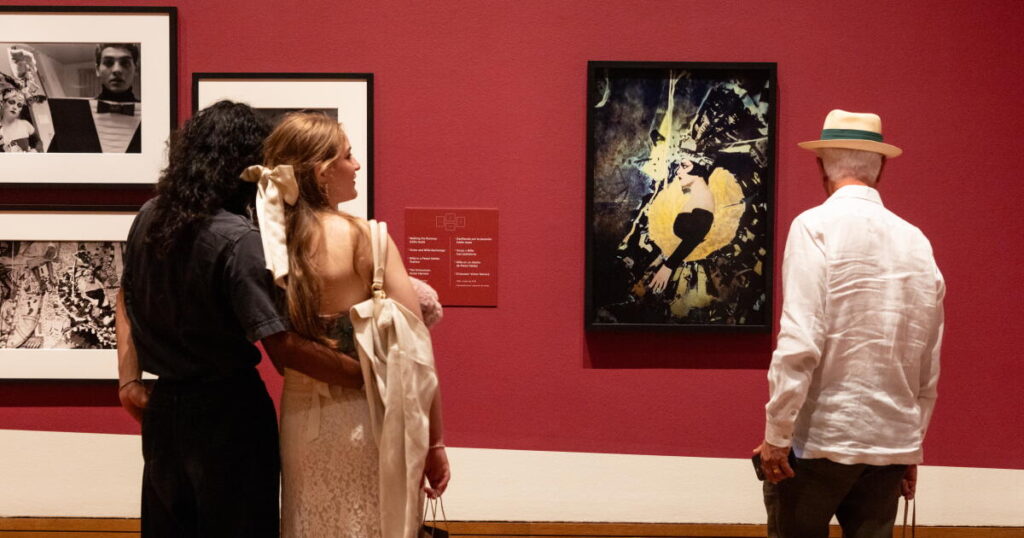
For the artist Valdez — whose photographic work is displayed on the gallery’s red wall — being a Chicana photographer in the 1970s and 1980s presented challenges within the city’s fast-growing immigrant community.
“I would take my camera, drive around downtown and just walk up and down Broadway for some photos,” Valdez said. “I would rarely look through the lens when I was photographing people, because I did that once and it caused some conflict.”
Valdez was the only Chicana artist in the Asco collective, an avant garde performance group that formed in East L.A. in 1972. In one of their legendary acts, they tagged a facade of the L.A. County Museum of Art with their names and claimed the space as Chicano art.
Though her work at the Getty focuses primarily on her solo career, the display includes photographs from her 1982 paper fashion show, in which she styled friends in maximalist outfits framed with sharp geometric edges — couture pieces all made out of paper materials.
“I had a group of friends that were very fashionable on their own,” said Valdez. “When I would look at images of brown people or my culture, I was like, ‘Well, where are all my friends in this?’ ”
Some of the photographs on display — which also include intimate noir photographs of a single, seminude subject — were stuck in storage for years, said Valdez. She added that other curators weren’t interested in showcasing her work in the past.
“We’ve been invisible for so long in the media, that was the goal [of my art],” she said. “And I think it’s very empowering, and I’m so happy to see my work on the wall at the Getty.”
Across the gallery corridor was a mustard-yellow wall featuring works by Rivera, a Mexicali-born, self-taught photographer with a passion for silent film. There is a noir-like single shot of him on display, which he captured in the mirror with his sister in the blurred forefront. Snapped in 1988, the photo shows a time he refers to as his “cholo” era, denoted by his subtle pencil mustache and slicked-back hair.
“Imagine that. I loved silent movies, that was my drive. I wanted to create that kind of scenery, but I was a cholo,” said Rivera during the gallery’s opening night on Aug. 31.
Rivera settled in L.A. in the early 1980s and captured intimate queer scenes at Latine dancehalls, such as La Plaza and Silverlake Lounge. These were historic venues for drag shows and cabaret acts, led by transgender Latina women who dominated the stage with impressions — ranging from Diana Ross to Consuelo “Chelo” Silva. “They were better than the real thing,” said Rivera.
“Most of those girls didn’t survive the last century,” he added, recalling the feather-plumed performers he photographed backstage in showgirl attire. “They really didn’t have a voice, [but] they played such an important artistic role within the gay community as a whole — not just Latino.”
He feels conflicted about using the word “queer” to categorize his work, but only largely because he does not want his pieces to be reduced to tacky, “kitsch-ified” representations of Latinidad.
“My work is predominantly Latinos — that we’re queer is part of that,” said the 62-year-old, who also snapped moody shots of patrons, often lovers, inside the bathroom stalls.
If there’s anything Rivera wants his viewers to take away from the exhibit, it is that L.A. history is Latino history.
“We play such an … important role in everything that’s happened here,” said Rivera. “You can’t talk about a history of this … city without us.”
The post They’ve documented L.A. Latines for decades. Now the Getty is honoring their work appeared first on Los Angeles Times.