In the traditional origin narrative of culture in the United States, a proud young country’s distinctive asset — its untamed natural beauty — propelled its artists into the Great Outdoors.
Thomas Cole’s 19th-century romantic landscapes clear-cut a path for the Hudson River School and the grandiose canvases of Frederic Church and Albert Bierstadt. They would be followed by the quieter mood of Impressionism, and Abstract Expressionism’s exchange of natural scenery for human nature’s turbulent inner life. Overwhelmingly, the artists were white and male.
But what if the story didn’t begin with them, and instead with earlier female artists who identified — and identified with — the matter of American place from within a different, domestic sphere?
That question animates “Locating Girlhood: Place and Identity in Early American ‘Schoolgirl’ Art,” an exhibition opening Oct. 9 at the American Folk Art Museum in Manhattan. It recalibrates the history of art in the United States by opening up its timeline to acknowledge young female creators, including young women of color who — whether enslaved, bound to service, or schooled in sewing in free Black communities — “raise the question of whose stories got told and whose didn’t,” said Emelie Gevalt, the museum’s deputy director and the show’s co-curator.
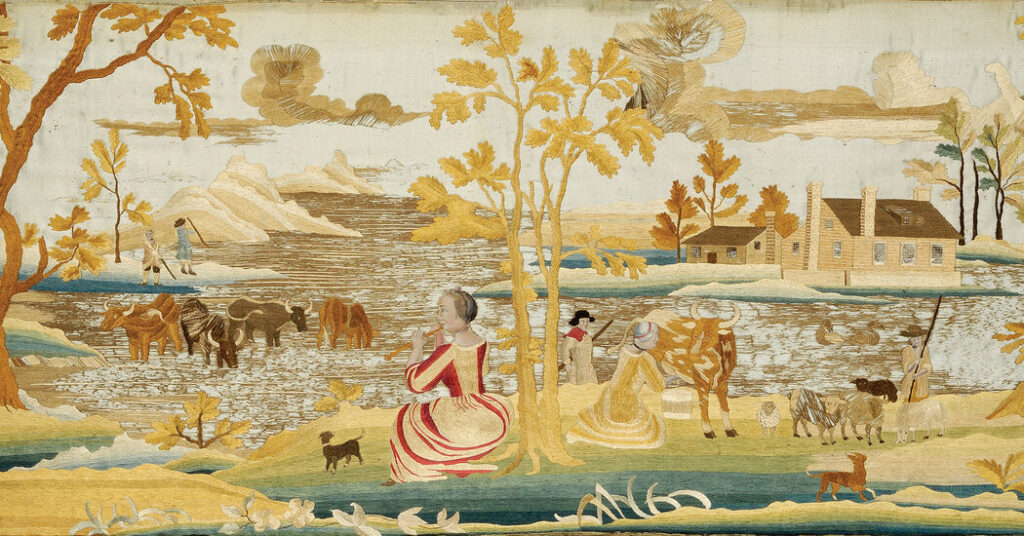
Its premise is that needlework pictures, embroidered samplers, watercolor studies, finely drawn and stitched maps, painted furniture and other forms of ornamental art produced by girls and young women from colonial times well into the early years of the new nation anticipated the emergence of landscape painting. The show presents nearly 100 objects as evidence.
“We hope it illuminates the contributions of young women to some of the founding narratives, and founding myths, of this country,” said Caroline Culp, a curator of American Art at the Chrysler Museum of Art in Norfolk, Va., and the Folk Art show’s co-organizer.
Formulated in dialogue with the sesquicentennial, the exhibition also constitutes an effort to offer a broader sense of artistic expression around American art by eliminating hierarchical distinctions between art and the decorative arts, and challenging the image of so-called “‘schoolgirl art’” as somehow inferior.
Far from girlish, the imposing and lush over-the-mantel piece “View of Boston Common,” on loan from the Museum of Fine Arts in Boston, was completed around 1750 by 18-year-old Hannah Otis, a member of the prominent anti-royalist family.
Executed in wool, silk, and metallic thread and beads on linen, it disperses its human figures, including a likely enslaved Black groom, throughout minutely observed greenery and animal life. Larger still is the anonymous “‘Fishing Lady’ Scene,” made between 1747 and 1750, a rendering of courtship in an idealized country setting. Its whimsical, coquettish mood vigorously defies the social instability and political unease permeating the colonial culture still chafing under British imperial rule and at violent odds with the Indigenous people it was attempting to displace.
“It had really struck me as odd that such monumental pieces and their treatment of space were dismissed as exercises in dainty femininity,” said Andrea Pappas, an art historian and the author of “Embroidering the Landscape: Women, Art and the Environment in British North America, 1740—1770.” She added, “Landscape has always occupied a special place in American art, and these show it going back a lot farther.”
Countless samplers stitched by young women as part of their proper upbringing were filled with meticulously observed and spatially reasoned architectural and landscape elements derived from their immediate surroundings. The Georgian building style depicted in many captured the urbanizing impulse of a stripling country hammering itself into existence. And detailed portraits of farm estates signaled agricultural cultivation’s westward thrust. As the art instruction considered integral to female education took hold, even the age-old motif of the family tree often branched out into images of full-blown landscapes.
Present at the birth of a new republic, Rebecca Carter of Providence, R.I., age 10, in 1788 fastidiously recorded the brickwork facade of the landmark Rhode Island State House, combining it with exuberant natural motifs, tidy alphabetical lettering and celebratory rhyming — “Honor and renown, shall the ingenious State House crown” — into a statement on civic virtue, and burgeoning community. The words “Rebecca Carter’s work made in 1788” proudly decorate an ample vase, a declaration of selfhood.
As the decades passed, pictorial embroidery would increasingly lean on American landscapes as settings for an emblematic female figure of virtue — that of Lady Liberty — outstripped only by needlework tributes to the posthumous cult of George Washington that ranged from military commemorations to worshipful depictions of Mt. Vernon that pushed to the margins its slaveholding economy.
Remarkable for the time, almost without exception, the works bear the names of their makers, salvaging them from the anonymity of unwritten history. “So often,” Culp said, “these are the only case where we encounter those names and identities: in censuses of the period, women were counted as unnamed members of a male’s household.”
All the more noteworthy, the show emphasizes, are works signed by or attributed to young women of color who, in applying their creative gifts to such needlework, they confronted negative stereotypes and the inherent racial bias of pictorial stitchery in which Black figures were miniaturized or relegated to a picture’s edge.
“These were assertions of humanity, and talent” said Gwendolyn DuBois Shaw, professor of art history at the University of Pennsylvania and a contributor to the catalog for “Unnamed Figures: Black Presence and Absence in Early North American Art,” organized by Gevalt at AFAM in 2023. “And for free Black women they were a claim to acceptance within a middle class.”
“It’s an intriguing premise,” Victoria Johnson, author of the new biography “Glorious Country: How the Artist Frederic Church Brought the World to America and America to the World,” said of the rearrangement of art history in “Locating Girlhood.”
She noted that Thomas Cole’s sister Sarah was afforded a degree of recognition as an artist, as was his daughter Emily, for her watercolors and porcelain painting, and such artists as Susie Barstow, Elizabeth Greatorex and Fidelia Bridges, were active during first and second generations of the Hudson River School. “Definitions of American nationhood have always existed in relation to the natural beauty of the North American continent,” Johnson added. “We can see ‘schoolgirl’ art in that tradition.”
For the artist John Trumbull, perhaps best known for his sweeping painting, “Declaration of Independence” (around 1817) depicting the presentation of the draft of the Declaration of Independence to Congress, growing up in the same household as his older sister Faith Trumbull was transformational. Faith, proficient in such charming needlework pieces as the Old Testament scene “The Hanging of Absalom” from around 1754, inspired her brother, he wrote, to become an artist himself. “But only one of them was sent to England to study,” Gevalt said, “and that was John.”
Both she and Culp remain committed to restoring these artistic women to the historical record and reject the contention that they were merely copying from widely circulated prints, reproductions extolling classical antiquity, or popular botanical illustrations.
As the 19th century dawned, the needle arts — encouraged to cultivate social refinement, prepare young women for marriage, and groom them as prospective mothers of the republic’s future leaders — were being integrated into the curricula of the country’s proliferating “dame academies” and female seminaries, where the infusion of such disciplines as classical languages, natural philosophy, astronomy, chemistry, mathematics, and the “science” of geography eventually sidelined the teaching of embroidery work.
But not the interest in locating selfhood. Mapmaking held the allure of charting new territories, or outlining the particularities of place, geopolitical and otherwise, against the vastness of the universe. Taught to young women as both art and intellectual pursuit, Gevalt said, “it emerged at a time of interest in the geography of the new nation and one’s place in it.” Embroidered and hand-colored maps, some of the earliest presented on samplers or worked into globes, helped lead the way.
In 1825, 15-year-old Juliana Carpenter, of Homer, N.Y., having ambitiously put pen and watercolor to over two feet of paper for a “Map of Two Hemispheres,” not only proudly pasted a merit slip she had received for her accomplishment in the upper left hand corner — but she decisively inserted a watercolor miniature of herself at the composition’s center.
The post The Young Women at the Heart of American Landscape Art appeared first on New York Times.