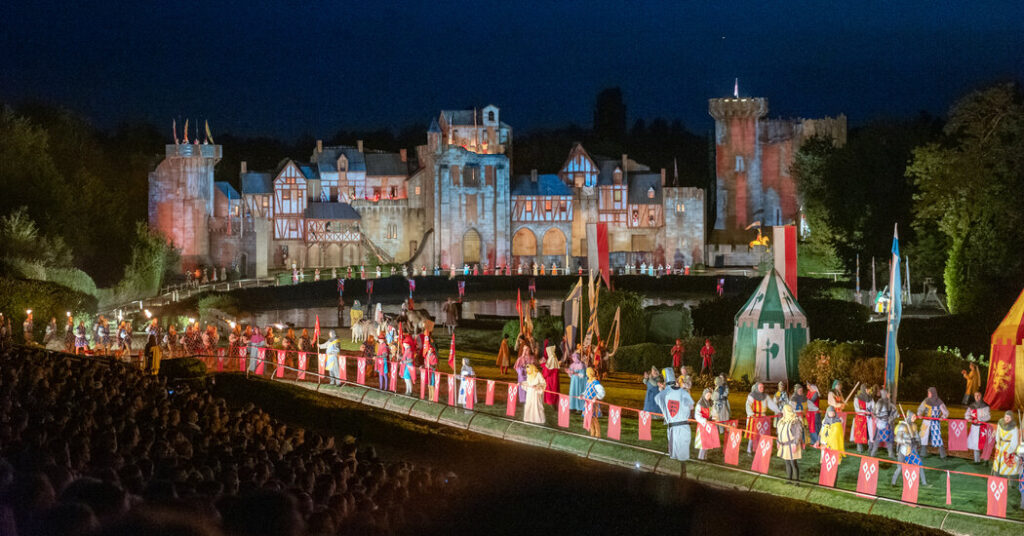
In a historical theme park set among the wheat fields of rural western France, Viking boats and pianos emerge from ponds, and knights ride on horseback. Now France’s most popular theme park after Disneyland’s sites near Paris, it has opened an outpost in Spain and aims to build one in England soon.
But many in France hate the park, called the Puy du Fou.
Critics have called it a peddler of “far-right propaganda,” an accusation that has gained in resonance as ultraconservatives edge closer to power for the first time since World War II. The critics accuse it of weaponizing history to popularize the values of its founder, Philippe de Villiers, a former lawmaker who supports far-right politicians and has long campaigned against the European Union, Islam, gay marriage and immigration.
He recently wrote that the park is part of a larger “cultural battle” for the country’s soul, and that “cultural victories precede political victories.” But his son Nicolas, who has run the park since 2012, said his only ambition is “to create shows that make people love France,” adding, “For me, that is my only cultural battle.”
The park is four hours southwest of Paris by car. With thousands of trees, growing amid man-made rivers and ponds, the Puy du Fou feels more like a national park than an amusement park. There are no carnival rides and few vendors. Instead, dirt paths lead visitors to immersive sets as well as performances, mostly about French history, that unfold in large outdoor arenas and indoor theaters, and usually last around half an hour.
The draw, for most, is not just the mythic French stories, but the spectacular special effects and the animals.
In a show about the Romans, charioteers race teams of festooned horses around an Egyptian obelisk that later splits into a giant galley boat. In another show, more than 300 live birds, including vultures and bald eagles, wheel over spectators’ heads.
“The mechanical engineering is incredible,” said Arido Agrifoglio, 69, a retired doctor from Switzerland, lining up with his wife, Sylvie, for their ninth show of the day. The night before they’d watched a performance in which dancers, a pianist and a piano rose out of a pond.
“I often wonder, ‘How did they do that?’” Mr. Agrifoglio said.
Before the 250-acre park existed, Philippe de Villiers launched a single show in 1978 beside a ruined castle called Puy du Fou, which he has said is Old French and Latin for “hill of beech trees.”
Then a student at the country’s elite university for civil servants, Philippe de Villiers wrote the script for a performance about the region’s bloody experience during the French Revolution, when locals took up arms against the new government and were massacred. Since Philippe de Villiers couldn’t afford to pay actors or stagehands, community members volunteered. The show, called the Cinéscénie, has since expanded, and is still run by thousands of volunteers in summer.
Philippe de Villiers went on to become the country’s secretary of state for culture, and an elected lawmaker. In 1989, after a trip to the Walt Disney World Resort in Orlando, Fla., he saw the business potential. He created a new park next to the Cinéscénie, staffed by professionals. He set about writing the scripts for new shows that would offer the country what he called its “founding narrative.”
“We must give the French back their past,” he wrote in his 2025 book “Populicide,” which said immigration was causing civilizational collapse in France, where the book was a bestseller.
Today, the park has around 3,000 workers staffing in around 20 shows, five history-themed hotels and 26 restaurants. The company earned roughly $350 million in 2025 with a record-breaking three million visitors, Nicolas de Villiers said. In 2021, he opened a park in Toledo, Spain, that focuses on Spanish history, and in 2025, he applied to open a British version near Oxford. (Projects planned in Russia, Russian-occupied Crimea and the United States never came to fruition.)
With its mounting success, the park has come under intense criticism from left-wing politicians and historians, who have for years pointed out inaccuracies in its shows, and accused it of warping history for political reasons. That criticism was amplified in 2022, when four historians published a scathing book called “Le Puy du Faux,” or The Puy of Falsehood, that calls the park “ideological,” where visitors will “learn nothing.”
“It’s the erasure of the French Revolution and the praise of Christianity. That right there is the Puy du Fou recipe,” said Florian Besson, one of the authors and a medieval historian.
Many of the shows center on Catholicism. The marauding Vikings set on attacking a Christian village are stopped by a ghostly saint and swiftly converted. The Romans are portrayed as cruel pagan overlords who — until they, too, converted — persecuted the Christian Gauls.
“It’s a complete reversal of history: Christianity came to Gaul from Rome, yet there it is presented exactly the opposite way,” said Pauline Ducret, another historian and co-author of the book.
The park presents an “eternal France” that is under attack, Ms. Ducret said, if not by Vikings, then by a revolutionary army or Germans — an echo of Mr. de Villiers’ anti-immigration views.
Then there are the choices of which parts of French history to present. There is nothing, critics point out, that touches on France’s darkest moments: slavery, colonialism, or Vichy — the government during World War II that collaborated with the Nazis.
Philippe de Villiers did not respond to interview requests. But his son Nicolas, 46, spoke to us twice, once in a room above a restaurant in the park where waiters sing French folk songs. He said that prescribing political aims to the park was “ridiculous.”
“Are Vikings right wing or left wing? Were Romans right wing or left wing?” he said. “That question is completely out of step with the shows we present.”
But he does see the park as helping to build the country’s collective memory. “If we want as a people in France to have a common destiny,” he said, “we need common memories.” And he made no apologies for omitting certain historical chapters.
“We always prefer glory against shame,” he said.
Nicolas de Villiers said he believed the recent deluge of criticism about the park was motivated by jealousy, particularly from the left-wing elite that he said controls the theater scene in Paris.
François Ruffin, a left-wing presidential candidate, offered another theory. The scrutiny, Mr. Ruffin said, rose with the fortunes of the far-right National Rally party, whose leader, Marine Le Pen, has a strong chance of winning the presidency next year.
When Philippe de Villiers built Puy du Fou, it was “a pocket of resistance, keeping the flame of neoconservatism alive,” Mr. Ruffin said in an interview. “Today they have become dominant, the majority, and potentially poised to take power next year,” Mr. Ruffin added.
The Puy du Fou is just one part of a mounting right-wing cultural constellation, he said, driven by the French billionaire Vincent Bolloré, whose holdings include publishers, film companies and a right-wing television channel, CNews, on which Philippe de Villiers has a Friday night show.
That constellation is now winning France’s “culture war,” said Mr. Ruffin.
He has called for the creation of a left-wing Puy du Fou that would mount shows on the French Revolution, and the French resistance during World War II.
On a recent sweltering day, families raced from one show to the next.
Some said they liked the park’s historical message. Critics only “hate it because it’s French,” said Laurent Smirnow, 53, a security guard.
But many said they had come for the entertainment, not the history lessons or the politics.
Valérie Billet, 57, took a break under a tree with her in-laws and adult children.
Her sister refused to come to the park because of Mr. de Villiers’ politics, she said.
“When I come here, I detach the park from the man who created it,” said Ms. Billet, an English teacher. Sitting nearby, her daughter Nolwenn, 28, muttered under her breath that the park’s biases were hard to ignore. “It’s something you can definitely feel,” the daughter said.
Still, she’d been back with her family four times.
The post The Theme Park at the Heart of France’s Culture War appeared first on New York Times.