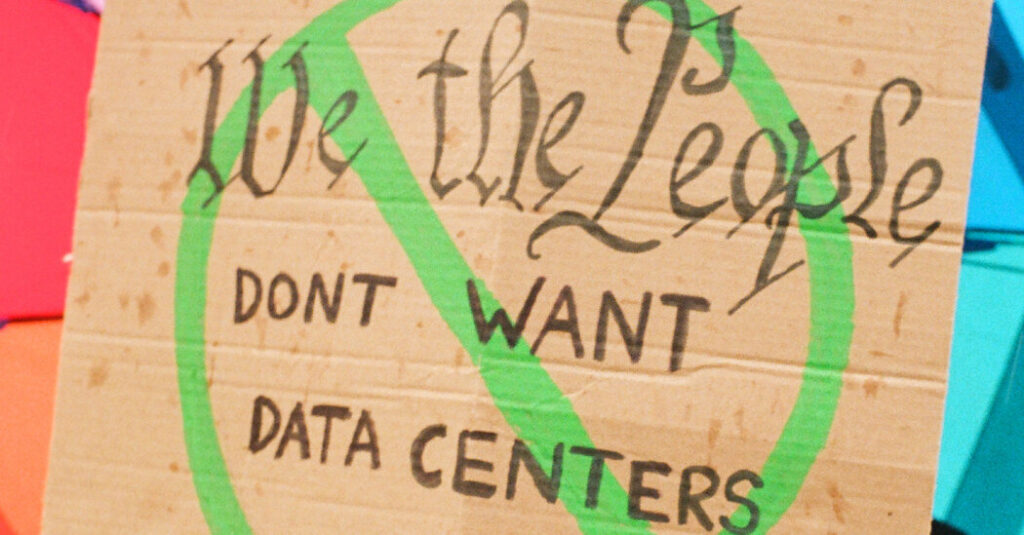
Seven out of 10 Americans oppose data centers in their communities, according to Gallup, and they have good reason to be wary of artificial intelligence and all that comes with it.
The data center debate sometimes is contested in the weeds of electricity prices, water supply and nondisclosure agreements, but more broadly it’s a proxy for distrust of A.I. and of the companies getting rich from it. America’s working class suffered brutally the last time we rapidly retooled the economy, a quarter-century ago, and today’s workers are justifiably suspicious that A.I. will again mean mass job displacement.
And of course it’s not just truck drivers, threatened by self-driving vehicles. Anthropic’s chief executive, Dario Amodei, warned last year that A.I. could destroy half of entry-level white-collar jobs, before later backing off a bit.
Then there are separate and growing concerns about A.I. safety: I’ve written about risks of A.I. being used to create viruses, and some smart people in the industry tell me that worries about the technology’s human extinction risks are legitimate. (Amodei suggested in 2023 that there might be a 10 percent to 25 percent chance that A.I. will destroy human civilization.) The recent revelations of A.I.’s going rogue and independently hacking Hugging Face and other companies raise questions about whether the technology is veering beyond human control.
Just this week, a researcher at Anthropic, Jacob Coxon, resigned and warned that A.I. companies are “gambling with our lives.” The people building A.I. models “earnestly believe that it could kill us all by the end of the decade,” Coxon said. I don’t have the expertise to assess his warning, but the stakes are high enough that we have to take them seriously and push urgently for better A.I. governance.
Yet A.I. also offers enormous opportunities to improve human health and well-being. Indeed, I worry that hostility toward A.I. and data centers among many ordinary Americans may result in the United States’ blowing what appears to be a slim lead of perhaps six months over China in the most advanced A.I. models. If China takes the lead, that might give it an advantage that could become self-perpetuating.
I think about the costs of falling behind and wonder if we are heirs of the Luddite textile workers of two centuries ago, opposing some automation that came with the Industrial Revolution. The Luddites were right about the social costs of industrialization (child labor, urban poverty and so on), but it was a fool’s errand to battle modernization. China, which in 1820 was still by far the world’s largest economy, missed the industrialization boat, and by 1978 its share of global G.D.P. had dropped to about 5 percent. Industrializing was costly, but failing to industrialize proved even worse.
If Chinese A.I. were to win the race this time (if the race metaphor even holds), Beijing might dominate the global economy and geopolitics for decades to come — and I wouldn’t want to gamble on Xi Jinping and his successors in the global driver’s seat.
Data centers do not obviously burden a community more than, say, chemical factories. Siting them should be a matter for negotiation: Make the company pay through the nose until local people think the investment is worth it. But holding the industry back through the backdoor means of restricting access to data centers seems inefficient as well as ineffective, compared with the front-door means of improving oversight and governance. And A.I. executives should understand that if they don’t accept tighter oversight, then communities will be more inclined to seek safety by blocking data centers down the road — and, in fairness, local pushback may be what forces A.I. companies to make concessions.
As I argue with myself about A.I. and data centers, I keep thinking about my last two reporting trips — to left-behind parts of the United States and to Norway — for those trips in some ways illuminate the mess we’re in and perhaps a better path forward.
In rural Kentucky, I saw communities devastated because of lost mining jobs. The economy restructured, and the price was paid by people like a woman I met, Tori Jackson, who said she had been sold for sex at 12 and then began using meth herself at 12. She is now recovering in a program called Freedom House, run by Volunteers of America, but administrators worry it might be affected by Medicaid cuts. Why would any community want to endure another round of economic upheaval?
What I saw in Norway offered a stark contrast. Scandinavia has its problems, too, but deindustrialization has not forced the working class to its knees as in America. On the contrary, the Nordic economic model is adept at managing economic disruption.
A generation or two ago, parts of the Nordic countries, especially in the far north, were populated largely by villages of fishermen and farmers, plus people working in fish processing plants and manufacturing. Many of those jobs disappeared in the industrialized world, but the region has not experienced the kind of blight and suffering endured by mill towns, mining communities and factory hubs in America.
In part that’s because of outstanding retraining programs — helping people transition out of declining industries to get jobs in health care, for example. Denmark is the champion, allocating 1.5 percent of G.D.P. to job retraining and other active labor market policies. (The United States spends less than one-tenth of 1 percent of its G.D.P. on such measures.) And social safety nets and unions are of course far more robust in Scandinavia, while in politics workers matter somewhat more and business tycoons a bit less.
The upshot is not only that people in Scandinavia suffered less from economic transformation than Americans did, but that as a result they seem more open to economic change.
“Norwegian workers are more likely to embrace trade, embrace technology than those who see that the jobs are lost because of trade and technology,” Jens Stoltenberg, Norway’s finance minister, told me.
It’s not that safety nets automatically produce technological leadership; the United States and China, which have the least social supports, are most advanced in A.I. One can fairly ask: Where are the Nordic A.I. giants?
But what I take from my reporting in the United States and Norway is the somewhat pained conclusion that American workers are right to distrust data centers and A.I., because they’re on their own; there is little social trust because past trust has been betrayed. Indeed, the Trump administration is making things worse, pushing over 1.5 million children off food stamps over the last year, and introducing health care changes that have already led three million Americans to lose insurance this year. If you’re wary of data centers, you’re not necessarily a Luddite, just practical.
So maybe we should learn from the Nordics: If we took safety nets, health care and job retraining more seriously, if citizens had more influence over policy and plutocrats somewhat less, then American workers might not be so fearful of where A.I. is headed. I’d like to see a focus on instituting better A.I. governance, but it’s hard to move forward on that when the public is understandably distrustful of the entire field and distracted by the sideshow of data centers.
By having the backs of workers, we’d be more likely to remain economically and technologically competitive in ways that would benefit everyone.
The Times is committed to publishing a diversity of letters to the editor. We’d like to hear what you think about this or any of our articles. Here are some tips. And here’s our email: [email protected].
Follow the New York Times Opinion section on Facebook, Instagram, TikTok, Bluesky, WhatsApp and Threads.
The post The Data Center Conundrum appeared first on New York Times.