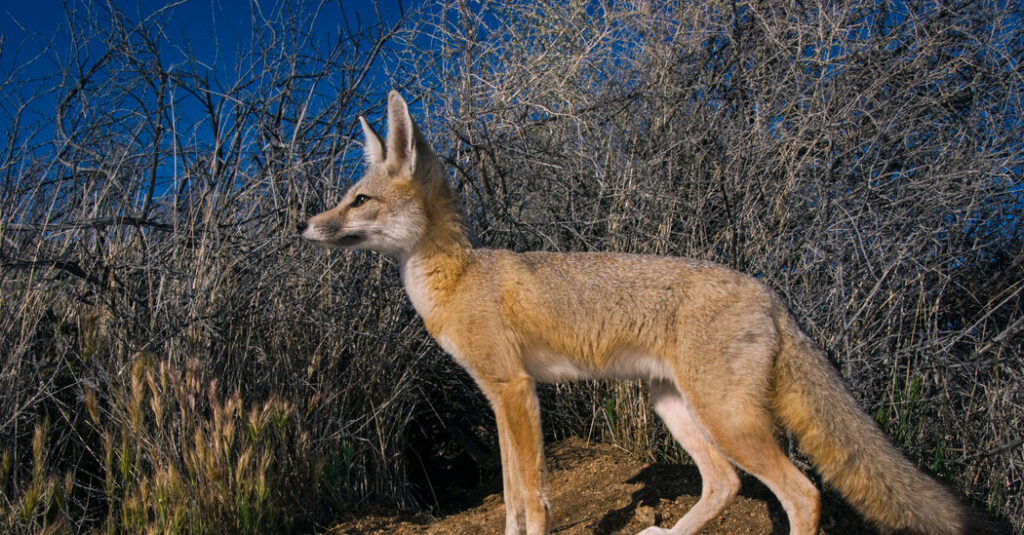
Twenty states and the District of Columbia sued the Trump administration on Wednesday over what they called the most severe cuts to protections for wildlife in the half-century since the passage of the Endangered Species Act.
Two lawsuits filed in federal court in California challenged a series of regulatory changes that opened the habitats of imperiled animals to drilling, farming, logging and other commercial activities.
The first suit asked the court to strike down a rule that redefined what it means to “harm” wildlife under the Endangered Species Act, which Congress passed in 1973 to prevent the extinction of imperiled plants and animals.
For decades, the government has defined harm as any significant “modification or degradation” of habitat that kills or injures animals by impairing their ability to eat, shelter or breed.
But the Trump administration tossed out that longstanding interpretation and instead finalized a rule that said degrading the habitat of an endangered species would no longer be illegal.
The change, which the Interior Department and the Commerce Department finalized in July, could allow oil drillers, farmers, loggers, home builders and others to disturb or even destroy the habitats of vulnerable species.
The second lawsuit challenged two regulations issued by the U.S. Fish and Wildlife Service, part of the Interior Department. One rule eliminated automatic protections for all species that are newly classified as threatened under the Endangered Species Act. The other allowed the government to consider economic factors, such as lost revenue for businesses, before designating areas as critical habitat for endangered species.
Both complaints argued that the changes violated the Administrative Procedure Act, the Endangered Species Act and the National Environmental Policy Act.
Rob Bonta, the attorney general of California, and Nick Brown, the attorney general of Washington state, announced the suits during a virtual news conference. They accused President Trump of politicizing protections for wildlife and noted that the Endangered Species Act was passed with bipartisan support and signed by President Richard M. Nixon, a Republican.
“As philosopher Immanuel Kant once said, we can judge the heart of a man by his treatment of animals,” Mr. Bonta said at the news conference. “Time and time again, Trump has proven that he’s willing to hit the deregulatory switch for his business tycoon buddies, proving that he cares nothing about protecting our nation’s precious and irreplaceable biodiversity.”
Charlotte Taylor, a spokeswoman for the Interior Department, said in an email that the Trump administration was implementing the Endangered Species Act as written.
“This lawsuit seeks to preserve a decades-old regulatory overreach that expanded the Endangered Species Act beyond the authority granted by Congress,” she said. “The department will vigorously defend its authority to implement the law according to its plain text.”
A spokeswoman for the White House declined to comment. Representatives for the Commerce Department did not immediately respond to a request for comment.
The other plaintiffs are the attorneys general of Arizona, Colorado, Connecticut, Delaware, Hawaii, Illinois, Maryland, Massachusetts, Michigan, Minnesota, New Jersey, New Mexico, New York, Oregon, Rhode Island, Vermont, Virginia, Wisconsin and the District of Columbia.
With the exception of Vermont, the states are all led by Democratic governors.
The post States Sue Over Trump’s Cuts to Endangered Species Rules appeared first on New York Times.