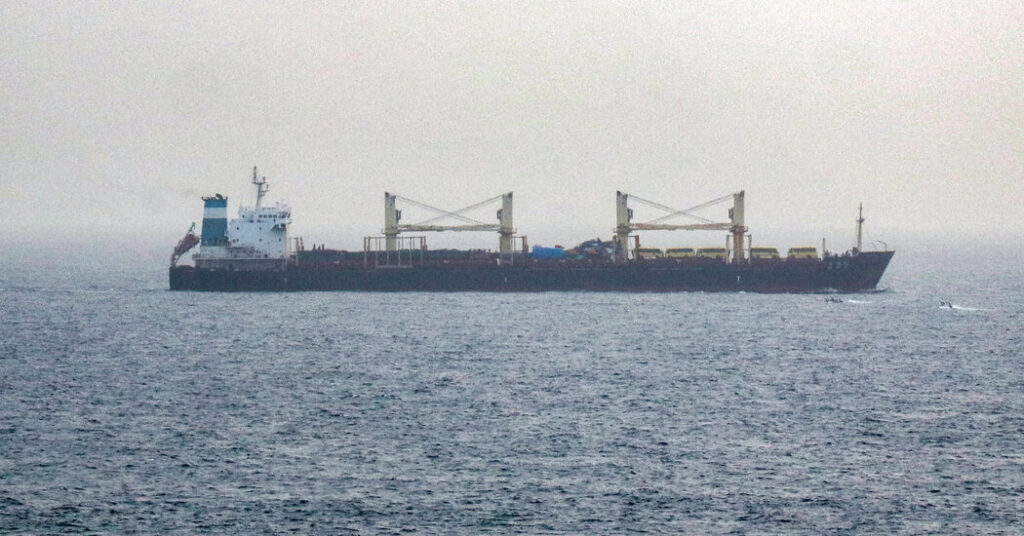
Saudi Arabia has made several quick pivots to keep its oil flowing since the start of the U.S. war with Iran.
Within weeks of Iran’s closure of the Strait of Hormuz — once Saudi Arabia’s primary export route for oil — the kingdom turned to Plan B: bypassing the strait by ramping up exports through pipelines to the Red Sea.
When the Iranian-backed Houthi militia in Yemen announced a blockade in the Red Sea, Saudi Arabia used a new detour, sending ships north to a pipeline near the Suez Canal. This Mediterranean route is costlier and adds weeks to the voyage to Asia, where most of the country’s customers are.
Now Saudi Arabia, long the world’s biggest oil exporter, is facing yet another test of its ability to deliver its oil. Edging toward a full-blown war with the Houthis, Saudi officials said the kingdom would retaliate after the Houthis injured 73 civilians and hit energy facilities in the southern part of the kingdom.
Whatever comfort shipping companies may have found using the Red Sea before the most recent escalation “has clearly soured,” said Peter Sand, a shipping analyst at Xeneta.
A steady supply of Saudi oil is critical to keeping global energy prices stable, and the kingdom’s exports are already squeezed. Its oil exports fell last month to 3.2 million barrels a day, the lowest level in at least 13 years, according to data from Kpler, a maritime information company. In the past week only two Saudi Arabian cargoes passed through the Bab al-Mandab Strait to the Red Sea, the group found.
The challenge comes as oil prices surged past $100 a barrel on Wednesday amid escalating attacks between the United States and Iran. Iran said it had launched missiles at a U.S. base in Jordan and fired on two Navy destroyers in retaliation for American attacks that the U.S. military said had destroyed five Iranian oil tankers. One sailor was killed and one reported missing on Wednesday after a drone hit a ship off the coast of the United Arab Emirates, according to Dimitris Maniatis, the founder of Marisks, a maritime risk agency.
The recent attacks by Houthi militants, on top of escalating tension in the Strait of Hormuz, are forcing further trade shifts, underscoring how the war in Iran has scrambled the normal routes for doing business.
“For commercial shipping, the immediate concern is therefore not simply the number of individual attacks, but the expansion of targeting criteria and geography,” Mr. Maniatis said.
Fighting in Yemen intensified last week as the Houthis tried to capture territory that could give them more control over shipping routes through the Red Sea, according to local security officials. Since July 20, when the group announced a blockade of Saudi shipping through the Red Sea, the Houthis have claimed responsibility for at least seven attacks on ships headed to or from Saudi ports, said Allison Minor, a former U.S. deputy special envoy for Yemen.
One attack on a Saudi tanker in late August occurred in the central part of the Red Sea, in an area that had been considered the safest alternative to using the Bab al-Mandab Strait. That attack demonstrated that the threat was not confined to the southern Red Sea waters around Yemen, Mr. Maniatis said.
Ships without links to Saudi Arabia are continuing to use the Bab al-Mandab Strait, but at a lower rate. Transits through the strait in August were the fewest since July 2025, at an average of 35 per day, according to Leth Agencies, a maritime data company. The Houthis have been clear that the Red Sea is open for ships without Saudi ties because the Houthis want to avoid U.S. retaliation, said Ms. Minor, a director at the Atlantic Council.
Still, the latest escalation between Saudi Arabia and the Houthis is worrying for global trade, said Burcu Ozcelik, a senior research fellow focused on the Middle East at the Royal United Services Institute, a defense research group in London.
“You don’t need the Bab al-Mandab to be physically closed for this to have a lasting economic impact,” Dr. Ozcelik said. The Houthi attacks that began in late 2023 had already caused many major shipping companies to avoid the Red Sea altogether, taking a much longer route from Asia to Europe around the Cape of Good Hope off South Africa.
Although the Houthis and Saudi Arabia have been locked in conflict in Yemen since 2014, the U.S.-Israeli war with Iran has introduced a dangerous new regional element. The Houthis have their own political agenda, but their attacks on Saudi Arabia also fit the broader Iranian strategy of putting pressure on global supply chains, Dr. Ozcelic said.
Fawaz A. Gerges, a London School of Economics professor focusing on the Middle East, said the Houthis viewed the war with Iran as “a golden opportunity” to change the balance of power with Saudi Arabia in Yemen.
“Iran directly and indirectly benefits from what the Houthis have been doing,” he said, adding, “All-out war could have major implications for the global energy supply.”
The post Saudi Oil Exports Plunge as Spread of War Shuts Off Shipping Routes appeared first on New York Times.