At 18, Martín Taborda began studying law at Argentina’s prestigious University of Buenos Aires, hoping to become the first in his family to graduate. Just two years later, that dream has slipped out of reach.
Unemployed and $1,300 in debt, he can no longer afford the bus fare from his suburb or the books he needs to keep studying — even at a tuition-free university that has helped generations of Argentines climb into the middle class.
He’s not alone. Nearly half of Argentina’s 45 million people owe money, and more than 5 million are behind on payments, according to the Center for City Studies, an Argentine nonprofit that tracks debt using central bank data. Borrowers under 25 have the highest delinquency rate of any age group, at 37.6%.
“There’s hardly any work for anyone in this country right now,” said Taborda, who borrowed the equivalent of just over $100 through a mobile payment app in 2024 for education expenses. His debt swelled tenfold as interest accrued on missed payments. Forced to rely on others, he said, “You start to feel like a parasite.”
A new wave of household debt is testing support for President Javier Milei among the young Argentines who helped elect him, and offering the nation’s fragmented opposition an opening to rally disillusioned voters ahead of next year’s presidential election.
Lawmakers debate plan to rein in debt
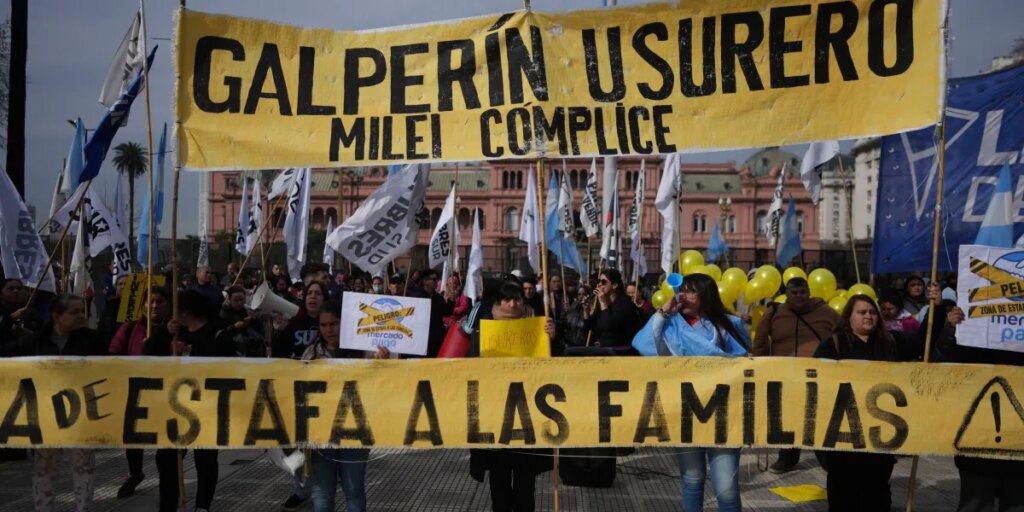
Opposition lawmakers have called a special session of Congress for Wednesday to consider interest-rate caps and other measures to help Argentines renegotiate their debts. Labor unions and debtors planned to protest outside the building during the debate, which strikes at the heart of Milei’s free-market experiment as voters increasingly look beyond his success in taming inflation to bigger concerns about jobs and wages.
“Households took on debt to survive and now cannot repay it,” left-wing lawmaker Nicolás del Caño and fellow sponsors wrote in their legislative proposal, describing it as “an emergency measure to address the crisis.”
Milei has rejected calls for government relief, arguing that unpaid debts are a private matter between borrowers and lenders rather than a symptom of wider economic distress.
Economy Minister Luis Caputo promised at a recent press conference that banks were easing repayment terms, although he added, “We shouldn’t confuse empathy with public policy.”
Argentines are borrowing just to get by
On a recent afternoon, Taborda joined a few dozen other students in a classroom at his university’s economics school to discuss the emotional toll of their debts.
The gathering followed confidentiality rules similar to those of Alcoholics Anonymous. A moderator asked for a show of hands: Who bought groceries in installments? Who borrowed through payment apps to make ends meet? Who took on debt to repay old loans?
Most hands went up.
Since assuming office in late 2023 promising to break with a discredited political establishment, Milei has slashed the budget deficit and brought annual inflation down from a peak of 289% in early 2024 to about 34% in July.
The greater macroeconomic stability has encouraged banks to lend more, while steep cuts to subsidies for gas, electricity and transport have pushed bills up faster than incomes, forcing many Argentines to borrow just to get by.
In the past, wage increases meant to keep pace with runaway inflation could gradually ease the burden of fixed loan payments. Now, slower inflation means smaller pay raises, while borrowing costs remain sky-high under the government’s tight monetary policy. Digital payment apps require less paperwork than banks but often charge much higher interest because of the greater risk, with annual rates reaching triple digits.
“There was a time when people took out loans to buy a house, an apartment, a car,” said Vanesa Bittoco, a spokesperson for Organized Debtors, an advocacy group that campaigns for repayment plans tied to workers’ incomes. “Now people take out loans to buy food to make it to the end of the month.”
At the anonymous debtors’ meeting, students described feeling trapped, ashamed and increasingly powerless over their futures. The distress extends beyond campus: More than 80% of adults surveyed in Buenos Aires and its suburbs in April said economic problems had a major impact on their psychological well-being, according to the university’s Applied Social Psychology Observatory.
Mounting debt poses political risk to Milei
Experts warn that Argentines’ mounting debt struggles could erode Milei’s support among young voters as he seeks a second term in the 2027 presidential election just 14 months away.
“Clearly, the economic model is hitting young people much harder than other Argentines,” said public opinion consultant Ana Iparraguirre, a partner at Washington-based strategy firm GBAO. “If this continues, Milei is putting his reelection at risk with the same electorate that helped him win.”
Milei has offered little sympathy for struggling Argentines, blaming the surge in delinquencies on irresponsible spending.
“They bought TVs to watch the World Cup and figured they’d decide later whether to pay,” he told investors in the port city of Rosario last month. “Well, now they haven’t paid.”
The debt squeeze comes as Milei’s broader support has weakened. A recent online poll of 1,500 people by well-known Argentine pollster Zuban Córdoba put approval of Milei’s administration at 33%, down from 49% in December 2025, with most respondents saying they’re worse off financially than when Milei took office. The survey, conducted from July 22 to 26, reported a margin of sampling error of plus or minus 2.5 percentage points.
“They’re going to have to provide a solution,” Bittoco, the advocate, said of the government. “Otherwise, they’re the ones who will have a problem.”
The post Nearly 4 in 10 young Argentine borrowers are behind on their debts as the generation that helped elect Milei struggles to get by appeared first on Fortune.