When I was 10 years old, trauma arrived quietly, through the voice of my pediatrician. I was out of school that morning with a toe infection when the doctor walked into the exam room and told my mother and me that a plane had hit the World Trade Center in New York City.
At 10, you live in a world that is small and immediate. Barely a week earlier, we had spent Labor Day weekend at my grandfather’s home at Candlewood Lake in Connecticut, sailing, cooking and living inside the sweet, unthinking comfort of an entirely ordinary weekend together.
That morning in the doctor’s office, my mind did not connect the news to the fact that hours earlier my dad had kissed us goodbye at our Greenwich home, driven to Newark Airport and boarded an early-morning flight to San Francisco to visit his brothers. My dad worked in aviation and flew often for business, so his departure was not unusual. Yet for some reason, the night before he left, I asked him to wake me to say goodbye — a request my mother would later look back on with disbelief.
Returning home from the doctor’s office, watching the smoke billow from the twin towers and the Pentagon on CNN, my mother turned to me with a look I will never forget and told me that my father’s plane had gone dark.
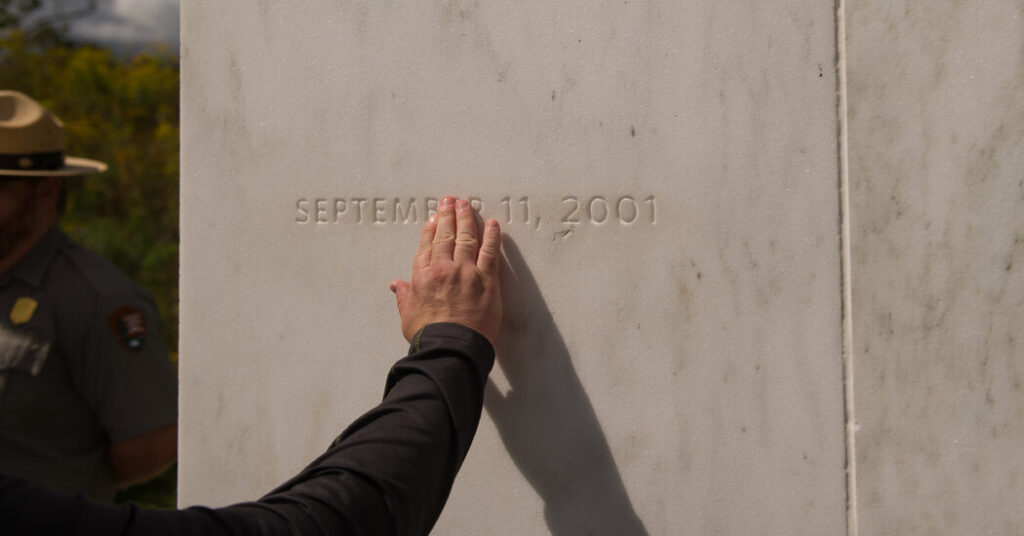
My father, Donald Greene, was on United Airlines Flight 93 on Sept. 11, 2001. Unlike the jets that struck the World Trade Center and the Pentagon that morning, Flight 93 never reached its target. Aware that their plane had been rerouted by terrorists toward Washington, the passengers and crew mounted a counterattack in the sky. During their fight to regain control, the plane crashed into an empty field in Shanksville, Pa. Those on board sacrificed their lives to prevent even greater catastrophe.
In the quarter-century since that morning, my family’s ritual of remembrance has taken us to that rural field.
In the early years, Shanksville was a raw, blackened burn pit. My younger sister, Jody, and I walked its perimeter, picking up stray wires from the debris. Over time, nature did what nature always does, as the scorched earth gave way to tall grass and wildflowers.
Today, the site is a soaring national memorial, where visitors — many of them middle schoolers on class trips to Washington, born long after 2001 — walk the ground where 40 ordinary people chose extraordinary bravery. Jody eventually joined the board of Friends of Flight 93 National Memorial, the monument created to honor them, writing beautifully about what that sacred ground means to her.
Watching that landscape heal mirrored my own journey. In the immediate aftermath, I was thrust into a surreal duality. I was a child navigating the crushing, intimate void of losing a dad, yet my private grief was constantly subsumed by national liturgy. President George W. Bush greeted me by name. I had my middle school homework excused by a handwritten note from Karl Rove, the president’s senior adviser.
I was trying to reconcile a fundamental contradiction: How could the most private loss of my life also belong to 300 million strangers?
The answer came slowly, measured in anniversaries. On the 10th anniversary, Vice President Joe Biden, no stranger to personal tragedy, offered advice that felt impossible at the time. One day, he said, the thought of your loved one will bring “a smile to your lips before it brings a tear to your eye.” He was right.
Today, as a father myself, I love talking about my dad. We remember him around the family dinner table. I’ve shared his story in boardrooms. I’ve spoken about him on the TV show “Shark Tank,” where I pitched Remento, a company that collects and commemorates family history. The sharp edge of loss has smoothed into gratitude.
As we mark 25 years, I find myself grappling with a different kind of grief — not for my father, but for the country we shared in his memory.
Two phrases from that era became permanently etched into the American ethos: “Never Forget” and “Let’s Roll.” The latter was heard on my father’s flight, as passengers began their charge toward the cockpit, converting crisis into collective agency. The former was a covenant we made to one another. A promise echoed in Bruce Springsteen’s post-9/11 anthem, “My City of Ruins,” that out of immense loss, we should hold fast to a common purpose as a nation, praying not just to endure, but to rise up.
Three days after the attack, a candlelight vigil formed spontaneously outside my family’s house. Our neighbors didn’t care about politics, ideology or social divides. They simply showed up at our driveway to create and carry light. For the first time in my young life, I felt the visceral, unprompted pride of being an American. It was a patriotism born not of military might or political rhetoric, but of radical, neighborly empathy.
Now, looking across a national landscape fractured by relentless cynicism and political exhaustion, I find myself almost nostalgic for that American unity. We often treat our current polarization as an inescapable reality of modern democracy. But having lived through the profound solidarity of September 2001, I know that our capacity for connection runs much deeper than our propensity for division.
We cannot, and should not, wait for another national tragedy to remind us of who we are to one another.
When I hold my 2-year-old daughter’s hand, I see the grandfather she never got to meet — the man whose blood runs in her veins, and whose memory shapes how I parent her every day. I don’t just want her to learn about the heroism displayed in the skies over Pennsylvania. I want her to inherit the spirit that took root on the ground in the days that followed.
To honor those we lost, we must do more than build monuments of stone or recite names once a year.
We must recommit to the steady, everyday work of citizenship — greeting our neighbors, bridging our divides and choosing unity before tragedy forces our hand.
The heroes of that day showed us how to respond in our darkest hour. Our task now is to prove that, even 25 years later, we remember how to live together in the light.
Charlie Greene is the founder and chief executive of Remento.
The Times is committed to publishing a diversity of letters to the editor. We’d like to hear what you think about this or any of our articles. Here are some tips. And here’s our email: [email protected].
Follow the New York Times Opinion section on Facebook, Instagram, TikTok, Bluesky, WhatsApp and Threads.
The post My Dad Died on Flight 93. I Miss the Way America Responded. appeared first on New York Times.