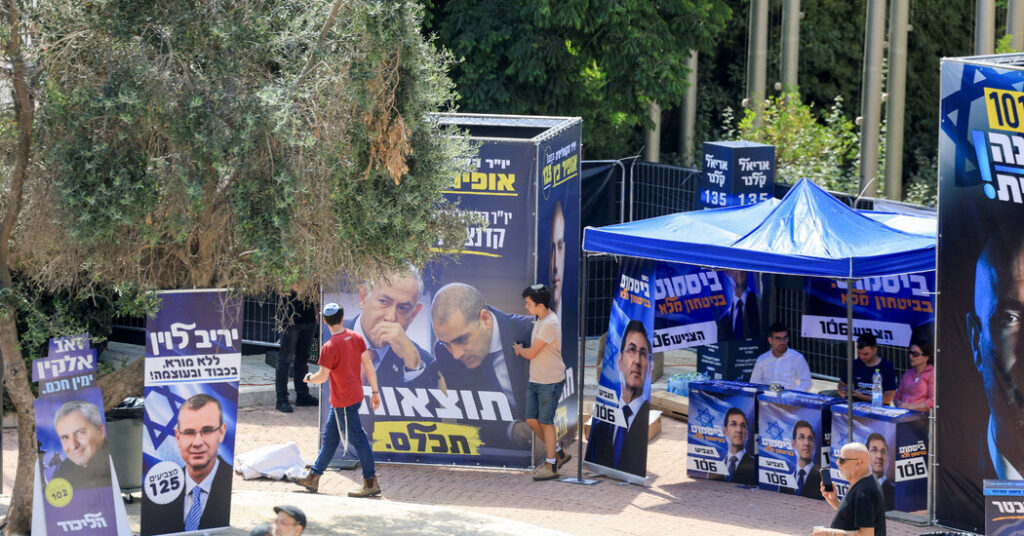
Israel’s political parties have finalized their candidate slates ahead of a general election on Oct. 27, which many Israelis and outside observers consider to be the most consequential vote in the country’s history.
The campaign so far has been dominated by a battle between Benjamin Netanyahu, Israel’s polarizing prime minister, and Gadi Eisenkot, a former military chief of staff who leads the largest opposition party. Polls show that neither man’s bloc has yet gained the support of a decisive majority of voters, and there is no guarantee that either of them will be the next prime minister.
The result is an unpredictable race, with profound implications for Israelis and the millions of Palestinians living under Israeli occupation, as well as for the country’s regional conflicts, its international relations and the Jewish diaspora.
About a dozen parties are expected to clear the electoral threshold to make it into Israel’s 120-seat Parliament, the Knesset. The real political wrangling begins after the election, when party leaders will try to forge a governing coalition of at least 61 lawmakers.
The leading contenders
Likud (Consolidation)
Historically the largest conservative party; increasingly populist.
Leader: Benjamin Netanyahu, 76.
Many consider this election a referendum on Mr. Netanyahu, who as prime minister has not delivered on his promise to achieve “total victory” in Israel’s wars and has not accepted responsibility for security failures preceding the Hamas-led attack on Oct. 7, 2023, the deadliest day in the country’s history.
He has also faced blowback over a deeply unpopular military draft exemption for ultra-Orthodox Israeli Jews and a divisive push for judicial reforms, which would in part reduce the Supreme Court’s powers.
A right-wing party with strong support in working-class and traditional Jewish communities, Likud has governed Israel for more than 34 out of the past 49 years, including 19 under Mr. Netanyahu.
Mr. Netanyahu, who faces corruption charges and an international arrest warrant in connection with the conduct of the Gaza war, has vowed to “complete the job” in waging Israel’s various conflicts and block the formation of a Palestinian state.
Yashar! (Honest, or Straight)
New party aimed at centrists and center-right voters worried about where the Netanyahu coalition is leading Israel.
Leader: Gadi Eisenkot, 66.
A former military chief of staff, Mr. Eisenkot served in Mr. Netanyahu’s war cabinet for part of the Gaza war, in which one of Mr. Eisenkot’s sons and two nephews were killed. He formed his party a year ago and has emerged as Mr. Netanyahu’s top challenger. His platform strikes at Mr. Netanyahu’s vulnerabilities, including by endorsing calls to investigate the failures preceding the Oct. 7 attack.
Mr. Eisenkot has rejected the prospect of Palestinian statehood in the near term. He has also voiced support for a more restrained expansion of Israeli settlements in the West Bank while promising to curb settler violence.
Other major opposition parties
B’Yachad (Together)
A partnership between the centrist, secular and liberal Yesh Atid (There Is a Future) party and Naftali Bennett, a right-wing nationalist.
Leader: Naftali Bennett, 54.
In 2021, Mr. Bennett and Yair Lapid, 62, the leader of Yesh Atid, allied to oust Mr. Netanyahu in a short-lived government. This year, they have sought to lead an anti-Netanyahu front again, emphasizing unity amid Israel’s bitter divisions. They have called for an expanded draft of the ultra-Orthodox and an inquiry into the Oct. 7 attack.
Yisrael Beiteinu (Israel Our Home)
A secular Jewish party that is right-wing on security matters but broke with Mr. Netanyahu years ago.
Leader: Avigdor Liberman, 68.
Founded in 1999 as a political home for immigrants from the former Soviet Union, the party has since expanded its appeal by promising to defend Israel’s secular Jewish character against the rising influence of ultra-Orthodox rabbis.
The Democrats
Heir to two parties from Israel’s dwindling political left, which once dominated the country.
Leader: Yair Golan, 64.
Mr. Golan, an outspoken former two-star general, formed the Democrats in 2024 out of the remnants of the storied Israeli Labor party and the more left-wing Meretz party. It favors a two-state solution to the Israeli-Palestinian conflict, while seeking to forge Israel’s identity as a liberal, secular Jewish state.
Other major pro-Netanyahu parties
Otzma Yehudit (Jewish Power)
A far-right, ultranationalist, anti-Arab party.
Leader: Itamar Ben-Gvir, 50.
Mr. Ben-Gvir, a right-wing provocateur, made his name as a lawyer defending Israeli settlers arrested for attacking Palestinians. His support appears to have grown amid a shift to the right among Jewish Israelis since the Oct. 7 attack. He has called for the removal from Gaza of Palestinians through “voluntary emigration.” Mr. Ben-Gvir has drawn international condemnation and sanctions for his anti-Arab rhetoric and conduct as national security minister in Mr. Netanyahu’s government.
Religious Zionism
A far-right, ultranationalist party with a focus on expanding Israeli settlement of the West Bank.
Leader: Bezalel Smotrich, 46.
As finance minister and a minister in charge of the administration of the West Bank, Mr. Smotrich has masterminded the steady advancement of Israel’s de facto annexation of the territory by expanding settlements, building roads for Israelis and crippling the Palestinian Authority, which administers part of the West Bank. He has repeatedly said that Israel should permanently occupy and resettle the Gaza Strip with Jews.
Amcha Yisrael (People of Israel)
A right-wing party that supports Mr. Netanyahu but opposes a draft exemption for the ultra-Orthodox.
Leader: Ofer Winter, 55.
Mr. Winter, a former brigadier general who formed the party in August, gained prominence for his hawkish national security views. He has spoken of encouraging the voluntary emigration of Palestinians from Gaza.
Shas
Traditional political home for ultra-Orthodox Jews whose families came to Israel from the Middle East and North Africa.
Leader: Aryeh Deri, 67.
Mr. Deri, a veteran political operator, spent time in prison for bribery and fraud, and was later convicted of tax fraud and barred from serving as a government minister. Shas’s following extends beyond ultra-Orthodox Jews to others who are less religious but whose roots are likewise in the Middle East and North Africa.
United Torah Judaism
An alliance of two parties representing different streams of ultra-Orthodox Judaism with roots in Eastern Europe.
Leader: Yaakov Asher, 61.
U.T.J.’s politics center on protecting the ultra-Orthodox, or haredi, community’s strict religious way of life. It has long been allied with Mr. Netanyahu, whose governments have supported U.T.J.’s voters with subsidies. But the partnership has grown increasingly shaky.
The Arab parties
Raam (United Arab List)
An Islamist party that increasingly advocates coexistence between Arabs and Jews.
Leader: Mansour Abbas, 52.
Mr. Abbas has taken a pragmatic approach to Arabs’ participation in Israeli politics, and in 2021, he made history by joining an Israeli governing coalition. In August, he recruited a Zionist former senior police commander as Raam’s No. 2 candidate. If Jewish opposition parties drop their resistance to joining a coalition with an Arab party, Mr. Abbas could be crucial to ousting Mr. Netanyahu.
The Joint List
An alliance of three parties representing Palestinian citizens of Israel.
Leader: Yousef Jabareen, 54.
The Joint List’s component parties represent a range of ideologies, including a Jewish-Arab communist alliance and a Palestinian nationalist party. Their goal in uniting is to bring more Arab voters to the ballot box, expanding their representation in Parliament.
The post Israel’s Election Campaign Is Heating Up. Here’s Who’s Running. appeared first on New York Times.