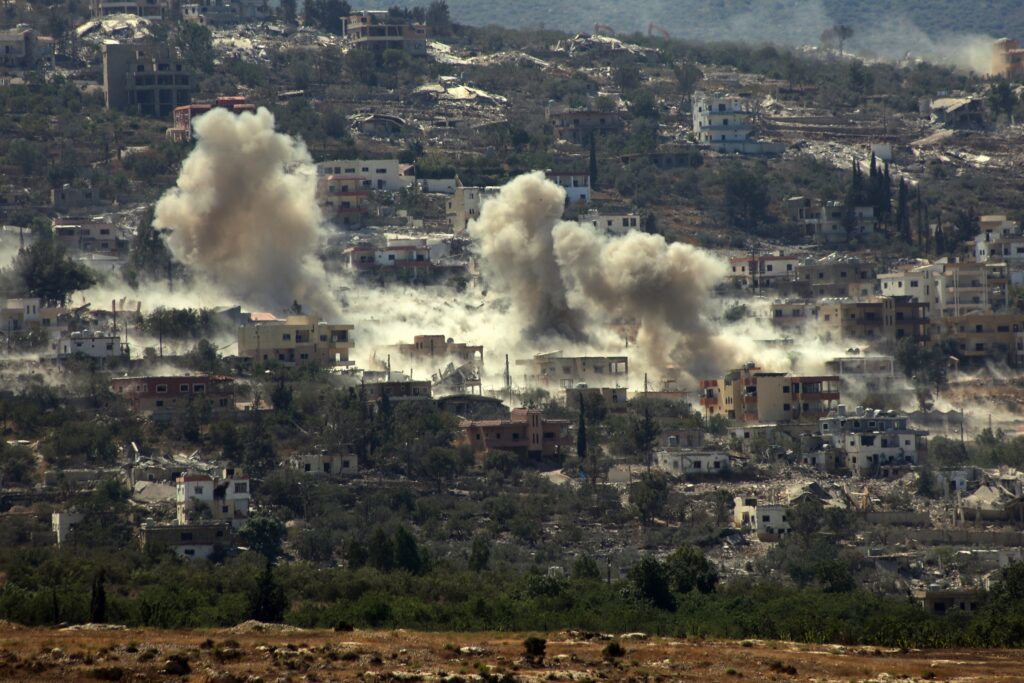
BEIRUT — Israel has in recent days ramped up strikes in southern Lebanon, killing more than two dozen people and prompting fears of an even larger-scale military escalation ahead of Israel’s elections.
The Israeli strikes have killed at least 28 people and wounded 79 others, according to the Lebanese Health Ministry, which does not distinguish between civilians and combatants.
Israel said it was attacking Hezbollah positions in response to drone attacks by the Iran-backed militant group.
The escalation indicates the fraying of the U.S.-brokered ceasefire between Israel and Hezbollah, a roadblock to ending the war between the United States and Iran, analysts say. A spokesman for Iran’s Revolutionary Guard Corps reiterated Wednesday that a peace deal depended on Washington meeting Tehran’s conditions — including an Israeli withdrawal from Lebanon.
“If the enemy wants an end to this situation, it must, while completely stopping the war, refrain from renewed threats, withdraw the Israeli regime’s army from Lebanon, end the blockade of Yemen, release $24 billion in Iran’s frozen assets and refrain from any interference in the country’s nuclear and missile capabilities,” the spokesman Hossein Mohebi said, Iran’s semiofficial Fars news agency reported.
Lebanon’s military on Wednesday said Israel has “escalated its targeting of residential areas and institutions,” amid a “new wave of widespread and condemnable attacks.”
Twelve people, including women and children, were killed in the town of Kfar Reman, the statement said.
“These actions violate international law, threaten existing understandings and arrangements, hinder the Army’s efforts to establish stability, and constitute a flagrant violation of Lebanon’s sovereignty and security,” the statement said.
. The Israel Defense Forces (IDF) said in a statement on X on Monday that it had struck “several Hezbollah terrorist infrastructure sites across southern Lebanon, including a weapons storage facility.”
The IDF also said it struck militants who “were identified transferring weapons in the area of Kfar Reman, in order to remove the threat they posed.”
The renewed fighting, a major challenge to the ceasefire in place since June, has spurred many war-weary Lebanese to flee for safer areas, a pattern that has become familiar over the past six months.
Under a framework set out in the deal, Lebanon would disarm Hezbollah, and the IDF would gradually withdraw from the country. But little progress has been made toward that goal, with Hezbollah refusing to disarm, and Israel expanding the “buffer zone” it occupies in southern Lebanon with the capture last week of a strategic corridor, the Ali Taher ridge, that it said housed a Hezbollah base.
In a statement, Israeli Defense Minister Israel Katz said that the IDF would not withdraw “from the security zone in Lebanon until Hezbollah is disarmed throughout the country and the threats to the residents of the Galilee are removed.” The capture of Ali al-Taher “is an important step toward achieving this goal,” he said.
The renewed fightingis “a worrying sign that escalation could continue,” said David Wood, a senior analyst for the International Crisis Group, a Brussels-based think tank.
The reality of the ceasefire, the strikes show, is that Israel “has the upper hand,” he said.
Lebanon’s president, Joseph Aoun, has urged the United States and the international community to take action to stop the attacks.
The only country “capable of changing the unbalanced equation is the United States,” Wood said.
“There are still hundreds of thousands of people who can’t go back home and a government that doesn’t have the money to pay for their housing,” he said. “The status quo is unsustainable.”
One such resident, Jalal Naser, 45, the owner of a restaurant in Nabatieh, a city around 45 miles south of Beirut, said that people “are angry and frustrated.”
“They know the Lebanese Army is unable to protect them,” he said. “And that the Israeli army cannot be trusted.”
“This is why I support the resistance, which never failed us,” he said, referring to Hezbollah.
He said his restaurant was damaged in strikes Monday. No one died, but the explosion was so loud his ears bled, he said.
“When you leave your home, there is a huge risk that you cannot come back and make it easier for the occupiers to stay,” he said, explaining why he had sent his family north but stayed behind himself.
Many people in southern Lebanon say their patience with Hezbollah has worn thin, with no end in sight to the conflict.
A person close to Hezbollah, who spoke on the condition of anonymity to share sensitive information, said that the group is expecting “a major strike” ahead of the Israeli elections.
“Hezbollah will fight to its last breath,” he said.
The ongoing round of fighting between Israel and Hezbollah began in early March, after Hezbollah attacked Israel following the U.S.-Israeli strikes on Iran that killed Ayatollah Ali Khamenei.
Israeli attacks in Lebanon have killed some 4,300 people and left another 12,400 injured, according to Lebanon’s Health Ministry. At least 40 IDF soldiers and two Israeli civilians have been killed by Hezbollah fire since March, according to Israeli authorities.
Chason reported from Abu Dhabi, United Arab Emirates, and Soroka from Tel Aviv.
The post Israel ramps up strikes in southern Lebanon appeared first on Washington Post.