A year into its military boat strike campaign, the United States appears to be targeting a new type of vessel — large fishing boats off the coast of Ecuador that the Trump administration says provide fuel to smaller vessels carrying drugs.
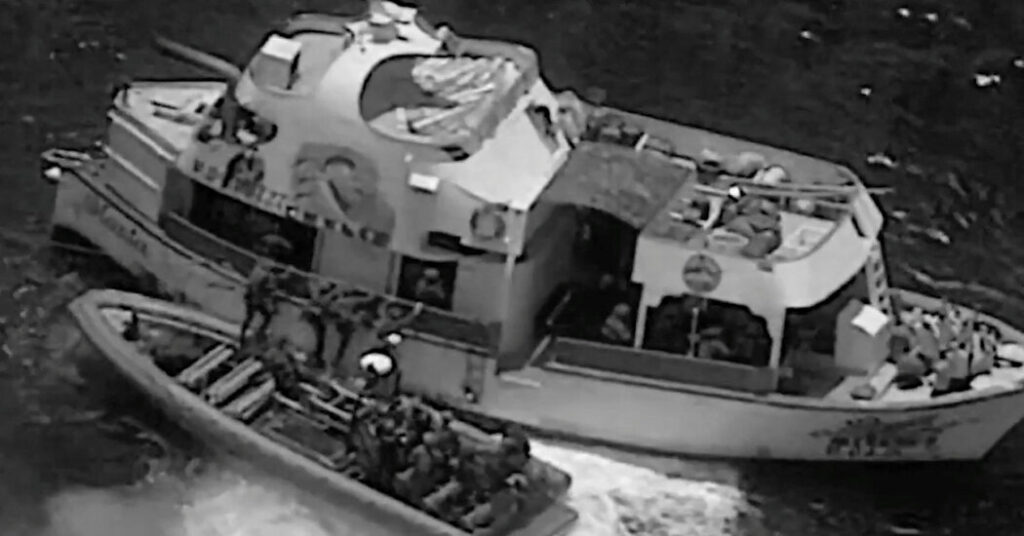
On Tuesday night, the U.S. military announced the sixth such operation in two weeks, posting a video that showed a helicopter hovering over the ocean and military troops boarding a large fishing boat to remove the crew, followed by the boat exploding.
U.S. Southern Command said the boat, like five other large vessels it destroyed off Ecuador’s coast since Aug. 28, functioned as a “floating refueling station,” restocking the kind of fast boats that the U.S. military has attacked in lethal boat strikes that have killed more than 220 people since they began a year ago.
The Trump administration has claimed, without providing evidence, that the boats are carrying drugs. Experts in laws governing the lethal use of force say the strikes are illegal because the U.S. military is not permitted to target civilians who pose no threat of imminent violence, even if they are committing a crime.
The string of strikes on larger vessels comes alongside a resumption of strikes on smaller boats allegedly carrying drugs after a two-month lull. Secretary of State Marco Rubio is traveling to Ecuador on Wednesday as part of a three-country trip to South America, with security and military cooperation against drug-trafficking groups at the top of his agenda.
Ecuador’s president, Daniel Noboa, who is expected to meet with Mr. Rubio, was the first leader in the region to enter into an agreement with the United States to allow joint military operations.
Officials have said that the larger fishing vessels targeted in the last two weeks — some in coordination with Ecuadorean forces — were linked to the Los Choneros gang, which the United States has designated a foreign terrorist organization.
Current and former U.S. military officials say that sinking the larger refueling boats is a more effective way of targeting the drug-smuggling infrastructure of criminal groups than blowing up smaller vessels.
One former senior U.S. official said refueling vessels were harder to replace than the smaller boats and have a bigger impact on the drug-smuggling network.
Taking aim at the larger boats has the added advantage of not killing crew members. Lethal boat strikes have faced fierce criticism from Congress, international leaders and rights groups.
In each case, U.S. troops have boarded the boats and removed the crew members, whom the American authorities have said are turned over to the Ecuadorean authorities. Then, U.S. troops attach explosives to the vessels and blow them up.
U.S. Southern Command said in a statement that “these interdictions cut off critical nodes in the narcotics logistics network” and advanced the administration’s goals of applying “total systemic friction against narcoterrorists.” The military’s other boat strike campaign, the statement said, “continued unchanged.”
Ecuador’s government did not respond to a request for comment on the recent strikes.
The Trump administration’s explanation for its military boat strikes has shifted over time.
U.S. officials originally said the strikes were intended to target a Venezuelan gang in the months before the United States captured Venezuela’s former president, Nicolás Maduro.
The administration later broadened its justification, explaining to Congress that President Trump had determined the United States was under attack by trafficking groups and that all traffickers were therefore enemy combatants.
In recent months, the Trump administration has moved to further militarize the fight against traffickers both at sea and on land in Latin America, urging ideologically aligned leaders to allow joint operations with the United States and to aggressively deploy their own security forces against criminal groups.
Administration officials have compared the new “anti-cartel” push in Latin America to the military campaign against Al Qaeda and the Islamic State. Since last year, they have added about 20 groups in Latin America to the U.S. list of terrorist groups, laying the groundwork for military strikes.
In August, Gen. Francis L. Donovan, the commander of U.S. Southern Command, activated the permanent military task force involved in the recent boat strikes, the Joint Task Force Western Hemisphere, to counter drug-trafficking threats across the hemisphere.
In August, the U.S. Treasury also placed sanctions on a network of Ecuadoreans it said had assisted Los Choneros and another gang, Los Lobos, by using fishing vessels to provide fuel, food, medical supplies and, in at least one case, drugs to fast boats shuttling narcotics to Mexican cartels. It said the larger boats also helped scan for law enforcement.
Despite widespread questions about the legality of military boat strikes, U.S. officials appear unbowed. On Sept. 2, U.S. Southern Command posted a message on social media commemorating one year since the boat strike operation began and declaring, “The Western Hemisphere is no longer a safe haven for narcoterrorism.”
José María León Cabrera contributed reporting from Quito, and John Ismay from Washington.
The post Escalating Boat Strikes Campaign, U.S. Targets ‘Refueling’ Vessels appeared first on New York Times.