Somewhere right now, someone is streaming “Stranger Things,” queuing up a Eurythmics synth-pop playlist, or buying a pair of the high-waisted jeans and leg warmers her mother once wore unironically. In the White House, President Trump celebrates the decade that brought him to prominence with his retrogressive policies and his bawdy, gaudy aesthetics.
Often portrayed as a prosperous interlude between the social movements of the 1960s and our anxious, polarized world, the 1980s live on in even more ways than many Americans recognize. When I covered the corporate boardrooms, economic upheavals and political campaigns back then, I thought I was witnessing a temporary political correction. Decades later, when I returned to investigate key moments, I realized how profound the changes were.
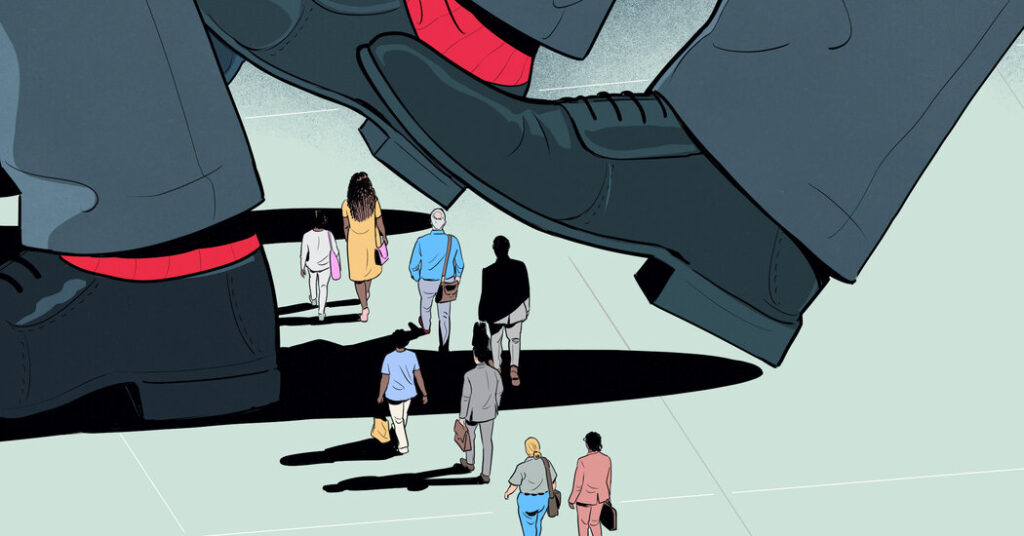
We’re not living after the 1980s. We’re living in them, trapped in the invisible architecture built by a clutch of executives, politicians and conservative advocacy groups (that was later abetted by a generation of business-friendly Democrats).
This small group of conservatives, dismayed by the chaos and upheavals of the 1960s and disappointed by failure of 1970s politicians to roll back big government programs, had carefully planned their attack. Moving beyond their grasp is going to require the same strategic thinking, organizing and patience that these men used so effectively 45 years ago.
Inaugurated in 1981, President Ronald Reagan, aided by conservative Democrats in Congress, devoted two terms to slashing corporate taxes and deregulating industries. This was no standard shift in administration; Mr. Reagan was following a highly coordinated, yearslong blueprint drawn by a network of conservative intellectuals to systematically dismantle the New Deal consensus.
It was perfect timing for Jack Welch, who was named chief executive of General Electric two and a half months after Mr. Reagan’s inauguration. Taking advantage of the changing environment, he transformed an industrial company best known for making appliances and lightbulbs into a fast-growing conglomerate that derived almost half its profits from the newly deregulated finance and banking sectors. Mr. Welch also made famous a new business practice: waves of layoffs. By eliminating 100,000 jobs while doubling profits in the 1980s, Mr. Welch, who preached a philosophy that emphasized profits over all else, eventually made G.E. the most valuable company on the stock market.
Mr. Welch’s rise earned him a national profile and helped usher in a new era: that of the celebrity chief executive. Before the 1980s, corporate leaders largely exercised power behind the scenes. But as businesses became more powerful and unconstrained, executives like Mr. Welch and the Apple co-founder and chief executive Steve Jobs came to be seen as cultural oracles whose advice could fix virtually everything wrong with the nation.
While the administration was reshaping the business landscape, the public square was being rewired by Mark Fowler. Appointed by Mr. Reagan to lead the Federal Communications Commission, Mr. Fowler embraced the strategy that conservative think tanks had spent years planning. First, he stripped away longstanding regulations that limited corporate control of the news media. Within a few years, all the major television networks were owned by giant conglomerates.
Perhaps even more significantly, Mr. Fowler introduced the effort to eliminate the F.C.C.’s Fairness Doctrine, which required broadcasters to present multiple perspectives on issues. Its demise under his successor in 1987 set off an explosion of hyperpartisan media, starting in 1988 with Rush Limbaugh and conservative talk radio, later followed by the birth of Fox News.
Why does the Supreme Court keep moving to the right, even as polls show a majority of the public disagrees with its decisions on abortion, gun rights and presidential power? Just as chief executives and government officials were emboldened by this new conservative agenda, so too were a small group of right-wing mostly Ivy League law students. They formed a student debating society, organizing their first national conference in 1982.
Conservative foundations swiftly funded the nascent group, and the Reagan administration and conservative judges were soon offering government jobs and judicial clerkships to a rising generation of conservative lawyers. This was the birth of the Federalist Society, the network that became a pipeline through which a supermajority of the current Supreme Court, and hundreds of federal judges, have passed and been screened on their way to the bench. The group’s leaders personally built the list from which Mr. Trump chose his first-term Supreme Court nominees.
We are also still living with one of the most enduring legacies of the 1980s: the unchecked power of big business. Today, the country suffers at the hand of extraordinarily wealthy tech and A.I. moguls. One of them, the Trump-friendly billionaire David Ellison, has rapidly assembled a sprawling media empire that includes CBS News (whose “60 Minutes” is being nudged to the right) and a multitude of film studios. He now hopes to add CNN and even more studios to his purview.
Even some of the original architects of the 1980s believe things have gone too far. Mr. Welch conceded in 2009 that the single-minded pursuit of profit and shareholder value as a strategy was “the dumbest idea in the world.” Mr. Fowler acknowledges that today’s tech monopolies and social media platforms like Meta and X should be subject to government scrutiny and antitrust laws.
For liberals and Democrats to wrest this country from the grip of the 1980s, they need to learn from four decades of conservative success.
A first step would be to rebuild needed protections. Congress should pass robust federal guardrails on mergers, private equity takeovers and disruptions like A.I. deployment — including advance notice of tech-driven layoffs, guaranteed severance and worker-retraining funds. A second step is to support the nascent resurgence of labor organizing. Despite public promises, the Democrats routinely stall on enshrining basic union protections in law. Unions are needed to support a new generation of workers: gig workers, freelancers and the contract employees being displaced by A.I.
With Washington so divided, Congress cannot bring back the 1980s broadcast rules and the Fairness Doctrine. But there may be enough votes to trim the sweeping immunity that tech companies enjoy by reforming Section 230 of the Communications Decency Act, which shields their social media platforms from being sued over content posted by users.
Most important, liberals and Democrats must learn to play the long game. There is an example in their midst. Gay activists built a 30-year legal, political and public relations strategy that won the greatest civil rights victory in recent decades: same-sex marriage. They prevailed despite years of powerful conservative opposition and frequent electoral setbacks. Such sustained effort, modeled in many ways on the successful crusades of right-wing groups, is what liberals and Democrats need now, and will need in the years ahead.
Many look fondly at the 1960s — the protests, the music, the social revolution — and bypass the decade that is easily mocked but was just as consequential. It is time to set aside the wistful nostalgia for shoulder pads, Rubik’s Cube, and Pac-Man and recognize that the 1980s actually built the architecture of the world we inhabit today. Dismantling it is the first step to escape.
Jonathan Kaufman is the director of Northeastern University’s journalism school and the author of the forthcoming book “When America Roared: How the 1980s Saved, then Broke, the Country — and Led Us to Today.”
The Times is committed to publishing a diversity of letters to the editor. We’d like to hear what you think about this or any of our articles. Here are some tips. And here’s our email: [email protected].
Follow the New York Times Opinion section on Facebook, Instagram, TikTok, Bluesky, WhatsApp and Threads.
The post Blame Ronald Reagan appeared first on New York Times.