We’ve written about how A.I. threatens jobs. About how it’s fomenting a political backlash. And, most recently, about how some in Silicon Valley now put the risk of a “total A.I. takeover” at more than 50 percent.
As a parent, one of the scariest things about A.I. is how pervasive it has already become in my children’s lives. Kids are not only using A.I. to answer questions. They’re using it to identify which questions to ask. (Although I was intrigued to hear from friends in New York that their teenagers were boycotting A.I. altogether.)
Today my colleague Natasha Singer, who has just published a book about how Big Tech is reshaping education, writes about Silicon Valley’s push to get A.I. into classrooms around the world — and why this year might be a crucial one.
The mass A.I. experiment in schools
by Natasha Singer
Children in much of the world are heading back to class right now, and it’s shaping up to be a school year like no other.
I’ve spent much of the past year reporting on how Google, Microsoft, OpenAI and Anthropic are racing to spread their A.I. chatbots in schools and universities.
This year alone, OpenAI, the maker of ChatGPT, signed A.I. education deals with Greece, Jordan, Kazakhstan, Slovakia and Trinidad & Tobago. Microsoft said it has helped “upskill” more than 160,000 educators in Thailand on A.I.
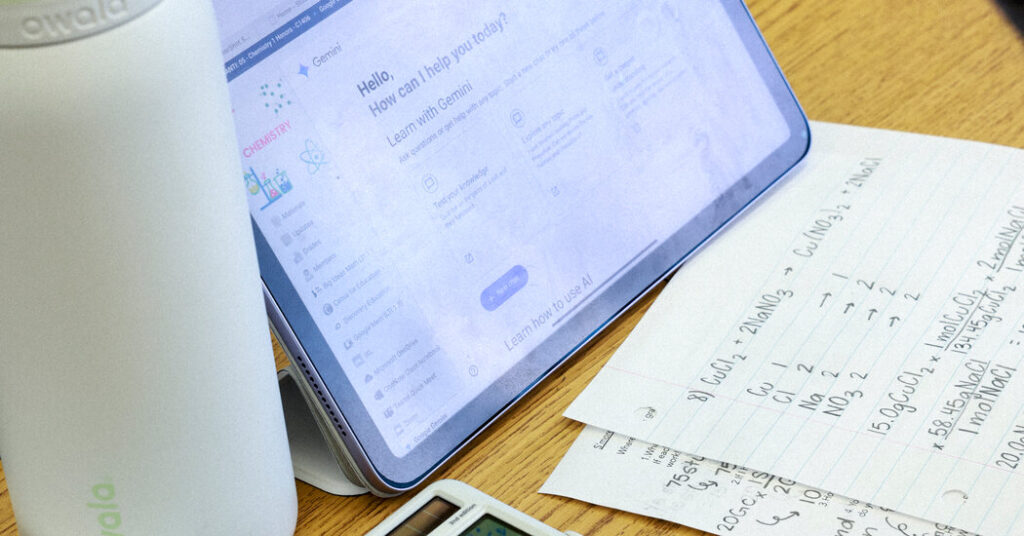
Anthropic says educators in more than 60 countries are learning to use its Claude chatbot. And Google turned on its Gemini chatbot in Google Classroom, an app used by tens of millions of students and teachers, in certain schools.
Many tech executives and billionaires say chatbots are poised to revolutionize education.
The industry’s pitch is that A.I. products will make teachers more efficient, engage children, automatically customize their learning and equip students with crucial career skills. In some schools, students are already using A.I. to help explain math and science concepts, build online games, and analyze data sets.
So far, however, there is little rigorous, peer-reviewed evidence to suggest that A.I. chatbots significantly improve students’ educational results. In fact, a number of recent studies show the technology can hinder critical thinking and reading comprehension.
And so unleashing unproven chatbots in schools amounts to a mass experiment, with the future of education at stake. Will A.I. become an effective tool for learning, or a classroom crutch?
The industry push for A.I. in schools pits Silicon Valley’s might against some local politicians and concerned parents’ groups — with many teachers and students caught in the middle.
A patchwork of policies
Amid the uncertainty, some countries are temporarily barring classroom chatbot use for students. Norway, for instance, has curbed student access to A.I. in elementary and middle schools. New York City, the largest U.S. school district, just announced a one-year ban on student A.I. use in elementary and middle schools.
Other school systems are studying the potential benefits and drawbacks of A.I. for students and teachers.
Iceland started a pilot program last fall in which teachers used chatbots like Claude, from Anthropic, to help brainstorm ideas for new lessons, create learning games and help explain complex concepts to students.
In Sierra Leone, Google recently conducted an eight-week study with local schools to test whether its “guided learning” A.I. system could help students with math. The company reported that its short study had found modest gains. Google also noted that students who already had strong math skills benefited more from using A.I. than students who were struggling.
Estonia, one of the first countries to provide computers to students in schools, has embarked on a more comprehensive program. Last year, researchers and education leaders there worked with OpenAI to develop a customized chatbot in Estonian that is designed to ask students questions and push them to think for themselves, rather than do students’ work for them.
“The idea is to create guardrails to make sure that students are not losing their cognitive skills in the age of A.I.,” Kristina Kallas, Estonia’s minister of education and research, told me.
Countries and school districts that are incorporating A.I. into classrooms note that many students are already using commercial chatbots like Gemini and ChatGPT on their own for help with their schoolwork. They argue that schools have an important role to play in training students and providing guidelines on how to use A.I. productively. Otherwise, they say, Silicon Valley will set the rules.
Tech values vs. education values
The fight over A.I. in education is ultimately a clash of values.
Tech giants, which have a financial duty to shareholders, want to train schoolchildren to use their products. Those business imperatives have helped fuel an industry-backed drive for A.I. education that has focused largely on teaching students to use chatbots and vet their outputs.
Public schools, in contrast, are government institutions whose mission is to serve the best interest of children. To do that, global groups like UNESCO, the U.N.’s agency for education, are urging schools to take a more human-centered approach to A.I. education — one that is less focused on how to use chatbots, and more focused on teaching kids about where A.I. products come from, how they work and how they are upending humanity.
“It’s not about how to use an A.I. chatbot,” Mark West, an education specialist at UNESCO, told me. “It’s: ‘What are A.I. chatbots?’ and ‘What are they doing to us?’”
As Silicon Valley drives schools to adopt A.I., it may be as important — or even more important — to teach students how A.I. is driving us.
(Read an adapted excerpt from Natasha’s new book, “Coding Kids: Big Tech’s Battle to Remake Public Schools,” here.)
MORE TOP NEWS
Yemen tips back toward war
The Houthi militia said yesterday that Saudi forces had launched dozens of airstrikes in Yemen. Saudi Arabia had vowed to retaliate for a Houthi attack that injured 73 civilians in the south of the kingdom. The two sides are approaching a return to a full-blown war, which has been mostly on pause since a 2022 truce.
The Iranian-backed Houthis appear to be trying to control shipping routes to the Red Sea. Fighting in the Persian Gulf has already cut off Saudi Arabia’s main export route, leaving the Red Sea as one of its few alternatives. Because of the intensifying conflict, the price of oil surged to about $100 a barrel for the first time since July.
OTHER NEWS
-
Nearly 2,000 flights were canceled in Britain because of a system failure that upended plans for tens of thousands of travelers, particularly at Heathrow Airport.
-
The bond market rejected the U.S. Treasury Department’s attempt to lower borrowing costs, sending yields even higher.
-
Israel reacted with fury to British sanctions on West Bank settlements. Analysts linked the response to Prime Minister Benjamin Netanyahu’s tough re-election fight.
-
At least 14 people were killed in an explosion at a weapons depot in Syria.
-
Ukraine says it needs an additional $27 billion in loans, and its European allies want to know why.
-
President Trump made large payouts to three White House aides, listed on disclosure forms as “cash gift for the holidays.”
-
With thousands still missing in Nepal after devastating floods, many families are holding symbolic cremations for their loved ones. Watch this video from our South Asia bureau chief, Mujib Mashal.
WHAT ELSE IS HAPPENING
-
Apple introduced the foldable iPhone Duo, the biggest change to the company’s most important product in 19 years.
-
A new narcolepsy drug has set off a race to develop a class of medicines that could treat Alzheimer’s disease, PTSD and even normal aging.
TOP OF THE WORLD
The most clicked link in your newsletter yesterday was about black bears in California.
SPORTS
U.S. Open: Elena Rybakina advanced to the semifinals after beating Zheng Qinwen. On the men’s side, Alexander Zverev takes on Botic van de Zandschulp. We have live updates.
In case you missed it: Carlos Alcaraz lost his chance at the title at 3:33 a.m. But he was still grinning.
SALARY BUMP OF THE DAY
64 percent
That’s the increase in salary that Singapore’s prime minister, Lawrence Wong, will be getting, bringing his annual earnings to 3.6 million Singapore dollars, or $2.85 million. The move is part of a broader pay raise for cabinet ministers meant to ward off corruption in Singapore, which has the highest political salaries in the world.
MORNING READ
Lue Yang, a Laotian refugee who has spent decades in the United States, was working overnight at a Michigan automotive plant when he was apprehended as part of President Trump’s deportation campaign. “Look for me,” he told his family before immigration agents handcuffed him. “Don’t let me disappear.”
Thus began a race that would stretch over 100 days, as his friends and family tried to get the deportation order lifted before a government plane flew Yang back to Laos, a country he barely knew. It all came down to the last minute. Read the full story of his race against the clock.
AROUND THE WORLD
A warmer England’s harvest
Britons drink billions of cups of tea each year, but very few grow their own. A rapidly warming climate may be changing that. “It should get easier over time, as the temperature changes and so does the nature of what is possible with passion, and a bit of science,” one British farm owner said.
The past summer was the hottest recorded in British history, and some farmers have begun to experiment with produce not typically grown in their country, including melons, kiwis and grapes. Read more about what they’re growing.
RECOMMENDATIONS
Appreciate: Check out these 25 international art shows.
Luxuriate: High-end cruise ships offer wellness experiences, great food and spacious suites.
Train: Here’s a 20-minute workout for aging well.
Slay: Is there a right length for a man’s pants?
RECIPE
If you’re celebrating Rosh Hashana, or even if you’re not, consider making these wine-braised short ribs, which should be made up to two days ahead. Don’t let the many ingredients, including optional Sichuan chile oil, scare you. They add balanced layers of savory sweetness.
WHERE IS THIS?
Where is this building?
TIME TO PLAY
Here are today’s Spelling Bee, Mini Crossword, Wordle and Sudoku. Find all our games here.
That’s it for today. See you tomorrow! — Katrin
Natasha Singer was our guest writer today.
We welcome your feedback. Send us your suggestions at [email protected].
The post Back to School, Now With A.I. appeared first on New York Times.