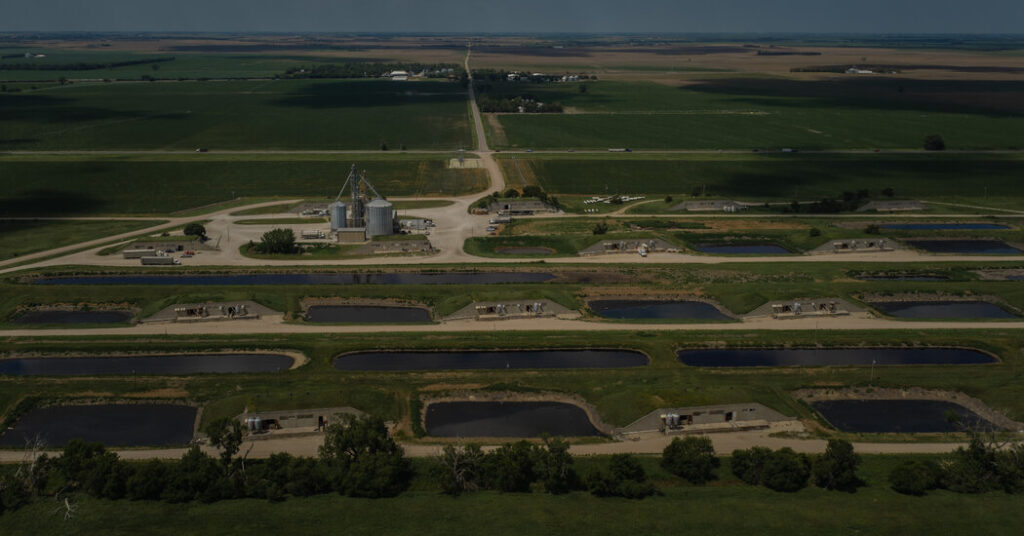
Before becoming Nebraska’s governor three years ago, Jim Pillen built a multimillion-dollar hog enterprise. Casting himself as a conservative businessman who would grow the state’s economy, he defeated a Trump-backed candidate in the Republican primary.
This time around, Mr. Pillen, who is seeking re-election this fall, won President Trump’s endorsement. The governor — who had rarely spoken out about immigration issues until last year — had embraced Mr. Trump’s hard-line immigration agenda.
Days after Mr. Trump’s return to the White House, the governor directed the Nebraska State Patrol to partner with ICE on immigration enforcement. He allowed the federal agency to use a former state prison, now referred to as Cornhusker Clink, to hold hundreds of detainees caught up in the administration’s mass deportation sweep. He has echoed Mr. Trump’s rhetoric about “criminal illegal aliens” who have “invaded our country” and decried “the worst of the worst” immigrants he has claimed are hiding out in Nebraska.
But for more than a decade, Mr. Pillen’s hog business has employed migrant workers, those who are in the country legally — and those who are not, The New York Times and The Flatwater Free Press found.
His company, Pillen Family Farms, has taken on undocumented workers as it has grown into one of the nation’s largest hog producers, according to a review of state and federal court records and interviews with more than 40 current and former employees, prosecutors, immigration lawyers and community organizers.
Many farms in Nebraska and other states rely on immigrants because of labor shortages. While the scale of undocumented workers in the Pillen farm labor force — which has about 1,200 employees in four states and Canada — is not clear, the fact that the company has used them is an open secret at some of its Nebraska farms.
Mr. Pillen has faced little public scrutiny about his workers. His spokeswoman, Laura Strimple, said in a statement that “Jim Pillen never knowingly hired an illegal immigrant and went above and beyond the legal requirements to verify the immigration status of his employees.”
At least 20 Pillen hog farms employed undocumented immigrants, according to court documents and interviews with more than two dozen current and former workers, including several managers. Six former workers acknowledged in interviews that they themselves had no legal status.
Court records show that at least a dozen Pillen workers were charged with using fake or stolen IDs for employment between 2015 and 2024. Many Pillen workers interviewed said the practice was common. At least 10 who assumed false identities, according to them or their relatives, never faced criminal charges for that.
David Armendariz, a Mexican who overstayed his tourist visa in 2008, said he worked at two Pillen farms until 2023. When he was hired, he recalled in an interview, a farm manager accepted the fake driver’s license he had purchased. The same ID was rejected years later, he said, when he applied for a construction job elsewhere.
Over the years, Mr. Armendariz said, more Hispanic workers arrived at the farms, many of them undocumented. One co-worker changed his name multiple times, he said, and another went by a different name from the one on his sign-in sheets. Mr. Armendariz said he was open about his own status. “Everyone knows that it’s not your name,” he said, “but they don’t ask you what your name is.”
Quinten Rowley, who managed two boar farms for Mr. Pillen’s business until 2022, said the company ramped up background checks for applicants about the time Mr. Pillen decided to run for governor. After that, Mr. Rowley said, he had to turn away more applicants.
Samuel Bethune, Platte County’s public defender until 2009, said he had represented hundreds of undocumented immigrants every year, most of them employed in meatpacking plants. He recalled that a few clients charged with traffic offenses identified themselves as Pillen workers but lacked valid employment documents.
ICE identified no records of audits or inspections at Pillen farms in the past 15 years after a request from The Times and Flatwater. The federal agency has raided relatively few workplaces in Nebraska. The largest and highest-profile one was an Omaha meatpacking plant where more than 70 workers were arrested in June 2025 over alleged identity theft.
After the raid, Mr. Pillen suggested in interviews that ICE would not target established immigrants. “Anybody that is here working hard and being a good neighbor, they’re A-OK, they’re fine,” the governor told The Nebraska Examiner. But he also said that stealing identities was a “grave offense.”
The governor did not respond to interview requests and declined to answer written questions for this article. Mr. Pillen’s spokeswoman said in her statement that he “has the strongest immigration record in Nebraska history. Under the governor’s leadership, Nebraska has assisted the federal government in the deportation of nearly 1,000 illegal immigrants through its variety of partnerships with federal entities.”
ICE has arrested more than 3,000 people in Nebraska since Mr. Trump’s second term, more than doubling the rate under the Biden administration. By comparison, in Minnesota, the epicenter of some of the nation’s most aggressive urban immigration enforcement operations, such arrests have more than quadrupled, according to an analysis of ICE data released by the Deportation Data Project.
Federal officials have largely avoided clashes with agricultural employers in states that helped re-elect Mr. Trump, according to agricultural producers and labor economists.
“If you’re going to come and pound on farmers in Minnesota, Iowa, Missouri, Nebraska, whatever, and daily raid their farms or their processing plants, you’re going to have some problems politically,” said Al Juhnke, former executive director of the Nebraska Pork Producers Association. “The farms are right smack dab in the middle of red areas.”
Hogs, Farmhands and Fake Names
The first farmer to lead Nebraska in more than a century, Mr. Pillen often talks about his agricultural roots. He grew up with livestock on his small family farm in Platte County in northeast Nebraska.
A Cornhusker football standout at the University of Nebraska, he studied animal science and then worked as a veterinarian before launching his own business more than three decades ago. What is known as Pillen Family Farms, based in Columbus, started with 60 sows, or female pigs, on a dirt lot.
Now, after expanding and buying out competitors, the company owns about 100 farms in Nebraska alone, with workforces ranging from a handful to dozens of people. Since Mr. Pillen became governor, his children Sarah and Brock have run the company, which ranks No. 14 nationally on the Pork Powerhouses list, with 78,000 sows.
The family also owns a hog-breeding business and has a minor stake in Wholestone Prestage, which operates a pork-processing co-op in Fremont owned by some 200 producers. Since 2019, at least 56 Wholestone workers have been charged with using fraudulent IDs to work, according to state court records. More than half pleaded guilty or were convicted, several cases are going through court, and the other defendants fled or failed to appear. Wholestone did not respond to requests for comment.
At Pillen farms and elsewhere, workers labor long hours for relatively little pay to keep the hog barns running. They vaccinate pigs, feed them, move and ship them. The job is one that most Nebraskans do not want, hog farmers said in interviews.
Facing labor shortages, large corporate hog producers in recent decades have turned to a workforce of immigrants, whether legal or not, according to John K. Hansen, president of the Nebraska Farmers Union.
Gary Stover, a consultant who helped a local producer manage a hog farm in Shelby, said in an interview that he replaced the crew there with Hispanic laborers in 2010 because their work ethic impressed him. He said that one employee there used a fake name, and that his other consulting clients also had undocumented workers with falsified documents.
Nathan Dallon, an immigration lawyer in Omaha who has defended hundreds of undocumented workers against criminal charges like identity theft and driving without a license, said Nebraska’s agriculture industry operated on the premise that there would be unauthorized migrant labor.
“H.R. for a lot of these companies are incentivized to take on workers that they know are using fake papers,” he said in an interview. “Sometimes they even help them get the fake papers, and then they know full well that they are making the crime worse for the person working.” (Mr. Dallon, citing client confidentiality, declined to say whether he had ever represented Pillen workers.)
The use of fictitious documents by immigrants for employment is hardly new in Nebraska. In Schuyler, fake IDs used at the Cargill meatpacking plant created a controversy more than two decades ago.
Dave Reinecke, then Schuyler’s mayor, told “60 Minutes,” “Would you rather have growth, or would you want to pick and choose where they came from?”
Now, three-quarters of Schuyler’s residents are Hispanic, the highest share of any municipality in the state. Court records show some undocumented workers for Pillen farms have lived there. Other Hispanic immigrants, including Pillen employees, have settled in small towns near their workplaces.
Carl K. Hart Jr. prosecuted a steady stream of identity fraud cases involving undocumented workers, including five employed by Mr. Pillen’s business, as Platte County attorney until 2022.
“There are folks who are facilitating all of this,” he said in an interview. “They’re in the community, and they’re filling a need for the agricultural industry to obtain workers.”
Nine of the 12 Pillen workers who were charged with identity theft or impersonation were convicted, and three failed to appear in court. Pillen Family Farms was not accused of any wrongdoing in those cases. Employers are rarely the target of such investigations, making it hard to determine whether they had any knowledge or involvement, prosecutors and defense lawyers said.
One former manager at a Pillen farm said in an interview that he told an immigrant to obtain a different ID a few years ago after an initial fake document was flagged by the company. Before working for Pillen, he had advised workers on how they could make their fake IDs appear more genuine, said the manager, speaking on the condition of anonymity because he still has relatives in the industry.
When Mr. Armendariz worked at Inland Foods, a Pillen farm outside Hastings, only a handful of workers had legitimate documentation, he recalled. About 20 immigrants did not, including him, he said. Roughly half had been hired by a co-owner that Mr. Pillen’s business eventually bought out. (Mr. Armendariz, who asked not to use his full surname because he feared retaliation, said he was let go after disputes with his boss.)
Some Inland workers are still undocumented after more than 20 years there, said a current employee, who requested anonymity because he was not authorized to speak about the company. Two people said their undocumented relatives currently work at a Pillen farm near St. Edward.
Ashly Cortez-Garcia worked at a Pillen-owned hog unit near Albion five years ago. In an interview, she said her manager learned from the head office that an employee was working under one name and had applied for state assistance under another. Ms. Cortez-Garcia recalled that the manager told her to ask the worker in Spanish, “Which one do you want me to use?”
The manager, now retired, declined to respond to requests for comment.
Pillen Family Farms was sued in 2021 by a former human resources specialist, Luis Lucar, who alleged that it knowingly hired undocumented workers.
Between 2015 and 2019, he said, he repeatedly complained that the business changed workers’ names in company and government documents, misclassified workers as contract labor and falsified employment verification forms.
Mr. Lucar was fired in 2019 and now works as an organizer in Schuyler for the Heartland Workers Center, a nonprofit advocating immigrant labor rights.
The company denied the allegations in a legal filing. Mr. Pillen’s campaign spokesman at the time, Matthew Trail, said Mr. Lucar was lying and described him to a reporter as a “disgruntled former employee” and “pro-illegal-immigration activist.”
In 2022, both sides agreed to dismiss the lawsuit. Mr. Lucar and his lawyer declined to comment for this article.
As Pillen Family Farms grew, it stepped up compliance with employment laws, said Mr. Rowley, the former manager. The business brought in more immigrants from Mexico on a specialized visa for skilled workers in the past decade. The day Mr. Pillen launched his campaign for governor, records show, the business opted into E-Verify, a government system to bolster employment verification.
In a statement echoing the governor’s, Sarah Pillen, the farms’ co-chief executive, told The Times and Flatwater: “Our team takes a great deal of pride and responsibility in following all employment laws. We have never knowingly hired an illegal immigrant.” She said that the company followed all employment verification rules and ensured that “all required forms of ID are reviewed and approved. We also voluntarily participate in the E-Verify program to go above and beyond in our commitment.”
A Pivot on Immigration
Since Mr. Trump took office, Mr. Pillen has worked to build good will in Washington. He has visited the White House 11 times since last year and Mar-a-Lago twice, including a one-on-one meeting with the president in July 2025, according to the governor’s official calendar. That is far more than his recent predecessors.
Despite the president’s endorsement, Mr. Pillen is in a competitive re-election race. Neither he nor his opponents have highlighted his immigration stance in the campaign.
But immigration remains a polarizing issue, even in a conservative state. Less than a third of Nebraskans support the federal crackdown, one national poll shows.
Before his first run for governor, Mr. Pillen’s business donated to Centro Hispano, a Columbus-based nonprofit supporting both legal and undocumented workers, and he accepted an award from the group in 2018. As governor-elect, he spoke about the need for the federal government to expand the number of legal immigrants who could do vital work in Nebraska and other farm states.
Backing Mr. Trump’s immigration policies, Mr. Pillen has emphasized the risk of violent criminals coming into the country and the need to target them for deportation.
On a radio program in July 2025, he recalled learning on a trip to the southern border that intruders had butchered a steer on a Texas family’s ranch. “There have been so many terrorists and criminals swimming across the border,” he said.
“The criminal illegal aliens who have invaded our country must be removed,” Mr. Pillen said in a social media post in December. “I will do everything in my power to stand strong with President Trump to get the job done.”
At times, the governor has appeared to soften his tone. After unveiling the new ICE site last summer, Mr. Pillen said that the detention center was intended for criminals, not hard-working families. He also emphasized the need to address labor shortages in industries beyond agriculture, including construction and hotels.
“President Trump knows, right? He knows that there are people in his industry that have worked forever and done good work but are not documented,” he said. Mr. Pillen added that he was “100 percent opposed” to mass deportation.
Mr. Pillen’s language distinguishing hard-working people from criminals ignores legal reality, some local officials and immigration lawyers say.
Undocumented workers in Nebraska, though sometimes committing a crime to obtain employment, rarely break other laws and are largely “law-abiding residents trying to live their American dream and support themselves and their families,” said Mr. Hart, the former Platte County prosecutor, a Democrat.
After the January killing of two people in Minneapolis by ICE agents and the resulting outrage, the governor largely refrained from commenting publicly about immigration.
More recently, under pressure to meet White House quotas, ICE agents have made arrests in record numbers nationwide, often deporting undocumented people with no history of criminal charges.
The Nebraska State Patrol has assigned more troopers to immigration enforcement roles. And the ICE detention center, in McCook, is expanding to house more people.
Ms. Cortez-Garcia, the former Pillen farm employee, said she was dismayed as a Republican voter that Mr. Pillen seemed to contradict himself on the immigration issue. “You can’t hire illegals and then stand against illegals,” she said.
Samantha Aguilar and Roselyn Gonzalez contributed reporting. Research was contributed by Emma Croteau, Georgia Gee, Bob Glissmann, Kirsten Noyes, Jane Bello Rivas, Asia Rollins and Jeremy Turley. Sarah Cohen contributed data analysis.
The post As He Backs ICE Crackdown, Nebraska Governor Employs Undocumented Workers appeared first on New York Times.