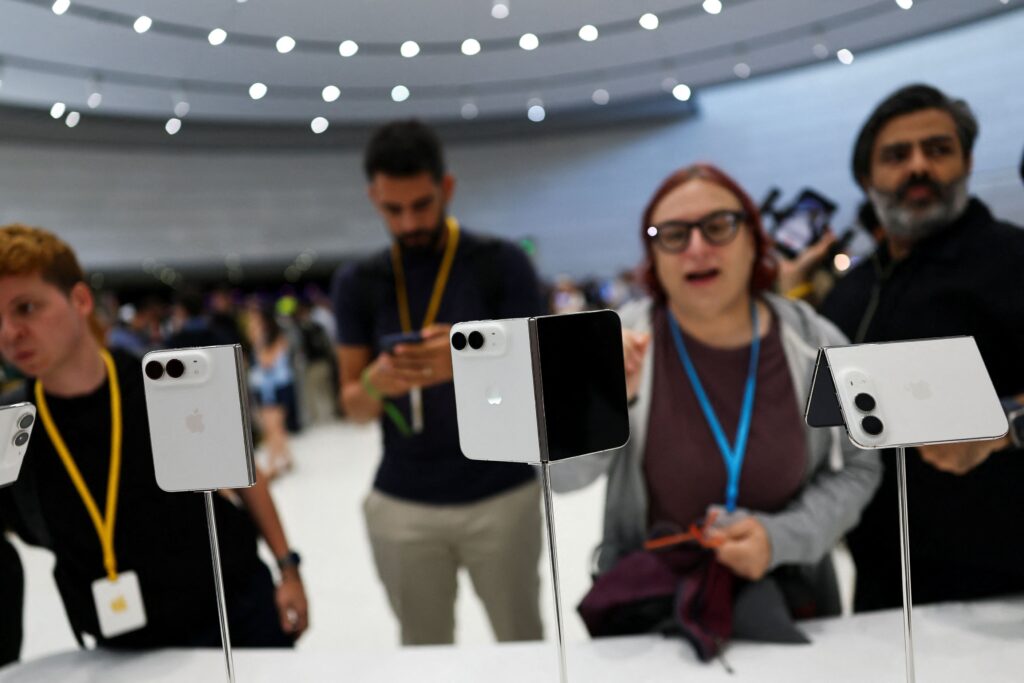
Apple on Wednesday announced its first foldable phone, known as the iPhone Duo, which hinges open like a book into a device about the size of a passport.
The new design is Apple’s most significant change to its flagship smartphone since its launch in 2007, and it starts at $1,999 — over 50 percent more expensive than the conventional iPhone 18 Pro Max series also announced Wednesday, and the same price as a starter MacBook Pro.
“Others have created foldables that just feel like two phones awkwardly stuck together,” said CEO John Ternus, adding that Apple wanted to make a larger display that felt intuitive, like an iPad.
The Duo’s 7.6-inch display is only slightly smaller than the smallest iPad mini, and Apple will launch compatibility with its pencils later this year.
Competitors to Apple have sold foldable phones for several years, including Samsung’s Galaxy Fold, which debuted in 2019. But foldable phones have remained a small share, as little as 2 percent, of the global smartphone market. A large portion of the popularity has been in China, where major smartphone makers Huawei and Xiaomi both announced foldable phones this week in an apparent attempt to get ahead of Apple.
Apple’s version comes, in essence, with three screens: two panels when open, and another on the back of the phone, which can all be used at the same time for activities such as taking photos or video calls. The only part that doesn’t have a screen is the side with the outward-facing camera.
Apps and displays are supposed to adapt as the phone is folded out or in. The company’s launch videos showed it being cracked open, as well as stood up to use as an alarm clock. The Duo doesn’t have the same snapping action as a classic flip phone, and it’s designed to open horizontally rather than vertically.
Apple said it worked to minimize the presence of the hinge when the phone is folded out into a flat screen. Foldable phones from Apple competitors have also had hardware challenges, such as hinges being susceptible to dust and debris.
The Duo is being marketed as Apple’s thinnest phone ever; the company took out the port for a physical sim card and made other changes to save space inside. The phone comes in white or navy, with storage options ranging from 256 gigabytes to two terabytes.
It also comes with new features for taking photos: “Kids Cue” will play animations from Peanuts on the outer display. There is also an AI-powered snapshot mode, which is supposed to capture whatever the camera sees, including if people are posing in front of a propped phone.
The iPhones announced this week are about $100 more expensive than last year’s versions, as Apple faces an industry shortage of memory chips driven by the artificial intelligence boom. Wednesday’s launch included a focus on new AI-powered features, including an AI-focused version of Siri that is supposed to work across apps for tasks like email or making a grocery list. The assistant will also appear on iPhones as a separate app.
At its price point, the foldable phone may be more of a boutique item for Apple enthusiasts than the company’s next blockbuster product. Ahead of the launch, analysts estimated Apple would ship up to 6 million Duos this year — predicted to be 25 percent of the foldable market, but still a fraction of the roughly 250 million iPhones shipped in 2025. Apple will open preorders for the Duo on Oct. 16 and begin shipping the week after.
The launch was the first major appearance for Ternus, who officially became Apple’s chief executive on Sept. 1 after longtime CEO Tim Cook stepped down to become executive chair of the company’s board. Ternus, a veteran of Apple’s hardware division, is being tasked with figuring out the next act for a company that, under Cook, went from redefining the role of personal technology to a global business juggernaut.
Other products announced as part of Wednesday’s launch included Apple Reference Image, which creates an unchangeable reference copy for every photo taken on an iPhone 18 — a way to verify whether a photo was altered from its original version.
The post Apple’s first folding phone has three screens and costs $2,000 appeared first on Washington Post.