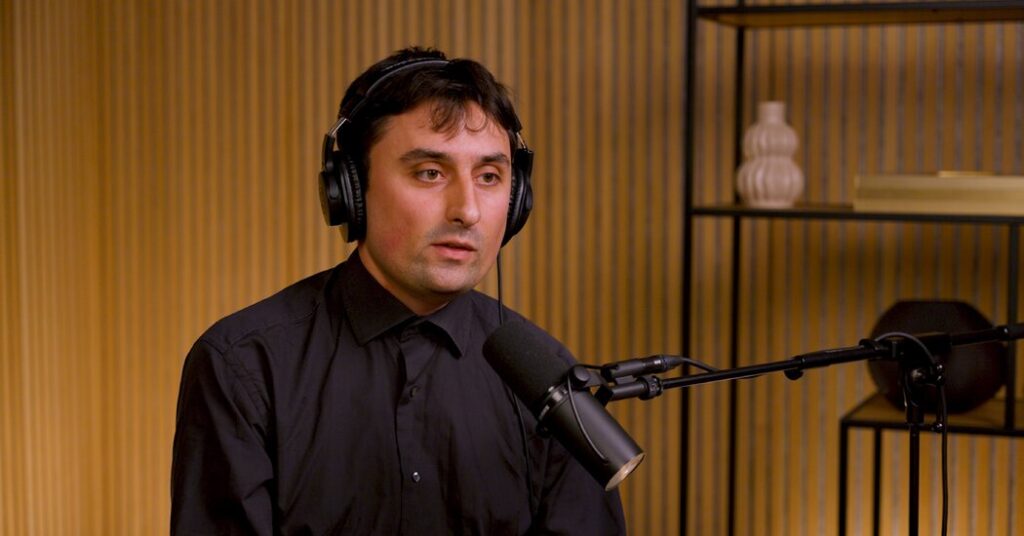
This is an edited transcript of “The Ezra Klein Show.” You can listen to the episode wherever you get your podcasts.
One of the hardest things to do is to describe the overall shape, texture and rhythm of a political era.
We’ll talk about wokeness, or we’ll talk about Trumpism, but getting at the overall form in which they all take place is really difficult.
One idea for this that has taken off a bit recently is hyperpoliticization. Hyperpolitics is a concept from Anton Jäger. He’s a historian, a contributing writer to New York Times Opinion and the author of “Hyperpolitics: Extreme Politicization Without Political Consequences.”
What Jäger is describing is an era in which politics feels like it is everywhere — that the intensity of political opinion and commitment is really high, that things are swinging wildly from one side to the other — but things are not securely attached to political institutions and structures. So these powerful periods of intense mobilization don’t seem to have lasting consequences.
I think it’s a really interesting way of trying to get at what is happening behind what we’re all feeling. Anton Jäger joins me now.
Anton Jäger, welcome to the show.
Anton Jäger: Thank you for having me.
So let’s just begin at the beginning. What is hyperpolitics?
Hyperpolitics is a concept that describes a change in political culture in the West, in which we see an increase in political activity on a variety of metrics, whether it’s voting, protests but also political violence. But that increase in political activity is not matched by an increasing institutional strength.
If you look at the indexes of union membership, party membership or other civil society organizations, those have stagnated or have continued to decline. And that is a situation, I think, that doesn’t really have a proper precedent across the 20th century, maybe also not the 19th.
And for that reason, I introduced the concept to make sense of a new, confusing political present.
So you’re describing a situation in which people and moments feel more political — in some cases, they’re doing more political things. You have huge mass protests, like Black Lives Matter, but there is a de-institutionalized reality to politics.
People are not part of parties in the way they once were. Unions, civic organizations are in decline, and so they’re not civically or institutionally attached.
It’s this kind of mixture of political activity absent institutional membership?
That’s right, yes. And, of course, the story I’m telling is a historical one, and it comes with contrasts.
So if you’re using these two axes — politicization, as I call it, and institutionalization — you can get a certain chronology of political forms, as well.
I talk about the mass politics of the 20th century, which could be highly politicized — particularly, let’s say, the 1920s and the 1930s — but was also very heavily institutionalized. So to be politically active often meant to be in an institution.
And I contrast it also to the postpolitics, as it’s called, of the 1990s and the 2000s, in which you had a decline on both of those indexes — so low institutionalization and low politicization. And what we’re looking at now, indeed, is this strange scissor shape.
Namely, collectivity has also become easier, and it has become more necessary to pursue it, but it doesn’t really have an institutional form. So it feels very inchoate, and as I claim, that also means it doesn’t have as many policy consequences as it used to have.
I don’t want to question your definition of your own concept, but one thing I feel that answer doesn’t quite pick up on, but which is part of why this idea has resonated, is the hyperness of hyperpolitics — this feeling of things rising and falling with incredible rapidity.
One year you’re deep inside Black Lives Matter and wokeness, and then the vibes have shifted to Trump, and then they come all the way back.
Nothing seems to last, but everything seems incredibly important. You have a very thoughtful, laconic style here, but I want to get at this frenzied nature of it, which you do describe in the book.
I think the volatility or the frenzy you’re pointing at is a quintessential feature of the phenomenon I’m describing. Because what do institutions do with political activity? They stabilize it, and they give it longevity over a longer time period.
And if you don’t have these institutions to tie your political action to, and also not the mechanisms of delegation or representation that come with these institutions — I’d say also maybe discipline — that means that short-termism is the de facto mode of a lot of political action.
Because you can be enormously interested and invested in one question for a couple of weeks, you follow the media cycle. But then, once the popularity fades or it doesn’t seem as urgent, you move on to the next thing. And there’s no institution that’s actually there to set the agenda to help you articulate a long-term vision that might unite your politics across all these short-term issues.
So the “hyper” has both a spatial and a temporal side to it. Spatial insofar as it can go everywhere, and it can gather loads and loads of people. I mean, there are record numbers in terms of turnout, not just in the U.S. but across the West, for protests in the last 10 to 15 years.
But it’s also hyper in that it doesn’t cover a very long time span. And almost like a political market, you can invest in a product, and then when you see that its value is plunging, you can dump your shares, and you can move on to the next issue.
One of my critiques of the book is that you often will gesture at what seems to me very obvious about this, which is that this is digital politics — this is online politics. This is algorithmically mediated politics.
You write about hyperpolitics: “It is dynamic, intense and polarizing, yet also ideologically diffuse, visibly modeled on the fluidity of the online world.”
You don’t spend much time in the book describing or theorizing on the fluidity of the online world. But I want to spend some time on it here, because the politics you’re describing are politics I recognize and live through.
This just feels like, not what institutions are or are not able to do now, but a politics that is fundamentally downstream of what we pay attention to. And our attention is fundamentally shaped now by algorithms that care about controversy, that care about newness, that are hunting amorally and constantly for whatever will get a rise out of people.
If you build politics on that completely bizarre superstructure of attention, this is what you get.
I’m broadly in agreement, and I don’t think it necessarily contradicts, or is in friction with the thesis I’m defending.
I’m a bit hesitant about a lot of views, particularly in the last 10 to 15 years, that assign not just a primary but, as we say, a monocausal role to digital technology, where somehow the internet explains everything.
And then the book shouldn’t have been called “Hyperpolitics” but just “Extremely Online Politics.” And then it’s just a book about the digitalization, or the increasingly digital nature, of our political lives.
I want to resist that collapse, or I want to resist equating hyperpolitics with extremely online politics. For the reason that many of the theories we’ve had that try to describe the Brexit vote or the Trump vote through something like Russian bots or the purchase of Facebook ads — there was, of course, during the Arab Spring, already a theory that these were so-called Facebook revolutions, that it was digital platforms that were really driving the upsurge.
But also recently, the idea that the reason social media is playing this role is primarily because it’s the only thing we pay attention to — I don’t think that’s very compelling. For the very reason that you also have to pay attention to the environment in which digital media was launched.
And there, it’s not as if social media did all the work itself. It’s more that the civic or social landscape into which it entered — it found a population that was ready to experience so much of politics online. Of course, these algorithms are addictive, but the question is always: Why does it stick? Why are people so taken to it?
And at the same time, a lot of the reason there are protests doesn’t just have to do with hallucinations online. These are very, very real and very important topics — whether it’s mass incarceration or police violence in the U.S., or inequality. Surely on the right, they’d say migration.
And these are not simply things that digital platforms have somehow conjured up out of nothing. It’s more that social media has acted as a magnifying glass and an accelerator of certain trends that came before — but that I think surpass the digital.
If we reduce everything to the digital, we are only having a conversation about platforms — when I think it should be a much broader conversation.
I always think of the conversation about what you’re calling digital as a conversation about attention, and you can have that conversation well or poorly.
I agree with you: Dissolving things down to Russian bots or Facebook ads is ridiculous. I didn’t believe that in the 2016 election. I don’t believe it now.
But let me push this a little bit, because when I say it’s my critique of the book, I don’t mean I think you have it wrong in the book. I actually just wish there was a chapter on it in the book.
One thing I was thinking about as I read the argument you were making about institutions is: Well, what do I see happening with the institutions we have today?
Because it’s not as if all institutions are gone, or nobody is part of a party. You can look at the Democratic Socialists of America, which is rising in America and has a real institutional formation. There are people who devote their lives to the Democratic Party, to the Republican Party.
And one thing I would say about all of these people — not literally every individual, but many of them — is they exhibit the tendencies of hyperpolitics even more than normal people do.
They have the tendency to get overly invested in what gets called online the current thing. To have incredible waves of sentiment but then not be able to translate it over a long period of time. The tendency to look back on something from two, three, four or five years ago, something recent, and think: Oh, my God, what were we just doing?
Famously, Alexandria Ocasio-Cortez just gave an interview where she said: “Woke 1 was crazy.”
Archival clip of ABC News’s “This Week”:
Alexandria Ocasio-Cortez: I have a local city councilman that has this saying: Woke 1 was crazy. [Laughs.]
Jonathan Karl: Woke 1 was crazy. [Laughs.] OK, that’s ——
Ocasio-Cortez: And I think that what’s important is that we have to assess ——
Karl: I mean, did the movement go too far with some of those positions? I mean, you briefly supported the idea of defunding the police.
Ocasio-Cortez: Well, I think that during this time, and especially during Covid, there was a huge opening of the Overton window. We were shut down. There were some of the highest unemployment rates that we have seen because of those shutdowns. And I think that the doors were really open in trying to entertain any and every policy that was going to get us to a better place. And I actually think that the discussions that were had during that time were quite fruitful.
I think what she’s describing there is the way online politics led ideas that are real, and rooted in the real world, to take some forms and be expressed in ways that people no longer wish to defend.
The way I think there’s a connection here is that the people, even those who are institutions, and the way institutions work and collectivities work — those people are also communicating with each other online and tweeting at each other and retweeting each other. Donald Trump communicates with the Republican Party through Truth Social.
So saying there are these two spheres: Institutions and the digital world — it doesn’t feel real to me. I watch people who lead these institutions communicating with each other through this digital world, and thus the institutions end up in the same sort of back and forth, with a slightly wild oscillation quality.
Yes. It’s very clear that the types of politicization that are typical of the contemporary world also have an effect on how people affiliate with institutions.
There, I would say, hyperpolitics obviously moves at different speeds in different groups. So with the political professional and, let’s say, the voter who maybe hasn’t voted in a couple of elections and isn’t professionally involved in politics — obviously hyperpolitics is going to have very different effects.
So the volatility or the short-termism that we detect in the general population and their relationship to politics will also find its counterpart, even with subjects who find themselves within these institutions.
Which I think is a striking illustration for A.O.C., but one could make the argument for a couple of other figures, as well: The reason one can easily rescind certain positions, or then step back on commitments that were made quite vociferously a couple of years ago, is that there doesn’t really seem to be a solid ideology behind many of these political choices and preferences. And this is important for an institutional side of the story — there isn’t a program to which she can tie herself.
Across the 20th century, political parties always had leaders or certain charismatic figures who led them forward. They always had people who were more individualized as members of their party than others.
At the same time, there was a program around which everyone could orient themselves. And this meant that changing or reneging on some of those aspects of that program came with costs.
The question with A.O.C. is: Well, she has a relationship to the D.S.A. The D.S.A. is obviously not an official political party — it’s a socialist organization. But the question is: What is the D.S.A.’s program she’s listening to — or she feels she has to be accountable to — and how can they discipline her when she then decides that she now wants to pursue a different political path?
And I think that’s the hyperpolitics at different speeds that I’m talking about. In the general population, it’s hopping from one theme to another.
But even for political professionals, it means a decline in ideological consistency or even the question of: What is my party line? Or what is my long-term vision for the transformation of society?
You tell a historical story in the book about these other periods in politics. And maybe it’s worth sitting in one of them for a few minutes, which is mass membership politics.
And I think you’re describing more European political parties in this than American political parties, which have always been somewhat different. But it’s such a different world to try to mentally inhabit if you’re an American in the year 2026, that I’d like you to draw that picture — what it was like to be at least in some of these parties in this other period that you’re describing.
So the portrait I’m painting is very much reliant on cases on the left. But I also want to highlight that it’s not exclusive to the left: There are right-wing variants of this.
But the case was that to be a member of a political party was not something optional and was often something that was handed down in families. So it was hereditary in many cases.
Describing it as voluntary is almost tricky, insofar as the social stigma for leaving a party or for not voting for it would be quite severe. You might have to move out of your neighborhood.
And at the same time, it also meant that your electoral choice was very much a function of your institutional membership. There was no question who you were going to vote for, because you were already a member. And this means that your political preferences were completely determined by that affiliation.
That obviously also meant that the party had a lot of control over your private life, as well. So there are cases in the 1970s, for example, that members of the French Communist Party were not allowed to buy certain cars or drive them.
Of course, the Christian democratic parties had very strong views on, let’s say, what happened in the bedroom. And it was a very authoritarian world in many cases, as well.
I don’t want to pretend as if it were egalitarian, as if people had complete control over these parties. But membership was immersive. It was something that could last a lifetime and for which the exit costs were quite high.
Now, of course, the U.S. is very different because the U.S. never developed mass parties in the way that Europe did. That probably had to do with the fact that the U.S. democratized very early.
At the same time, I want to resist the idea that American parties haven’t been profoundly transformed in the last 50 to 60 years — the period I’m covering. Because even as parties that are more part of the state than of society, they still had this hinterland of civil society organizations, particularly in the case of the Democratic Party, for example, unions or different minority interest groups ——
The Black church would be a good example of this, I think.
Yes. And, of course, religious institutions are massively important and have been for both parties for a while now.
But even as that hinterland has started to shrink or desiccate, that also meant that even American parties that are not mass parties have reconfigured their relationship to society as a whole. And they now fulfill a very, very different function than they did across the 20th century.
Of course, as I say, it is a different story because there never was the membership model as we knew it in Europe. And this means that the story of hyperpolitics, American-style, has to be told differently from the European variant.
One of the things that I thought about when reading that part of the book — and you’re signaling it here — is that I think at a high gloss, that sounds good to people. This idea that we have hollow political parties now and everything just moves too fast — you can’t stretch ideology over an actual structure of civic belonging and civic membership and civic action.
But these much more totalizing parties that you describe, it led to a lot of horror, among other things. You sort of gesture at the parties of the right — fascist parties, the Nazis. That it is the case that ideology could bring you into a much more immersive world where the cost of exit was much higher, and the pressure for total ideological indoctrination was more constant.
So is this a thing to look back on with nostalgia? I mean, indoctrination is not a concept I think we look back on with a lot of fondness, and having a party sit there and tell me how I should look at everything in the world and be able to socially or, possibly, professionally — in patronage models — punish me if I don’t look at it that way — that’s not a world I’m so eager to live in, either.
No. So I talked about the inegalitarian aspects of that system. The book also wants to maintain a focused ambiguity without too much nostalgia about what this world was — how unpleasant it could be for certain people.
It starts, of course, with portraits of figures in the 1990s and 2000s who are happy to be liberated from that world, who also experience a degree of individual freedom precisely because those institutions don’t dominate their lives anymore. And also with the idea that one cannot clone a dinosaur. So we cannot take the DNA of those parties and implement them in the present and hope that they will revive and survive the current environment.
At the same time, it is also very clear that there is a question of power there. People don’t simply join institutions because they don’t want to be lonely. That’s also a reason, and I think it’s part of the story that the book also tells — the crisis of sociability, the loneliness epidemic, as it’s called, is obviously also a part of the deinstitutionalization the book is trying to analyze.
But except for the sociability element, parties are also guarantees of collective power. They’re instruments for collective action. And as they have declined, and as sometimes their immersive or totalitarian aspects have disappeared, there has also been an increasing difficulty of translating individual preferences into collective action, particularly in the West.
I think there are a few exceptions to this, maybe China and India, that do have these weird mass parties left. But for the rest, the decline of parties has gone hand in hand with an inability, or declining gradient, of popular power, particularly from below.
Can you expand on that? That’s a thing people sometimes say and then move on from very fast.
Defend that position for me: That somebody sitting around in American politics in 1973 or 1954 was more capable of translating individual politics into collective power — into governmental reform.
Well, there is political science research about this — so obviously about the negative correlation, for example, between public preferences and policy results.
The typical case, for example, is Medicare for All, where there has been a majority for it now for a while, but the chance of its getting implemented ——
But this is a very weak example. I’ve covered these fights.
Medicare for All: You poll it, it polls high. You then tell people: Here’s what the taxes will be. Your insurance is going away. And then it polls lower.
And it’s a very common thing when you have a complex policy. You can frame it at the outset, and people are like: Great. And it’s a gigantic change, and they are very, very afraid when you begin actually putting the change on them.
So in this comparative take you’re making, I want to hear this defended — that we were so much better at getting what we wanted politically in another era.
I find a lot of the political science on this, when I do read it, to be a little bit confused. So that’s why I’m pushing this point before we just skate by it.
Yeah. It’s also important to keep in mind that this is not the only factor feeding into this capacity. There is a question of state capacity — there are other kinds of channels that need to be examined.
There is just one element — namely: How has the decline of these institutions negatively affected the capacity for policy change? And I do think if you look at the heyday of what is called the New Deal Order in the 1930s and the 1940s, when the American welfare state — which was never as spectacular as the European variant — was built, there is a very clear correlation with mass power there at the time.
And it is also very, very clear that after McCarthyism, and particularly after the subduing of the civil rights movement, that the fall of this mass power goes hand in hand with the difficulty of actually getting concessions, particularly from America’s business class.
In Europe, it’s different. But it’s also very clear that, for example, Europe’s welfare states were not just built by technocrats but were built through the exercise of mass pressure.
Once again, mass pressure is not an intrinsic good. It can have very negative consequences. But at the same time, to me, there very clearly is the case that the set of social rights that were built up in Europe and the U.S. in the middle of the century were also a function of mass power — not only a function of mass power.
I mean, it seems indisputable to me that the decline of union power in the U.S. probably has something to do with the staggering levels of inequality that the U.S. currently has. Now, it’s a correlation, and then the causal mechanism is complicated, but I think that’s one illustration of how institutional power can translate into policy results more concretely.
One of the reasons I’m pushing on this is that I think there is a widespread view — and I think this view is correct — that people feel particularly powerless over politics right now.
So then the next step in thinking about that view is whether it is a perception or whether it is true.
And I would tell the story you just told a little bit differently. You have an American political system that is very resistant to reform for very, very long periods of time. The Great Depression fractures the system. It functionally annihilates the Republican Party for a period of time. Franklin D. Roosevelt does not pass all that policy because all of a sudden union density jumps. F.D.R. passes all that policy because there is a level of Democratic dominance over Congress that is unimaginable to us today.
Lyndon Johnson’s Great Society, where you have another big period of expansion of the welfare state, comes after John F. Kennedy is assassinated. Kennedy was not getting things done.
The civil rights movement is stymied for a very long time by Southern power over Congress. The filibuster is used basically exclusively to stop civil rights bills for decades in American politics.
So you have these punctuated moments when a lot can get done, but they tend to come for unusual reasons.
Now I’m not saying mass power isn’t important in that — and I do agree with you, by the way, that union density is a reason we’ve had inequality rise. The causality of that, as you say, people can argue over.
The reason I bring all this up is that one of the things that does not always seem obviously true to me is that the average person had so much more power in these times. You needed a moment, and then the Overton window cracks open, and all of a sudden, a bunch of things happen. But it’s very contingent. It’s not a linear process in which the work you are doing as a citizen, day in and day out, feels like it is getting somewhere most of the time.
And one of the things, going back to attention — which I just think is undertheorized in politics, so much as we do talk about it — is that people today know so much more about the world. They know so much more about it so constantly than they could before.
So you have all of this information, and the information is now tuned to be much more arousing emotionally than it was at another time.
One of the things I suspect is that it is the mixture of how much you know and how much you are being made to feel at all moments, mixed in with the powerlessness, that actually is real.
The amount of power an individual has, and then the amount of institutions you’re tied to, is low. That creates this feeling that everything is being done without your consent, without your control. There’s no way for you to affect it.
In America now, we have this red-blue system where you live in a blue state and your vote barely matters in national elections. Same thing in very red states. Everybody knows how your state is going to go, so what does it matter how you vote?
We always want to put this as a question of individual capacity — but is it a question of individual capacity? Or is it a question of: Does the amount you’re being pulled into politics and then your absence of capacity conflict with each other for you?
Yes, to both, with some modifications maybe, I’d say.
So for the first, I think that individual powerlessness is also not completely without precedent. The heyday of mass politics in, for example, the 1930s and 1940s, maybe a bit in the 1950s, was also the start of the nuclear race, which to many people seemed to be the supreme expression of powerlessness in the 20th century. It was the most anti-democratic weapon, as George Orwell said. So it’s not as if that wasn’t with us before.
And I also don’t want to pretend as if reinstitutionalization or rebuilding those institutions today will automatically mean that it will become easier to implement certain policies. Because there is also a question of where power has moved, even on the level of the state.
So I don’t think that in the 1950s and 1960s, unelected bodies, both in Europe and the U.S. — like central banks — had as much power as they do today. And they’re not subject to popular pressure or even electoral pressure in the same way. So there’s no immediate guarantee, and it’s one factor among many.
You do, I think, have to have certain coalitions within the elite, together with mass power, to get some of these policy results done. And it could also be that the constellation is favorable, and then it turns out that it works.
I do think that one of the most important factors in the policy blockage we’re witnessing across both sides of the Atlantic in the last 20 years is that the factor of mass power has been severely reduced, even as politicization has risen. And that probably explains why it has become more difficult.
When it comes to the paradox of increasing visibility, or the dynamics of contemporary political mobilization, I fully agree. I mean, the kinds of footage you can now get beamed onto your smartphone screens — whether it’s a genocide in the Middle East or a mass murder on the other side of the planet — increases political awareness greatly, so there’s an immediacy to the experience.
But there’s also a feeling of complete helplessness. And I do think that’s different in that if you heard about the nuclear race in the 1940s and 1950s, you read about it, but it’s not something you could livestream into your living room all the time. That is something you can do now, particularly if you spend a lot of time on social media, and that probably increases the feeling of helplessness.
One of the other things I think is interesting about social media is that it does create an answer to the question it poses: You have seen something terrible in front of you, and what you can do is post or comment or like.
And I do think it creates this confusion between action and effect. It’s an action that may not have an effect. But it does complete an instant stress cycle: You’ve just seen something terrible. Well, you have to do something. Well, in the place you’re in, what you do is post.
And again, one reason that I focus on it here is that I think this is truer for political elites than for anything else. And I think one of the unusual things about this whole story we’re in is that the elites are more addled than anyone else is.
So you go back to Walter Lippmann’s book “Public Opinion,” which comes out in 1922. And Lippmann’s answer to the reality that the world outside our head differs from the world inside our head — that our pictures of reality are always flawed, so how do we engage with this world that we don’t really understand? — is this famously, quite unsatisfying answer: Well, there should be these technocratic elite panels, and they know everything.
And one of the ways that ends up being an obviously wrong answer is that assumed the elites would not be addled. But, in fact, nobody is more brain-addled right now by social media than Donald Trump or Elon Musk, than the top people in the White House. Nobody is more attentionally hooked on this kind of information than the people who have made politics their life’s work.
And that just creates, I think, a strange thing. Because normal people will then turn to people who are engaged in politics all the time for cues on what to do and how to feel and where to join.
And not always, but often, they’re the worst people to ask or to follow because they’re the most crazed by this form of political attention.
Yeah, so this is a book that’s mainly written from below, in some sense. It’s not just for the left, but it’s written from the left. And that means it describes the effects of the declining cost of political expression online.
So as you say: You’re faced with an obvious wrong, or a moral scandal. And before, you maybe had to write to a newspaper editor, you had to contact your local party chief, or you had to go and stand in the middle of a square and start shouting.
Now you can do something else. You can express yourself politically much more cheaply and easily than before. But then there’s a question of diminishing returns, as well. It’s easy — but what are the actual effects?
Now that is a question of how the declining cost of political expression affects the popular capacity for social change. When you look at it from the top of society, we can see, as you say, that there’s also a variant of hyperpolitics there.
I think the modus of government of the second Trump administration — its short-termism, its incapacity to plan, its unwillingness to plan — also indicates that deinstitutionalization, or incoherence, between different factions of the elite has also had severe consequences for the people who are actually in charge.
I mean, there’s a really spectacular example of this — of Elon Musk being interviewed by the editor in chief of The Economist recently. And it gets very brutal.
Archival clip of “The Economist Insider”:
Zanny Minton Beddoes: But do you see why this makes people think that this man, who has all this power — he’s the world’s richest man — he thinks he has a right to influence our politics, it makes people — we started this conversation saying superlatives. It’s why people loathe you.
I mean, some people do loathe you.
Elon Musk: Yes, some people do. I don’t care.
Minton Beddoes: But do you understand why? Do you think what you’re doing is helpful for Western democracy?
Musk: Well, maybe some people do loathe me. And that’s probably true. I don’t care. But the fact that, as you pointed out, a quarter of a billion people follow me is that I think a lot more people actually like me than don’t. And I think a lot more people hate you and the media more than you realize.
He also openly insults her after the interview on his own private platform.
But the striking thing about the interview is that these are two members of the same class. They’re shouting at each other in the middle of the public sphere. Normally, in a different situation, you’d expect some class solidarity from both sides: We’re in this together, we have to think about a common project.
And the elite is severely divided, particularly in the U.S., but also in Europe. And they don’t actually have institutions to reconcile their social, sectoral and geographic interests. And what the online world does is that it, I think, aggravates this polarization to such an extent that they cannot think long-term about what their interests are.
So hyperpolitics, I think, has compounding and very severe consequences for the elite, as well. It’s just that the book doesn’t provide a full theoretical model of how you should probe these effects.
I want to come back to that in a second, as you did write a very interesting piece in the New Left Review that is more in this direction and thinking about Donald Trump.
But quickly, because, as you say, the book is written from within the left — something you said there pinged for me. Which is that you would expect a kind of class solidarity between Elon Musk and the editor in chief of The Economist.
Can I ask why you would expect that? Because when I look back on past interviews, you have huge divisions between the elites of different countries at all times. Musk is a highly right-wing American elite who has highly politicized himself. He’s not just a random C.E.O. at this point. The press is often very antagonistic.
I think about the Buckley-Vidal debates, where they’re threatening to punch each other in the face on live television.
Archival clip of 1968 ABC televised debate:
William F. Buckley Jr.: Stop calling me a crypto-Nazi.
Howard K. Smith: Let’s stop calling names, and let’s get ——
Buckley: Or I’ll sock you in your goddamn face. And you’ll stay plastered.
Smith: Gentlemen, let’s ——
Gore Vidal: No, Bill.
Tell me about your intuition that there is an absence now of elite class solidarity, when in the past that existed.
Because from my read of history — you think about McCarthyism, where they’re getting each other destroyed from public life on the assumption of being a Communist, whether or not it’s true — elite politics has often been very rivalrous. And that assumptions of solidarity have never held for any great number of them.
So I’ll have to confess that this is a manifestation of a vulgar Marxism, I believe, working in me, where I see two creatures that should have the same class instinct and should be naturally sympathetic to each other.
But as you say, actually, elite division, or elite rivalry, is the rule rather than the exception across history. Particularly in the U.S., because the country is so large, you have all kinds of economic sectors. It’s very difficult to unite each faction of the elite into one organization.
The only periods in American history — and I’d say also in European history and, more broadly, on a global scale — when you do have elite unity and solidarity is when there’s a working-class threat on the other side. So when it comes to anti-Communism, or squelching the labor movement under Ronald Reagan — that is really the last time you had a concerted employer offensive.
But once that opponent is severely weakened and fractures, you immediately have elite factionalism showing up.
So yes, you’re right, they should not like each other, or they’re not destined to like each other. Still, I think it’s striking because it is violence within a specific class, and it should not be confused for the type of radical polarization that we’ve often been taught to think about in the last 10 years, where somehow society has highly polarized.
I think a lot of recent politics can be more explained through elite polarization rather than social polarization as a whole. But that’s still a different discussion.
I wrote a book on polarization a couple of years back, and this is actually the argument of the book — that the elites are polarizing, and then they’re giving the public much more polarized choices, which is polarizing the public in turn.
It creates a kind of flywheel. And I think that’s very true.
I want to go back to this piece you did in the New Left Review, which is more focused on Trump and Trump’s second term.
You quote the political scientist Ivan Krastev, who writes: “The essence of the Trumpian revolution is … the implosion of time itself.”
Tell me a bit about that idea.
Well, it’s a fascinating piece that he wrote for The Financial Times. It’s a bit speculative, so it’s trying to make a couple of observations about Trump’s mode of rule, which, I mean — anyone who has turned on the television or logged in to their social media platforms has probably gotten a taste of it in the last two years.
And it is, obviously, I think, very different from previous American presidents. But there’s one thing that really stands out, and that is its short-termism — or the fact that there’s no thinking beyond the 24-hour news cycle. In fact, a lot of political decisions seem to be informed by the presumed effects those decisions will have on a media cycle and on his perceived popularity.
That doesn’t mean there isn’t a court around Trump that feeds ideas into the machine — obviously, there are different ideological factions, whether it’s Marco Rubio or it’s Under Secretary of War Elbridge Colby, who have certain plans for how to reestablish American hegemony in the new century.
But it seems that what Trump does is that he takes these suggestions, and then he evaluates them on their efficacy in terms of media effects: Will this keep me in the news for the next 24 hours if I bomb this country? Or if I do this? And then afterward, for the next 48 hours, he’ll come up with a different plan.
And I thought it was a very illuminating observation because it depersonalizes Trump, to some extent, as the symptom of a wider malaise that can also be institutionally explained.
It’s because everyone is so personally dependent on his caprices and because the G.O.P., despite some theories, is not a mass party — it’s still a small camarilla, or a small clique, that is very strongly attached to the state. That probably also explains why the administration cannot think a week or two ahead.
I mean, it’s a striking contrast with a Chinese Communist Party that is still formulating five-year plans or five-year designs — and a Trump administration that I think can revise a decision over the course of one day.
Yeah, you have this line in there: What if short-termism is structural now?
And I’ve been thinking about that line. Because I do think there is this constant question around Trump and Trumpism of whether or not, with him, you’re looking at a very idiosyncratic psychology that is highly tuned to the particular moment.
I’ve often described him as a human engagement algorithm. And he really reflects, to me, the way Twitter thinks and the way X or Truth Social — whatever it is — feels.
The people around him don’t, necessarily. I’ve got a lot of critiques to make of JD Vance, Marco Rubio, Stephen Miller — but they’re not actually short-term thinkers. All of them consider things on a longer time frame and think in a more — to other political elites — recognizably ideological way.
Joe Biden, toward the end of his administration — one of the things that his defenders were saying was that his plans were measured in decades, but unfortunately, elections happen in mere years.
And so there’s a question of whether Trump is a kind of harbinger of what is coming or what is really going on. That short-termism, for reasons of both deinstitutionalization and maybe online algorithms and other things, is coming, and he’s like a tuning fork for the future — or not.
But I do look at a place like the U.K., and they’re running through prime ministers at an incredible clip. There is a kind of volatility out there that is not affecting China the same way. [Laughs.]
And so, yeah, I guess I’d like to hear you talk more about to what degree you think this short-termism is structural — to what degree you think the Trumpism that you’re describing there is distinctive to a kind of person.
Is it simply an adjustment period in a new formation of technology? How do you see that?
It’s a loaded metaphor, but I think some Darwinian reading, in that you have the species and you have the environment — and the environment has obviously changed — that is the structural story we’re telling. But there does seem to be one species, or one particular example of that species, that really flourishes in this new environment. And that’s Trump.
And I do think there is a personal dimension to it. I mean, he himself went through the transition of different media regimes. He was the man of television, the showman of reality TV. And then he, I think, handily transitioned, or moved into, the era of the algorithm and social media.
But it’s very clear that in the case of Rubio and Vance, the ideology is actually a burden, and it’s precisely because Trump is unburdened by any ideological convictions. This doesn’t necessarily mean he doesn’t believe anything. It’s more that ideology, as a kind of cognitive frame that filters your decisions, is not something that he’s very familiar with. He has other concerns that come first.
And that probably also allows him to be such a showman. And that’s why he was able to win those two elections.
And I think someone like Vance, who you can sense is opportunistic but is more invested in the idea of ideology and wants to write books in which he talks about his conversion and expounds on his worldview — I’m not sure that his pitch to the contemporary, media-addled, volatile voter will be as convincing as that of the showman himself.
And it’s very clear that some politicians in Europe have also tried to ape that Trumpian style. It’s hard. I mean, there is a certain skill, or even artisanal quality, to how he does it. Which once again is a question of structure and agency at the same time.
Trump himself is an unusual case. But MAGA, as a broader movement that, for many of its people, you can really live in. It really does have ideas. Increasingly, it has institutions that are associated with it and leaders who are associated with it. You can live in its world.
It can give you a sort of meaning. It has rallies. In some ways, it seems very much more like past eras of politics than anything we’ve seen more recently.
So from your perspective, is MAGA hyperpolitics? Is it the coming of something new? How do you see what is happening there on the American right?
I think it’s an interesting and complicated question, because the first Trump term and the second term are obviously very different. And I do think the second Trump term is much more institutionalized.
For the first election victory, he and his entourage were surprised that he even won. That wasn’t the case the second time around. The Heritage Foundation, Project 2025 and all that indicates that they were better prepared and that there was a project of institutionalization that they consciously pursued.
The question of whether MAGA is a mass movement and whether they’ve managed to reinvent even certain forms of 20th century far-right mass politics — which I think is also related to the so-called F-question debate: whether Trump is a fascist or not.
I think, yes, the second Trump term is different from the first. There has been a weaponization, for example, of parts of the security state such as ICE. There has been an attempt to create a solid base of supporters that will remain with them through the fact that there’s now all kinds of state funding involved. And of course, these paramilitary organizations do resemble the 20th-century squads that we usually associate with fascist politics.
At the same time, the question always remains whether there will be a Trumpism without Trump.
There’s maybe a question as to whether Tucker Carlson or Marjorie Taylor Greene and some of the first Trumpers now see themselves as carrying that movement forward, also by dissenting from certain types of G.O.P. orthodoxy.
I’m just less convinced that they have the institutional structure, except for a couple of podcasts and media channels, to keep that going. So that is obviously an open question. We’ll see what happens.
But the G.O.P. has not transformed itself into a mass membership party. The buy-in of a lot of ICE agents does seem to be heavily reliant not on their ideological agreement but more on the financial opportunities they have in joining the security state. And when they lose the midterms, and we’ll obviously see what happens with the next election — I’m just not sure that it will persist for such a long time.
There could, of course, be another mass movement that goes further and radicalizes it. But I don’t think that’s the same as a party that, throughout the 20th century, could bide its time across cycles of five to 10 to even 20 years, and then strike.
When MAGA is so beholden to these contemporary media cycles that are very short and very volatile, it could as easily rise as it could fall.
One thing that we’ve been talking about here is the way institutions — I think we’ve primarily been talking about civic institutions — have eroded.
I think there’s another question, which is about the way that the institutions of governance and power have ossified. This maybe goes back to what you were saying earlier, about the ways in which a system might have become more resistant — not in this case, to me, to individual power, but almost to any form of power.
Which is to say that in America, where we have a much more closely divided politics, where you’re less likely to get bipartisan compromise, you get more filibusters, your ability to pass big bills has gone down over time — and that is true even when power is arranged behind the bills.
I remember for Barack Obama, you had the Chamber of Commerce and the A.F.L.-C.I.O. both supporting an infrastructure bill. It went nowhere.
There was a lot of power behind immigration bills in that era. They went nowhere. Because you could kill so much more in Congress. There are so many more ways to wrap things up, so much more you can do in the courts.
In Europe, it’s a situation I know less well, but, certainly, there is a broad sense that the European Union has created more slowness — more powers that are acting upon you from far away.
And I wonder if some of the movement of political energy to spaces of discourse — of posting things that, on the one hand, are low effort, but at least some kind of answer comes back to you quickly — I wonder if it reflects, to some degree, a disillusionment with what you can get done in institutions that are now very hard to get anything done in.
They’ve been around a long time. They are balancing out a lot of different interests. People know how to work them better. Money can talk very loudly. But I actually always think it doesn’t talk as loudly as people think it does, because I’ve watched a lot of money fail to get its way in American politics and elsewhere.
It’s just so much easier to block anything than to achieve anything, people almost don’t believe in achievements.
I mean, George Soros is, of course, a spectacular example of someone who has been spraying millions at certain causes. If you look at where the world is headed politically, it’s not very clear that he has the total control that some conspiracy thinkers attribute to him.
I think, yes, it is absolutely true that, even on the level of the elite, there has been a complete legalization of outside election spending in the U.S. It has also become easier in Europe. But it’s not very clear that this increasing lobbying power actually also makes it easier to achieve your policy aims.
And that is a paradox. Because you could say: OK, social change has become impossible from below. But if you say also from above, it has become very difficult to pursue, there’s a much more profound puzzle to be examined there.
I think there is a question about the story of deinstitutionalization as affecting society, but also affecting the state. Because the adjustments in the 1980s and 1990s — a story that’s often told as neoliberalism but that I think goes much deeper — is that, on the one hand, it entails a concerted attack on certain institutions that are seen as hampering economic recovery. Particularly unions, which are blamed for inflation, and, thereby, you have to get rid of them to basically restore economic normality.
But on the level of the state, there is also a concerted displacement toward unelected, nonelectoral bodies, to keep them shielded from certain elite pressure groups — to say a central bank has to govern in the interest of everyone and, thereby, they shouldn’t be meddled with.
But what’s interesting is that does two things. It moves power to institutions that are not open to pressure, whether it’s elite or popular pressure. Obviously, it’s still easier for the elite to get access, but not as easy as many people think it is. And at the same time, it increases the attractiveness of the veto option you’re describing.
So if we cannot get certain things through these institutions, what we have to do is just build a kill switch or create something that at least makes it possible to stop something if we don’t want it going through. And that also, I think, becomes attractive from the lower half of society.
I do think that just eliminating these veto capacities is not going to solve the problem, either, because the problem is much more structural insofar as the attractiveness of the veto is a function of an institutional issue that’s older.
And if you want to make the contrast with China, Chinese state capacity means very little without the Chinese Communist Party. And that’s not just a state, that’s an institution that plays a very strange role in uniting classes but also different factions of the elite. I don’t see an American equivalent of the C.C.P., let alone a European equivalent, that could play that role.
I think China is such an interesting counterexample here. I don’t ever pretend to know the structure of Chinese public opinion, but across a number of measures that people do look at — and I do think we feel like we have some confidence in — there is more optimism, less pessimism, and a sense of agency around things like A.I. in China than in America.
And China is a place where, as an individual, you really don’t have a say in governance. There’s very little you can do to affect what the top levels of the C.C.P. are going to do.
On the other hand, somebody is doing something constantly, and change is happening and movement is happening. And even if you are not the one acting upon the world, the world is there to be acted upon.
I would not want to live under that system. I’m not lauding it in that respect. But I do think it sits now as a kind of counterexample to a lot of Western systems, where it almost has created this choice of: Do you want rights and inaction — or few rights and action?
Trump is interesting from this perspective, to me, because he comes into office and is able to make a very big show of cracking the system, it appears, in half and doing things that people thought couldn’t be done. He signs all these executive orders, including one ending birthright citizenship, and throws them out into the crowd, and it looks like a World Wrestling Entertainment rally mixed with a governance function.
But it turns out he has not cracked the code. He is passing less legislation than other presidents. Many of his things end up turned back in courts. DOGE moves with incredible force and speed for a little while and then collapses entirely. He seems overwhelmed by events. He’s in an Iran war he clearly has no control over.
So Trump had maybe an attentional answer. He was able to create the spectacle of things happening.
But then you’re a member of the public, and, well, what has really happened that is different now for you? Are your prices lower? Does America seem like it is doing better? Is anybody really in control? And the answer, again, is no.
Now Donald Trump is falling asleep in meetings, and they’re going to lose the midterms. So that sense persists: I am not in control, but nor is anybody else.
I think you have this dilemma right now of a West that seems in a kind of political drift, often a dangerous one. But it is not like the illiberal forces in the West have mastered the system, either.
China is moving very fast, and I think it exerts a pressure on the West to move faster. But it’s not really clear how to respond to it.
And I just wonder about the politics that creates on both sides. The politics of action there, but without much individual agency. And the politics of individual agency here, but without much ultimate promise of action.
I’d be careful to say there’s no such thing as input legitimacy in China, either. So there is, obviously, not the electoral system that exists in the West. But it’s very clear that, for example, protests around Covid did have an effect on how the Chinese leadership refigured its policies.
And there is a kind of distinction one could make between input and output legitimacy, where parts of the West have seen an increase in input legitimacy — there’s increasing turnout in elections. But when it comes to output legitimacy, which the Chinese state is so spectacularly good at, it’s not very clear that’s happening.
To me, the question is whether the discussion about state capacity or the discussion about getting some of these policy packages through can be linked not just to a discussion about what the state can do, but rather what institutions are necessary for it.
Because as you say, deinstitutionalization also makes it harder for elites to plan. And Europe is a striking instance of this, where — in the face of Chinese competition but also the Trumpian onslaught of tariffs, the geopolitical rivalry they’re currently embroiled in — European elites are simply not coming up with an answer at all.
I mean, there are a couple of plans that are floating around, but it’s not as if there’s an articulated plan. For that, you need some kind of institutional infrastructure to basically unite these different factions to make sure that Europe relaunches itself into the 2020s.
But it’s strange, because you’re put into a position, particularly as someone like me coming from the left, where you kind of have to help elites save themselves. Or say: Please get your act together and find some kind of organ that can coordinate between all of the different factions of you.
Pointing out elite failure in and of itself is not a policy, but that’s mostly what commentary on European politics has become in the last 10 years.
One of the ways you’re telling this story is you have mass politics, and that goes to the postpolitics — the calmer political period — of the 1990s. Your Bill Clintons, your Tony Blairs. Not everything is political. We’re at the end of history. Everybody can calm down now. Communism has fallen.
That then gives way to the period after the financial crisis — anti-politics, Occupy Wall Street, the Tea Party. Political movements are rising, but ones that fundamentally hate the idea of political institutions — that are not trying to, in ways that are traditionally recognizable, take them over, or even build power in the way we normally think about it.
And then you get hyperpolitics. And one way of thinking about hyperpolitics as a period is that it’s actually just fundamentally destructive, but necessarily so. That institutional story we’re telling now is one in which culture, institutions and bureaucracies had ossified.
And is Donald Trump a good answer? No, he’s not a good answer.
But he has demonstrated that somebody with more planning could do something like DOGE and maybe do it in a way that is constructive. That many things that had become ideologically rigid — from how we think about trade to immigration to China to much more — has now opened up.
You see a kind of rise on the left in American politics, with the D.S.A. and Zohran Mamdani and others in that cohort. And there is a dynamism to it.
I think the question is whether this just ends up in destruction and nihilism. Because nothing can gain power for long enough to build something that is new and enduring.
Or it’s actually, in a Darwinian sense — to go back to the metaphor you used earlier — this is a kind of necessary byproduct of revitalization.
For Canada, for Europe, for others — that what was there is breaking down, and we’re in a messy interregnum. Everybody loves quoting the misquotation of Marxist philosopher Antonio Gramsci here — that it’s a time of monsters.
Do you come down on one side or another of this — that we’re going through a cleansing fire versus we’re just going through a fire?
Well, the problem with the time of monsters quote is that it’s describing a prerevolutionary situation. That was the age that Gramsci himself was living through in Italy. I don’t think we’re in that. I don’t think we’re in a prerevolutionary state. I do think we need to be honest about this, particularly from the left.
I do think there is something to be said about the revitalization story you’re indicating, in that Trump at least has the refreshing effect of clarifying or forcing choice. He’s ended some notion of the TINA dogma — the There Is No Alternative dogma. Namely, that you choose between Pepsi and Coca-Cola at the election booth, and in the end, it’s basically the same product with a couple of tweaks. I think he has finished off that perception or that world of politics.
At the same time, you can very clearly see that the increase in election turnout in the U.S. is also a function of the fact that voters see choice. And if someone attempts to assassinate a candidate before an election, as happened to Donald Trump in 2024, that means you very clearly see choice because you want to eliminate one side of the choice matrix that’s presented to you.
In Germany, now, there’s an election in Saxony where they’re guessing that there’s been a doubling of voter turnout from 2006, let’s say from 44 percent to 77 percent. I don’t think that’s a crisis of democracy. I think there’s an economic crisis in Europe, but democracy is doing better.
And there’s a beautiful phrase about political literacy — namely, the sense that people have that the factors in their social lives — whether it’s their rent, the state of their roads, the price of the product — are partially subject to political decisions. Politics has an effect in my life. It matters, and it can change things.
Hyperpolitics has entailed an increase in political literacy to some extent. Now, of course, there’s a lot of nonsense and crazy theorizing going on online.
Hyperpolitics is often quite exhausting. And it induces a nostalgia for the 1990s and 2000s, which I cover in the book, as well, because people simply don’t want to talk about wokeness with their uncle at a family gathering, for example.
But at the same time, I want to make this very clear: This book is not rejecting or dismissing hyperpoliticization as somehow reversible or even negative. I think it is good that people care about politics. I think we should celebrate the end of postpolitics.
The question is more: Where is hyperpolitics going? And can there be such a thing as an institutional formula that extends hyperpolitics beyond mere outrage?
I think that is a good place to end.
So always our final question: What are three books you’d recommend to the audience?
There are three books I chose that are a bit miscellaneous in that they belong to different genres. The first is “The Prophet” by Isaac Deutscher, a Polish historian who only learned English, I think, in his early 30s, and then wrote one of the greatest biographies of the 20th century.
It’s a three-part biography of Leon Trotsky, the famous Russian revolutionary. It’s obviously beloved by Trotskyists, so it has a sectarian appeal.
There are a lot of neoconservatives that were brought up on its diet. Even Tony Blair is said to have read it. But I read it when I was in my early 20s, and I’ve recently revisited it also in the form of an audiobook, and it is completely enchanting.
It is an absolute masterpiece, not just of biography, but also of political history. It also captures a moment in time that feels enormously distant but still very relevant, and it is a pleasure to listen to and read in stylistic terms. So even if you are an instinctual or aggressive anti-Communist, I don’t think you will not like this book.
The second book is “Cheese” by Willem Elsschot, written in the 1930s. This is something much more obscure. It’s by a Flemish or Belgian author. The story is relatively simple. It’s about a middle-aged man with a family who wants to become rich as a merchant. He starts selling a product he hates and never eats — namely, cheese — and fails at doing so. That’s the whole plot.
And I think it is a beautiful parable, particularly in the 21st century, for a society in which buying and selling things has become this compulsive, almost obligatory, habit. But we seem to be relatively indifferent to the products we actually are buying and selling.
The final one — and I’m not sure if there is already an English translation of this — is “Some Months From My Life” by the French writer Michel Houellebecq. He’s a novelist who also plays a very prominent role in the book “Hyperpolitics.” He appears as a protagonist in several chapters.
It is not a novel but more of a personal memoir of his in which he relates a couple of rather chaotic months in his personal life, in which he was asked to star in an erotic movie ——
Who among us? [Laughs.]
Yes, these things happen. [Laughs.] And after which he meditates on contemporary questions of sexuality, culture wars and politics.
This might be strange, but it’s a profoundly moving book.
You really take him as a bit of a prophet, to use the first book’s title in there.
[Laughs.] Yes.
I’ve always meant to read some of his books, and I haven’t. So given that maybe the translation of this isn’t out yet, if somebody wanted to start with his fiction, and you sort of see him as this prophet figure — somebody who understands the future before it comes, even though his politics are very, very different than yours — what would be the starting book of his fiction you’d recommend?
So his debut, “Extension du domaine de la lutte,” which is translated into English as “Whatever,” is the best place to start.
If you go for later works, I would recommend “Serotonin,” which also gave him a Nostradamus-like quality in France, because he seemed to predict part of the Yellow Vest and farmers protests that shook the country.
Once again, it’s not just about his apperceptions of the contemporary world. I think he’s a novelist for a world that has become less novelistic, in some cases even resistant to novelization. And I’m always impressed by how he’s still able to give us a rendition of a world that somehow doesn’t seem to produce very novel-like characters.
Anton Jäger, thank you very much.
Thank you so much.
You can listen to this conversation by following “The Ezra Klein Show” on the NYTimes app, Apple, Spotify, Amazon Music, YouTube, iHeartRadio or wherever you get your podcasts. View a list of book recommendations from our guests here.
This episode of “The Ezra Klein Show” was produced by Marie Cascione. Fact-checking by Michelle Harris. Our senior engineer is Jeff Geld, with additional mixing by Aman Sahota and Gautam Srikishan. Our recording engineer is Aman Sahota. Cinematography by Marina King and Azamat Yakubov. Video editing by Dani Dillon and Arpita Aneja. Our executive producer is Claire Gordon. The show’s production team also includes Annie Galvin, Rollin Hu, Kristin Lin, Emma Kehlbeck, Jack McCordick and Jan Kobal. Original music by Pat McCusker. Audience strategy by Shannon Busta. The director of New York Times Opinion Shows is Annie-Rose Strasser. Transcript editing by Kate Wilkinson and Marlaine Glicksman.
The Times is committed to publishing a diversity of letters to the editor. We’d like to hear what you think about this or any of our articles. Here are some tips. And here’s our email: [email protected].
Follow the New York Times Opinion section on Facebook, Instagram, TikTok, Bluesky, WhatsApp and Threads.
The post What ‘Hyperpolitics’ Explains About This Era appeared first on New York Times.