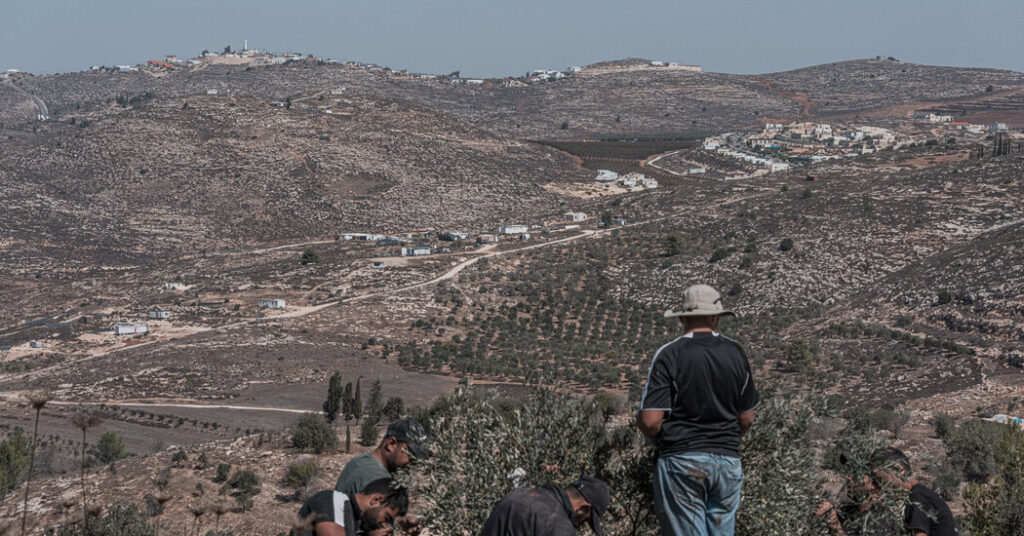
Britain announced significant trade restrictions on settlements in the occupied West Bank on Tuesday and accused extremist settlers of perpetrating “ethnic cleansing of Palestinians,” as it acted with Canada and France to toughen policies toward the Israeli government.
Britain’s package of measures, including a trade ban on goods produced in the settlements, was announced on Tuesday in Parliament by Ed Miliband, who became foreign secretary in July.
The decision is the clearest shift in British foreign policy since Andy Burnham became prime minister in the same month, succeeding Keir Starmer who was elected in 2024.
It was coordinated with Canada and France, whose foreign ministers issued a joint statement with Britain promising “national measures” to ban trade in settlement goods, and supporting other nations that have done so.
“Today marks the beginning of a new approach,” Mr. Miliband told lawmakers, adding that the British government “agrees that there is ethnic cleansing of Palestinians in areas of the West Bank — perpetrated by settler terrorists.” All too often, he added, “The Israeli government has turned a blind eye to this and worse.”
In a speech with an often deeply personal tone, Mr. Miliband said that he made his announcement as a “proud British Jew” who was “unwavering” in his support for the state of Israel. He added, however, that Britain had concluded that the occupation was unlawful in line with a ruling of the International Court of Justice.
“So I can announce today that we will introduce an import ban on goods from illegal settlements in the occupied territories,” he said, adding that the measures would also cover those who provide services to settlements including “construction, infrastructure, financing or real estate for settlement expansion.”
Mr. Miliband also announced that Britain would refuse applications for the sale of arms that would “materially contribute to the occupation.”
Speaking before the statement in Parliament, Pat McFadden, a senior British cabinet minister, said that the overriding drive behind the plan was to keep alive the possibility of a two-state solution, a proposed framework to resolve the Israeli-Palestinian conflict by establishing an independent Palestinian state alongside Israel.
“What we’re really concerned about is that there is an attempt, openly, by some Israeli ministers, to erase that possibility through the expansion of these settlements in the West Bank,” he told the broadcaster Sky News.
He added that the trade restrictions would be limited to those settlements. “I think it’s also important to say that Israel is an important trading partner for the U.K. This isn’t intended to be a boycott of all Israeli goods,” Mr. McFadden said.
Britain, a longtime ally of Israel, has repeatedly condemned Israeli settlements in the West Bank, which are considered illegal under international law. Within Israel, a number of former generals, intelligence officials and prime ministers recently accused armed settlers in the West Bank of ethnic cleansing after they raided Palestinian homes, mosques and villages.
Prime Minister Benjamin Netanyahu has shrugged off international and domestic criticism and promoted building more settlements at a breakneck pace.
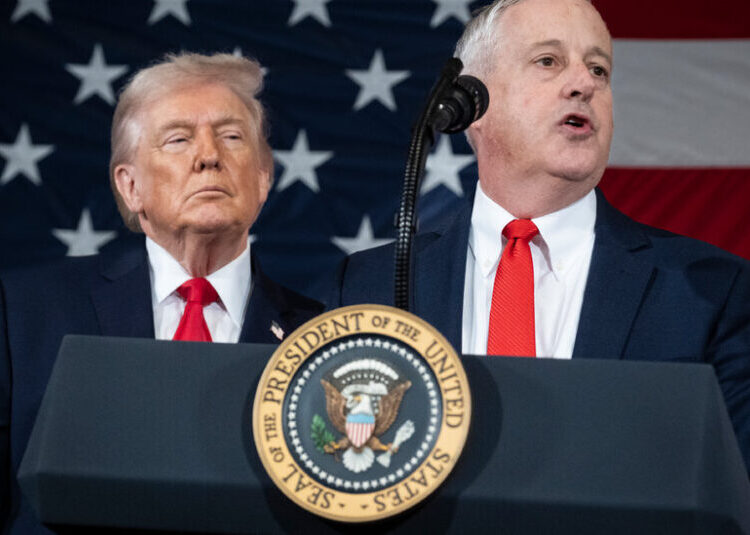
Even before the British announcement was made, Mike Huckabee, the U.S. ambassador to Israel, warned that the plans could stoke tensions with Washington and that countermeasures could have a “huge economic impact on British businesses.”
Mr. Huckabee told the BBC that Britain’s firms might face restrictions on business in some U.S. states, citing Florida as an example. “It’s like throwing a stone and not having an idea where it’s going to land,” he said.
Husam Zomlot, the Palestinian ambassador to the United Kingdom, welcomed Mr. Miliband’s announcement, describing it as a “turning point in every sense.”
“The U.K. has finally matched its values with its actions,” he said in a phone interview. “What happened today is the beginning, not the end. But it is a very, very powerful beginning.”
The Israeli president, Isaac Herzog, said early Tuesday that other nations might join Britain and said in a speech that he believed the sanctions would “prove to be a grave miscalculation, a decision that will fall on the wrong side of history.”
Itamar Ben-Gvir, Israel’s hard-line national security minister, said it was time for Israel to recognize that the Falkland Islands, a British territory in the south Atlantic, belonged to Argentina and were under “occupation.”
Other critics have warned that action against Israel could be used by Mr. Netanyahu to galvanize his supporters ahead of elections scheduled there for next month.
Israel has become increasingly isolated on the world stage in the aftermath of the devastating war in Gaza, and international attention has increasingly focused on Israel’s tightening grip over the West Bank. The sanctions are set to be imposed at a time when Israeli extremists have repeatedly attacked Palestinians, on occasion assailing homes with little intervention by Israeli forces.
Israel’s conduct of the war in Gaza, where tens of thousands of Palestinians have been killed, became increasingly contentious in Britain, particularly after a United Nations commission said that Israel was committing genocide in the enclave. Israel has rejected allegations of genocide from scholars and human rights groups, saying the target of its campaign is the militant group Hamas.
When he took over as prime minister, Mr. Burnham apologized for the British government’s initial reaction to Israel’s conduct in Gaza, saying that his Labour Party “didn’t get it right” and adding: “There’s increasing evidence that war crimes appear to have been committed.” He did not say genocide had been committed, saying that only the international courts could determine accountability.
The debate over Gaza has had domestic political consequences in Britain with an insurgent Green Party capitalizing on misgivings over Labour’s earlier caution among left-leaning voters.
Last month, Britain condemned the Israeli government decision to move ahead with plans for new homes for settlers in E1, part of the West Bank near Jerusalem, in a joint statement with countries including France, Germany, Italy, the Netherlands, Canada, Norway and Australia.
The statement urged Israel “to retract these plans immediately and end its expansion of settlements in the West Bank. Not only will they take us further from peace, but they further undermine Israel’s international standing.”
The post U.K., France and Canada Announce Sanctions on Israeli Settlements in West Bank appeared first on New York Times.