The economic pain that Canadian Prime Minister Mark Carney warned would come from a trade war is now a harsh reality for some small businesses that export to the US.
Across Canada, companies are losing orders, contemplating job cuts and paying higher costs. For some, the threat is existential.
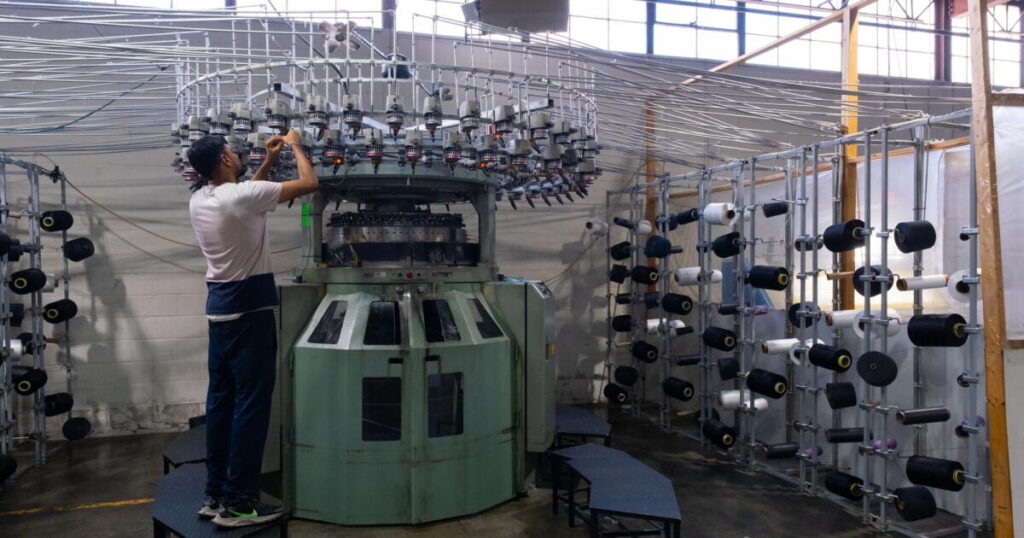
Toronto-based Fine Cotton Factory Inc. exports 30% to 50% of its products to the US. Since the tariffs kicked in, some U.S. orders have been canceled or postponed, and new ones from both sides of the border have slowed, according to Executive Vice President Skip Kann. He fears he’ll need let go a small number of his 250 employees as soon as this month.
“We’re fighting for our life right now,” Kann said.
Talks between the two countries collapsed Aug. 21, triggering 50% U.S. tariffs the next day on $20 billion of Canadian goods such as textiles, paint, apparel, alcohol and honey. Canada announced retaliatory duties on imports from the U.S. worth roughly the same amount, which came into effect Tuesday. The risk is that the trade war will spiral further.
Many small Canadian manufacturers were shielded from earlier U.S. tariffs because of exemptions under the North American trade pact. But the latest levies imposed by President Donald Trump in August ignore that deal.
While the $20 billion accounts for only about 5% of Canada’s annual goods exports to the US, the new tariffs appear to disproportionately affect small and medium-sized businesses. In turn, those firms account for about half of Canada’s gross domestic product. The Canadian government bolstered loans and other financial support for such firms as part of a broader C$7.5 billion ($5.4 billion) package for businesses and workers hit by the latest round of tariffs.
Those measures won’t put out the fire, Kann said. Like many entrepreneurs whose growth potential lies beyond Canada, he has already exhausted domestic opportunities. Plus, some federal supports, such as funding for market research and new technology, are longer-term fixes.
It could be too late by the time the government solutions come through, Kann said.
Fine Cotton’s survival isn’t just important for its workers. As owner of one of Canada’s only large-scale dye houses, the manufacturer is also crucial to Jerico, an Ontario clothing maker that prides itself on a fully domestic supply chain.
If that dye facility closes, Jerico won’t be able to dye and finish knitted fabrics at scale in Canada, said Salmaan Andani, managing director at Jerico. In Andani’s telling, manufacturers like his would be forced to source product overseas, and the country’s knitting and apparel manufacturing industry could unravel, link by link.
Andani said the tariffs mean the company will likely to lose all of its U.S. exports, which account for up to 10% of sales. He has C$22,000 worth of products ready to ship to the University of San Francisco, which ordered from Jerico because the institution wanted to support ethical, organic manufacturing, he said. It will now cost the school an extra C$8,600 to receive the shipment, so the two parties agreed to put it on hold instead of canceling.
Redwood Classics Apparel is another Canadian manufacturer expecting a complete loss of U.S. sales, currently about 25% of production. Kathy Cheng, an immigrant from Hong Kong, co-owns the business with her dad. A clothing wholesaler, Redwood has supplied brands such as Roots Canada and Holt Renfrew from its Toronto factory, which employs about 80 people.
Cheng describes her operation as a “love story to Canada”: giving back to the community that embraced her family by insisting on manufacturing domestically. She wants Canadian corporations to choose Canadian partners, which can move the needle for a small business like hers. She said she doesn’t need to cut staff for now, thanks in part to more inquiries for corporate apparel orders from local firms.
Cheng has also received order requests from longtime U.S. customers since the tariffs kicked in. But because neither side can absorb the 50% surcharge, she, like Andani, has put these orders on hold.
Devastating Blow
Kevin Nixon runs a honey farm in southern Alberta and sells as much as half his production across the U.S. border. He shipped a few loads in early August in order to beat the tariff deadline.
He doesn’t know if his U.S. buyers can absorb a 50% increase in price, but said he can’t take the hit because his margins are already thin. Meanwhile, he’s trying to wrap up the harvest season and market this year’s crop. “We’re in limbo,” Nixon said. “It’s stressful.”
For others, Canada’s counter-tariffs hurt more than the initial tariff blow.
Cloverdale Paint Inc. makes industrial paint in British Columbia, but its steel cans are made in the US. As of Tuesday, those containers are subject to a 50% levy, up from 25%. Altogether, Cloverdale President Darrin Noble expects tariffs from both sides of the border to shrink profitability by 20%, which will likely come out of the bonuses of the firm’s more than 1,100 Canadian employees. “It’s devastating,” he said.
Noble is asking the Canadian government for relief from the levy on imports of steel cans. Cloverdale benefited from a similar program instituted last March, during the first round of the trade war. That time, the support came through in a matter of weeks.
Henry of Pelham Family Estate Winery expects the duties to kill all of its exports to the US. But Paul Speck, who owns and runs the business with his two brothers in St. Catharines, Ontario, counts himself as a winner of the trade war. Less than 1% of his sales go to the US, and business jumped 25% after the province banned U.S. alcohol, including wine, from government-controlled stores. In turn, Speck is switching to European providers for farm equipment that he used to buy from the US.
Grassroots support is a familiar sentiment to Nixon, the honey farmer. Days after the tariffs went into effect, people from all over Canada began asking to buy a few jars to help out a Canadian business caught in the trade war.
“I had people from Vancouver Island to Ontario emailing,” Nixon said. “We’ll work through it.”
Xu writes for Bloomberg.
The post Trade war shock: Tariffs push Canadian small businesses to the brink appeared first on Los Angeles Times.