
The pitch was simple: Artificial intelligence would be the great leveler, narrowing the gap between junior and senior, credentialed and non-credentialed, freeing workers into higher-value work. Two years and several trillion dollars later, a different pattern is showing up.
Wall Street’s own economists find that the households most exposed to AI’s risks are also the ones cushioned by stock portfolios large enough to absorb them. It’s welcome news that the AI “jobpocalypse” hasn’t materialized, but the technology appears to be compressing wage growth in a half-decade of inflation above target—a trend that hits hardest on the lowest-paid workers in the most-exposed jobs. Corporate profit margins are near postwar highs not because AI made companies more productive, but because firms used it as cover to raise prices while holding wages flat. And a nationwide backlash against AI’s data centers suggests the public felt what was going on the whole time, not to mention their surging electricity bills.
Taken together, Wall Street research doesn’t describe a technology upending the old order. It describes one being absorbed by it—and rewarding, so far, almost exactly the people who were already winning.
The myth of the vulnerable elite
The loudest version of AI-anxiety held that white-collar professionals—the credentialed, salaried, laptop class—had the most to lose. Assembly-line workers had already lived through automation; now it was the lawyers’ and consultants’ turn. Brookings’ Mark Muro found that 62 of the 100 most AI-exposed counties were primarily urban areas that leaned left in the 2024 election—the white-collar precariat, in other words. Tufts’ Bhaskar Chakravorti called this trend the “Wired Belt,” a 2020s-era echo of the last 50 years of Rust Belt economics.
Morgan Stanley’s economics team tested this fear against the data this month and found it to be half right. High-AI-exposure occupations are concentrated among what the bank calls “CHIC” households: college-educated, high-income, city-dwelling. Nearly 70% of workers in high-exposure jobs hold a bachelor’s degree, versus about 10% in low-exposure work. Median pay in high-exposure occupations is more than double the low-exposure figure: $97,000 versus $46,000. But the investment bank’s team, led by Heather Berger, argued that affluent Americans “may be safer than advertised” after looking through the lens of “elevated equity wealth.”
American household wealth rose roughly $21 trillion between the first quarter of 2024 and the first quarter of 2026, Berger’s team noted, with direct equity holdings driving half of that increase, despite making up only about 30% of total wealth. AI-related stocks are projected to drive nearly 40% of S&P 500 earnings growth this year and next, according to Morgan Stanley’s equity strategists. Equity wealth is “very elevated relative to labor income” for this upper class of Americans, they noted, with an arresting chart.
Ownership of that upside is heavily concentrated. The top 20% of earners hold 87% of direct equity and mutual fund exposure; college-educated households hold 85%; households over 55 hold 79%. For the bottom 40% of earners, equity wealth roughly equals a year’s wages: $1.7 trillion against $1.8 trillion in labor income. For the top 20%, equity wealth runs six times labor income: $49.8 trillion against $8.3 trillion. The practical effect, per Morgan Stanley’s own modeling: a top-earning household needs its portfolio to rise just 4% to offset a 1% drop in labor income from AI disruption.
The jobs aren’t disappearing: the raises are
Separate research from Apollo Global Management shows how the pain is landing on everyone else, and it isn’t through layoffs.
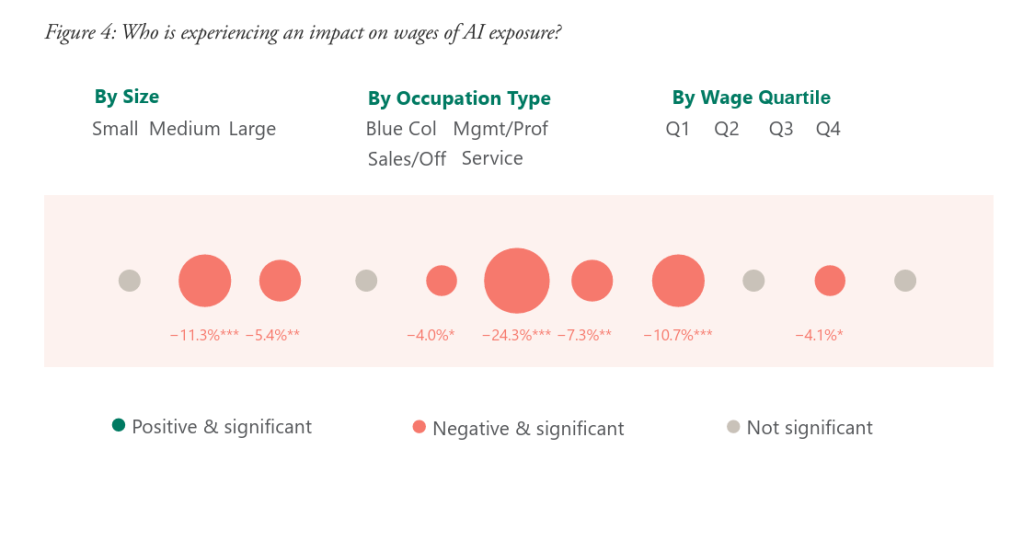
Economists Sania Edlich and Torsten Slok skipped the usual theoretical exposure scores and instead used the Anthropic Economic Index—built from real Claude usage logs—matched against Bureau of Labor Statistics wage data across 321 occupations from 2015 to 2025, with 2023 as the dividing line. Only 11 of those 321 occupations cleared their bar for “high exposure.” But within that group, the wage effect was stark: real wage growth ran 6.7 percentage points slower after 2023 than in low-exposure work, with no significant change in employment. Nobody in this data is losing a job to AI in large numbers. They’re just not getting raises.
The penalty concentrates at the bottom. Workers in the lowest wage quartile saw a 10.7-point wage growth decline; the second quartile, 5.4 points; the third, 4.0 points. The top quartile saw no significant effect. Service work saw the steepest estimated hit, 24.3%, though Apollo cautions that figure rests on a thin sample. Even management and professional roles took a smaller but real 4.1% hit, while blue-collar work showed no effect at all—evidence, the authors write, that AI “has had limited reach into more physically intensive work.” Apollo’s overall estimate: 5.8 million workers, 3.7% of the labor force, are absorbing about $28 billion a year in lost wage growth—a number the authors call a conservative floor, not a ceiling.
Research from IESE Business School, using a separate dataset of 138 million workers, found the same shape from a different angle: starting pay at AI-exposed firms fell most sharply for junior roles, less for mid-level ones, and stayed flat or rose at the senior level. Exposed firms also hired fewer juniors relative to mid-level staff—narrowing the one entry point where workers have the least capital, seniority, or leverage to begin with.
The corporate playbook was already written
Wage suppression looks less like an AI side effect and more like a strategy the corporate sector already knew how to run.
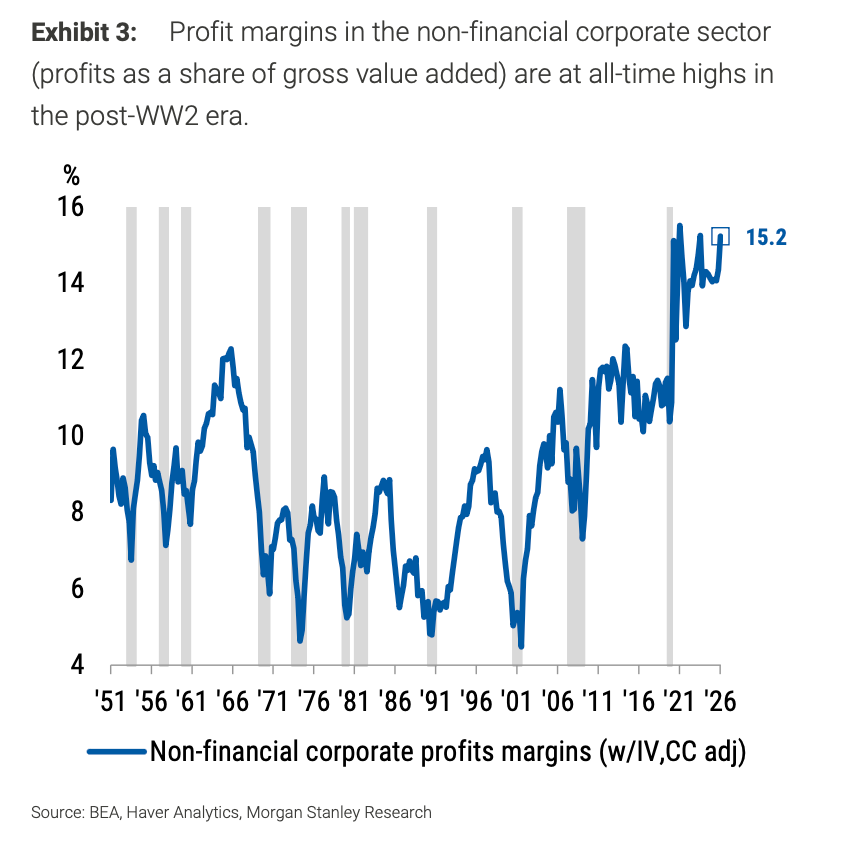
In a separate report on second-quarter 2026 earnings, Morgan Stanley’s Michael Gapen found non-financial corporate profits jumped $400.9 billion in the quarter, pushing margins to 15.2% of gross value added—near post-World War II highs. The driver wasn’t an AI productivity miracle. It was pricing power: firms raised per-unit prices by 2.30 cents while labor and nonlabor costs barely moved, sending the entire increase straight to profit. “The dynamic looks difficult to sustain,” Gapen drily concluded.
The strangeness isn’t confined to profit margins. In a recent note to clients, David Kelly, chief global strategist at J.P. Morgan Asset Management, laid out a labor market that’s stopped following its old rules. Payroll growth has slowed to roughly half its pre-pandemic pace even as GDP growth has barely moved. Unemployment sits at an 18-month low of 4.1% not because hiring is strong but because millions have quietly left the labor force—driven, Kelly finds, by an aging population and, among older workers, by stock gains that let those “who weren’t financially able to retire” finally do so.
Wage growth, meanwhile, has slowed to its weakest pace since May 2021, despite record profits and a supposedly tight labor market—held down, Kelly notes, by workers who don’t feel the market is as tight as the statistics claim, and by a private-sector unionization rate under 7%. “While unemployment is relatively low,” he wrote, “so is hiring, so workers may be finding it unusually hard to move to another job that will pay them more.”
The public appears to know what’s going on
While economists spent two years building models, most Americans seem to have reached a verdict already—not about AI in the abstract, but about the class system at work in the economy. Data centers, the most visible physical piece of the AI boom, have become the flashpoint. A Gallup poll in May found seven in 10 Americans oppose a data center in their own area. A Politico poll in July found just 16% think data centers benefit their local area and the country; about 60% said the projects cost more than they give back. The same poll found belief that data centers raise electricity bills jumped from 43% in January to nearly 60% by July—six months before Apollo or Morgan Stanley published a word of this research.
That’s the same asymmetry the economic data would later quantify, arrived at through a utility bill rather than a regression: costs that are local and immediate, gains that land somewhere else, with someone else. Public Citizen found six in 10 Americans distrust AI to some degree, and nearly three-quarters want the government to act on AI-driven job losses. Pew found 57% think AI’s risks outweigh its benefits.
The anger has become organized and bipartisan. Data Center Watch counted 75 local projects worth $130 billion blocked or delayed by citizen opposition in the first three months of 2026 alone, matching all of 2025 in a single quarter. New York signed the country’s first statewide moratorium on large data centers in July. By August, Democratic candidates in Michigan, Wisconsin, and Pennsylvania were running ads against data centers directly, and Republicans have begun quietly distancing themselves from the same policies many once championed.
A warning against overreading the occupation
None of this means AI’s effects are fully predictable from a worker’s job title. A St. Louis Fed working paper—cited in Apollo’s literature review as the study that “directly motivated the approach” behind its research—complicates the picture by looking at which tasks workers actually use AI for.
Using a survey of nearly 14,000 workers, Fed researchers Alexander Bick, Adam Blandin, David Deming, and Tyler Schumacher measured which tasks people actually use AI for, not which tasks a model predicts they could. Their occupational exposure scores explain only about half the real variation in adoption. Medical secretaries—high-exposure by conventional scoring—use AI at just 16.8%, far below a predicted 61%, because privacy rules and error costs make them cautious. Computer repairers, special education teachers, and laundry workers adopt at roughly double their predicted rates, finding uses the models never anticipated.
The researchers’ larger point: what predicts an individual’s AI adoption has little to do with age, education, or occupation, and much to do with whether that person has already spent time experimenting with the tool. Adoption has a genuinely unpredictable, almost democratic layer that class-based frameworks miss.
The promise of AI was liberation from the old order: credentialism, seniority, capital ownership, bargaining power. The evidence so far shows something else. The rules haven’t been broken. They’ve been rewarded.
For this story, Fortune journalists used generative AI as a research tool. An editor verified the accuracy of the information before publishing.
The post The betrayal behind the data-center backlash: AI promised to break the rules of class but is just rewarding them so far appeared first on Fortune.