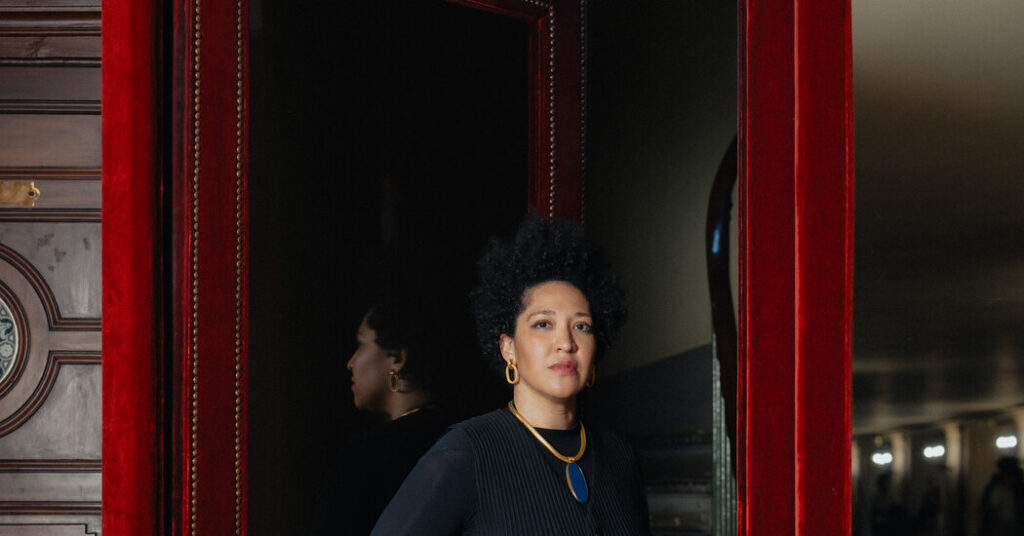
Looking out at a sea of empty red-velvet seats at the Paris Opera’s opulent Palais Garnier theater, the American composer and performer Tyshawn Sorey was pondering the upcoming premiere of his piece “Perle Noire: Meditations for Joséphine.”
“There’s a bit of anxiety in the air for me with this,” Sorey said, “because the audience in France, while they are very much knowledgeable about Josephine Baker — I mean, this is literally her home — they have a different relationship to her than those in the States.”
The Missouri-born Baker is mostly known in her native country as a sensual, charismatic Jazz Age diva. She also seen that way in France, where she moved in the mid-1920s and eventually became a citizen — but she is also famous here for her activities in the Resistance during World War II and her antiracist activism. In 2021, almost half a century after her death, she became the first Black woman to be inducted into the Panthéon, the Paris monument where France’s national heroes are honored.
Baker’s extraordinary life, filled with successes and hardships, could fill several biographical shows or greatest-hits cabarets. “Perle Noire,” which opens the Paris Opera’s season at the Palais Garnier on Wednesday and runs through Sept. 19, is not one of them.
Created in collaboration with the soprano Julia Bullock and the director Peter Sellars, with spoken texts by the poet Claudia Rankine, the piece debuted at the 2016 Ojai Music Festival, in California, as “Josephine Baker: A Portrait.” Tellingly, the title was changed fairly quickly to the current one, which better reflects an impressionistic, experimental approach that Zachary Woolfe described in a New York Times review of the Ojai performance as “a landscape of glacial melancholy, shot through with glinting fragments.”
In Sorey’s doctoral dissertation, which was about “Perle Noire,” he wrote that the piece “deliberately reimagines and deconstructs essentialized, simplistic views of Baker.” This might be misinterpreted as implying a detached, analytical bent, but while the music has an exacting precision, it also has a haunted, aching emotion that was evident at a recent rehearsal, despite the stop-and-go pace.
The piece is especially personal to Bullock, who shares a hometown, St. Louis, with Baker. Bullock said it was during her undergraduate years at the Eastman School of Music that she began looking behind Baker’s facade and researching a life that also included civil rights advocacy and a “rainbow tribe” of adopted children. Eventually, Bullock featured a selection of Baker songs in her New York recital debut in 2014.
“That program utilized some tunes Josephine Baker sang to talk about objectification, exoticism, demoralization, hypersexuality — of Black women in particular,” Bullock said, which led into classical repertoire dealing with similar subject matter, “then civil rights songs and spirituals.”
Sellars heard about the recital and suggested that Bullock develop a stage work about Baker for the Ojai festival. The director enrolled Rankine “to create a space that was not a tight, narrow show-business revue, but something that just feels spacious and at the same time precise,” he said.
Rankine declined at first, but, like Bullock, she read up and became interested in Baker, including the way the singer handled her image as a Black performer. “She knew what she was doing,” Rankine said. “She wasn’t blind to who she was constructing as a public persona.”
Bullock worked with Sorey, the composer, to select the numbers. A particularly striking one is “Si J’Étais Blanche” (“If I Were White”), which Bullock had sung at the 2014 recital in a manner close to Baker’s. The version in “Perle Noire,” like the rest of the show, is much slower.
“Those lyrics are really the crucial point for me,” Sorey said. “That’s what drew me to take that approach and get the audience to not only really hear every word, but to also hear how the music and the lyrics can support each other.”
A sense of mutability was baked into “Perle Noire” (which heads to the Barbican in London on Oct. 20) from the start. In a 2016 interview, Sorey described it as “a living project.” At the Palais Garnier rehearsal, the company, which includes five members from the International Contemporary Ensemble plus Bullock, and Sorey on piano and percussion, closely watched one another as they worked through sections that require improvisation.
Bullock tends to sing fully notated music (she did “Carmen” in Minnesota last month, for example), but she seemed to thrive on the mutating nature of “Perle Noire.”
“I’m sometimes surprised,” she said. “I’m like, ‘Oh, I wasn’t expecting that to be a full scream, but maybe in this one performance, that is exactly what that phrase must be. And maybe tomorrow night it’ll be whispered.’”
For Sorey, “the music is always changing, because the way I look at it is: Every experience we have to offer is designed for the audience for whom we’re preparing it,” he said.
Which brings us back to “Perle Noire” at the Paris Opera. The company’s director, Alexander Neef, saw the piece at the Dutch National Opera in 2023, and immediately decided to book it. He put it at the Palais Garnier for logistical reasons (the Paris Opera’s other venue, the Bastille Opera, is bigger, less intimate), but also because the older house’s history creates a connection with Baker’s life and career, he said.
Neef also pointed out that the Palais Garnier’s artistic identity had been partly shaped by the avant-garde of Serge Diaghilev and his Ballets Russes in the early 20th century. “It works really well when you put something onstage that creates a contrast or a friction, a tension,” he said of staging “Perle Noir” at that house.
A measure of contrast has actually been incorporated into the building itself since 1964, when the ceiling was adorned with a bright fresco by Marc Chagall that somehow complements the golds and reds of the 19th-century décor.
“It was so extraordinary walking out onto the stage before they had any of the set built,” Bullock said. She recalled finding the house a “really ornate and mildly oppressive environment,” she said, laughing. “But then you look up and see the Chagall painting, which uplifts you immediately.” She paused slightly. “Yeah, I think this piece is ready to be here.”
Perle Noire: Meditations for Joséphine Sept. 9 through 19 at the Palais Garnier in Paris; operadeparis.fr.
The post Reimagining Josephine Baker, on the Most Opulent Stage in Paris appeared first on New York Times.