Nearly two weeks have passed since a fierce deluge of ice, boulders and mud tore through a border complex in Tibet, but China has not released an official list of those missing. In the information void, people have found their own ways to seek help and vent their grief.
Internet users have compiled lists of the missing based on public contributions and posted them online. Others have sought information by leaving comments on social media posts by travel influencers in the area, in the hope that they might have seen their missing family members.
The floods killed more than 1,000 people on both sides of the Chinese-Nepalese border, most of them in Nepal, but the full toll in Tibet remains difficult to assess. China has said more than 500 people were missing in the border area of Gyirong in Tibet.
Across Chinese social media, many posts have taken the form of unanswered text messages, old family photos and simple appeals: Please come home.
In Tibet, China has tried to focus public attention on the government’s rescue efforts while minimizing coverage of the victims. Since the disaster on Aug. 26, the police have punished people for spreading false information about the landslide, while state media journalists and online influencers have been warned to hew closely to the official narrative.
Chinese state media outlets have highlighted the stories of some of the immigration officials and border police officers at the Chinese side of the border with Nepal who are missing. Those stories mainly praise the workers’ devotion and patriotic sacrifice on a harsh frontier.
Many of the messages posted by people on social media, by contrast, are intimate portraits of loss, showing the personal heartbreak and uncertainty that hundreds of families are now experiencing.
Feng Guanglong, 26, posted about his childhood friend who worked at the border. Mr. Feng keeps thinking about their last conversation earlier this year, before his friend, Yang Shizi, went missing during the flood. They had grown up together in a village in Yunnan Province where the two swam in rivers, caught fish and had each other’s backs in fights with other kids at school.
Their conversations were often perfunctory. “Knowing the other was safe was usually enough,” Mr. Feng said. They spoke earlier this year when Mr. Feng went back to their hometown.
“If I regret anything, it’s that I didn’t say more that time,” he said.
After the disaster struck, Mr. Feng tried to contact Mr. Yang, but his calls went unanswered. Later, he saw his friend’s name on an unofficial list of missing people that was circulating online.
He knows that there is little hope his friend could have survived, but he cannot let go until there is confirmation of his death. He said that Mr. Yang’s two brothers and an uncle traveled to Tibet to wait for news. Mr. Feng hopes that if the remains are not found, that at least Mr. Yang’s belongings will be located and will give the family some closure.
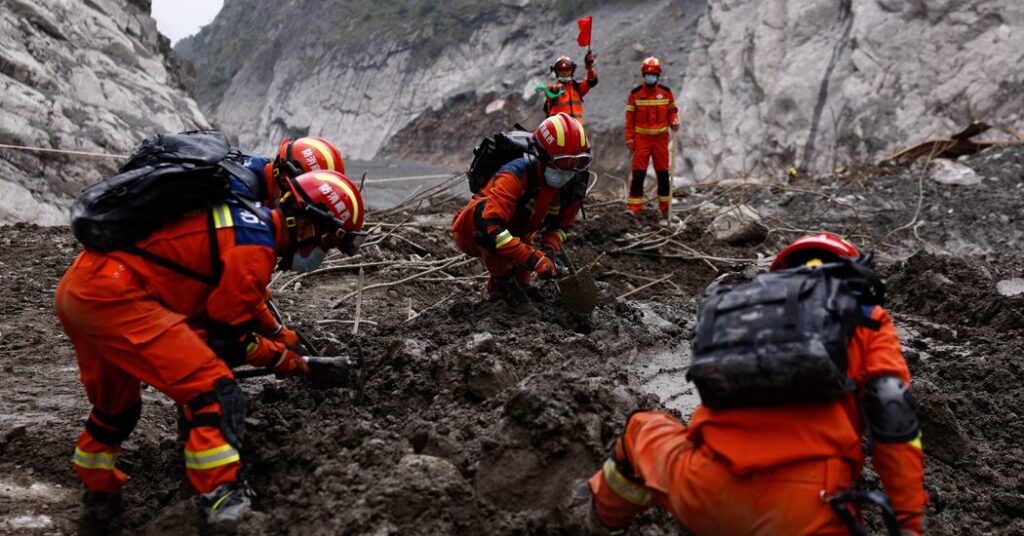
Chinese government updates on the death toll have been limited, in part because of how difficult the rescue work has been. It took Chinese emergency workers more than two days to reach the devastated border crossing, which was covered in more than five feet of thick mud.
On Sunday, officials in Tibet said that 43 people had been killed while 519 were still missing. During a state-guided tour for a selected group of foreign reporters, Pu Weidong, a senior police official in Tibet, said that specialists were still identifying the bodies pulled from the site using fingerprints and other genetic data. (The New York Times was not invited on the tour.)
In response to questions about the slow release of information and online censorship of videos of the landslide, Chinese officials have said that their release of information has been “public, transparent and timely.”
One reason the government tightly controls information is its fear of the power of collective grief, according to Yaqiu Wang, a human rights researcher and a fellow at the University of Pennsylvania. “If families learn about one another’s experiences, private grief can become a shared grievance and eventually a collective demand for truth and accountability,” she said.
The posts seeking information have become a roll call of the missing border workers. Many feature pictures of young men and women in uniform standing proudly in front of the same immigration gate whose total devastation was later caught on camera. The posts often include a brief history of how those people came to work at the border, their plans for the future, plus photos of the children, partners and other family waiting at home.
One woman searching for her husband, who was near the border, found a clue in a news report. She posted a screenshot of footage showing unopened packages that belonged to missing border workers in Gyirong County. She had spotted a box that she recognized as diapers her husband had bought for their daughter. It sent her into a state of panic. “It hurts so much I can barely breathe,” she wrote. “Please let us find you, hubby. I’m begging you.”
Other messages described going to Tibet to search for the missing. A man had been posting about his daughter, a young police officer named Wen Yan who worked at the border. Under a caption of a family photo, he listed all the family members who were waiting for her to come home. “You are the pride of our family,” he wrote.
On Friday, he posted an update that he and his wife were on their way to Gyirong. “Daughter, your mother and I are coming to see you,” he said.
Many of the messages were expressions of heartbreak.
A person who describes himself as a 38-year-old man based in Tibet posted a screenshot of a chat window with messages sent to his wife from their daughter on the day of the flood. “When you get connected to the internet, please call Dad. He’s really worried about you,” she wrote.
She followed that with another text that they would wait for her call tomorrow. “I’m sure you are fine,” she added.
The next day, the messages grew more panicked. “Mama, please get home quickly.” Finally, she sent the same text, four times in a row: “Mama, I miss you.”
There was no response.
The post ‘Mama, I Miss You’: Relatives Go Online to Grieve Tibet’s Flood Victims. appeared first on New York Times.