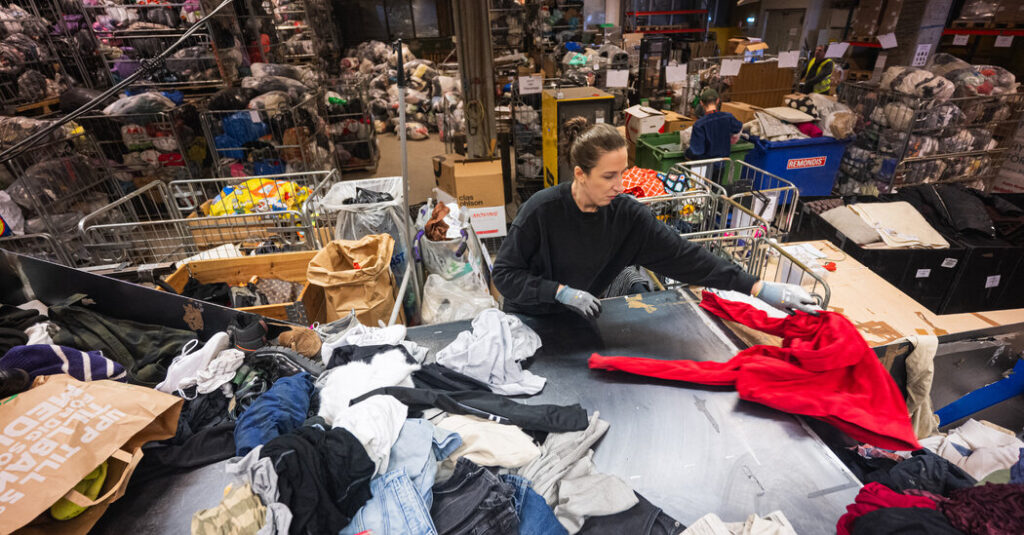
California is trying to become the first state to make fashion brands, manufacturers and retailers pick up the tab for textile waste, and the details of the plan are taking shape now.
If it works, the transformation could be enormous: California residents discarded nearly 1.2 million tons of textiles in 2021 alone, according to a report from the recycling company USAgain. Worldwide, about 120 million metric tons of clothing are discarded every year, research by Boston Consulting Group has found.
“The vast majority of textile waste is landfilled,” said Sheng Lu, a professor of fashion and apparel studies at the University of Delaware. “There’s no solution.”
Currently, consumers and local municipalities pay for managing all that waste. But under a state law adopted in 2024, the Responsible Textile Recovery Act, that’s supposed to change. By 2030, businesses will be legally responsible for the cost of collecting, sorting, repairing and recycling used clothing and household textiles.
Here’s what to know about the idea, the implementation and what it all means:
The quick breakdown
A single, state-approved nonprofit group called Landbell will collect fees from apparel manufacturers, importers and retailers and then use the funds to build recycling and other infrastructure for the program.
The details
The system is supposed to have simple collection mechanisms for clothes, including mail-back programs, drop-off kiosks and thrift-store participation.
Today, keeping clothing out of local landfills usually means exporting it to become waste somewhere else. The goal of the new system is to tackle the waste problem by supporting the development of textile-to-textile recycling (not just downcycling, like shredding old clothes into stuffing) and by incentivizing repair and other services to keep clothing in use longer.
In theory, the new law will also encourage brands to produce more durable and sustainable clothes from the start, because fees will be lower for clothes designed to be easily repaired and for clothes made from recycled materials. Fees will be higher for clothes that are difficult to recycle, like those made of blended fibers or that contain toxic chemicals.
That’s a key point because, if the new network successfully increases repair and recycling, those services will need markets to feed.
“Until there is a market for those materials, it’s just collecting and sorting products with nowhere to go,” said Rachel Kibbe, the founder and chief executive of American Circular Textiles, a policy advocacy coalition. “If you create a product and no one’s buying it, how long is the product going to be useful?”
What are the big challenges?
If it’s successful, the program will fundamentally alter how discarded clothes are managed. But it’s ambitious: The infrastructure for managing castoff clothes in the state, and across the country, doesn’t just need strengthening. Much of what’s needed, like recycling systems and repair services at scale, doesn’t exist at all.
Some of the technical details are also tricky. The law says the system should prioritize reuse and repair over recycling. But does it count as a repair if a sloppy job makes the garment so unattractive that nobody would wear it?
Foreign companies and online marketplaces present challenges, too.
For example, CalRecycle, the state agency that will oversee the system, can’t impose fines on companies in other countries. But noncompliant brands could be barred for selling in California.
Building a system to reshape how clothes are handled is a complex prospect. Fashion brands probably won’t want to pay high fees. In Europe, for instance, where legislation includes a similar framework for producer accountability, fast-fashion brands have protested higher fees for inexpensive materials like polyester.
Compliance deadlines written into the California bill were extended after apparel industry trade groups voiced concerns. That said, California has had some success with similar programs for other industries, including mattresses and paint.
Has this been tried before?
Yes. A similar law in France, which passed in 2008, increased the collection of clothing. But with a fee that was often less than five cents per garment, the program didn’t have the resources to build adequate systems for managing those collected castoffs. The result was an increase in exports of clothes to lower-income countries.
So, a lot depends on how well-funded the program will be.
Where are we now?
The law requires the system, called an extended producer responsibility program, to be put in place. But it doesn’t specify the program’s design. That’s what Landbell, selected by the state through a competitive application process, is now supposed to do. As of July 1, apparel producers were required to register with Landbell and to pay an initial flat fee.
The next step is a needs assessment, due next March. The results will help plan for what services are needed, where they should be located, what the fee structure will look like and who is included in the distribution of those fees. By July 2028, CalRecycle is supposed to adopt formal implementing regulations, with a full program rollout, including annual reporting and enforcement of noncompliance penalties, by July 2030.
“There’s this promise that we can reuse and refill and repair a lot more,” Kibbe said. That’s mostly theoretical at this point, she said, because it conflicts with the current model of selling and buying clothes that are easier and cheaper to replace than to repair.
But if California can pull off a successful program, it could help shift the economics.
“We will start to see not just our sector, but other sectors, change their business models fundamentally, from linear manufacturing to manufacturing that takes account for its end of life, and uses those materials over and over,” Kibbe said.
Join us at Climate Forward Live
If you’re in New York City, join us at Climate Forward Live on Wednesday, Sept. 23. Journalists from across the newsroom will interview government leaders, business executives and activists. You can apply to attend here.
Why states are cutting back on their climate goals
After President Trump pulled the United States out of the Paris climate agreement during his first term, many Democratic-led states passed their own laws to curtail carbon emissions.
But most states that set goals for 2030 are not on track to meet them. Now, with voters worried about inflation, and with the war in Iran raising energy prices, some states have begun to cut back or abandon those goals instead. — Francesca Paris and Ben Blatt
More from the web
-
The United States built more grid batteries in the past quarter than ever before, according to Canary Media.
-
A tropical mosquito that can transmit dengue, chikungunya and the Zika virus has been found breeding in London, The Guardian reports.
Read past editions of the newsletter here.
If you’re enjoying what you’re reading, please consider recommending it to others. They can sign up here.
Follow The New York Times on Instagram, Threads, Facebook and TikTok at @nytimes.
Reach us at [email protected]. We read every message, and reply to many!
The post California’s Ambitious Plan for Textile Waste appeared first on New York Times.