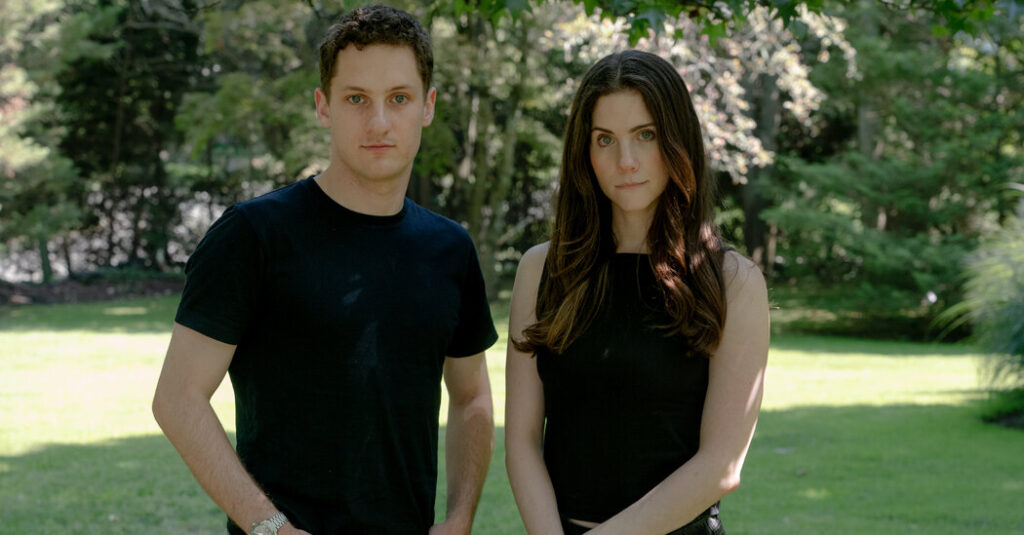
Jacob Fortinsky and his twin sister, Sarah, were a month away from turning 4 when the first jetliner slammed into the World Trade Center 25 years ago. They had been watching Franklin the Turtle cartoons in their apartment one block west, on the 21st floor of Gateway Plaza. As fire trucks and ambulances gathered below, the twins began to count them.
When the south tower collapsed that morning, Sept. 11, 2001, the windows of their apartment blew in. Dust and debris filled their home, bringing darkness. Sarah thought a monster had come for them.
Their mother and nanny carried them and their 2-year-old sister into a stairwell frantic with fleeing neighbors, then down to a basement boiler room. Someone distributed strips of wet fabric, with instructions to breathe through it as a filter.
These are Mr. Fortinsky’s very first memories: the fire engines in the street, the dust cloud, the panic in the stairwell, showing his sisters how to use the wet cloth. When they eventually emerged from the building, they were barefoot. The ground felt soft, covered in powdery ash. They boarded a boat to New Jersey. At a cousin’s home, the children took bath after bath until the water was no longer murky with the gray dust that had clung to them.
“I don’t remember anything before,” Mr. Fortinsky, now 28, said.
It has been impossible to forget. In the months after the attack, he was anxious that other tall buildings would collapse. And there was a fear of fire. He would shrink from even the Shabbat candles his family lit on Friday nights.
In the years that followed, his mother was diagnosed with breast cancer, and he developed asthma, ailments that they believe are linked to the World Trade Center dust, which was full of toxins. Once, after playing soccer in the cold, he had such difficulty catching his breath that his friends worried he was dying. “It’s hard to know with 100 percent certainty if it’s from 9/11, but it obviously took a toll on my body,” Mr. Fortinsky said.
Growing up, he worried he might someday get lung cancer. “I’d wonder what the equivalent number of cigarettes is — you know, in terms of what I inhaled that day,” he said.
Those fears subsided long ago, and he hasn’t had an asthma attack in years. But many researchers share his questions about how that day so early in his life could affect his long-term health.
Research into the toxic exposures from the attack initially focused on firefighters, police officers and other emergency responders who toiled at ground zero, searching for survivors and human remains, and sifting through rubble. An alarming number have fallen ill with respiratory ailments and cancer.
Researchers expanded their focus to the health effects on nearby residents and workers — including the survivors from buildings that were destroyed or damaged. But children who were nearby have received less attention and have proved harder to study. Researchers estimate that about 25,000 children lived or attended school near the World Trade Center.
Mr. Fortinsky and his sisters are among the youngest of the generation of children who witnessed Sept. 11 or were exposed to the dust cloud. Others are entering middle age.
The toxic exposures did not end that day: The pile where the towers once stood smoldered for months. The dust and smoke deposited toxins into homes and schools. The dust lingered on carpets where toddlers crawled and in the ducts of air-conditioning systems.
Now, 25 years later, the federally funded World Trade Center Health Program is endeavoring to track down exposed children and enroll them in a large research cohort. Congress ordered the project in 2022, and it is inching forward: The federal government recently began searching for research partners.
Scientists who have been studying the health effects of the dust exposure welcome the federal effort but say it is overdue.
“I would say it’s a tad late,” said Dr. Leonardo Trasande, a medical researcher at NYU Langone Health. “That might be a nice way to put it.”
Studies of various sizes over the years have found that children who witnessed the attack or were exposed to the toxic dust have, by some measures, poorer health than their peers. They have been diagnosed with depression and asthma over the subsequent decades at higher rates.
Dr. Trasande’s studies found that children exposed to the dust had far higher levels of certain toxins in their blood more than a decade later, including dioxins, which are linked to cancer, and PFAS, commonly known as “forever chemicals.”
Other questions remain unanswered, including whether young people exposed to the dust get cancer at higher rates than others.
After Dana Nelson felt a lump in her breast in 2020, the cancer diagnosis at age 33 did not feel like random bad luck. “I had been waiting for the other shoe to drop,” she said.
On the morning of the attack, Ms. Nelson, then 14, and her father had taken the ferry from their home in Staten Island to Lower Manhattan together, their usual morning routine. She went to Stuyvesant High School and her father worked in an office building, each a few blocks from the World Trade Center.
The first plane struck while Ms. Nelson sat in English class. Another student, looking out the classroom’s windows, said she could see birds near the towers. They weren’t birds, but people jumping, Ms. Nelson realized.
The students left school and walked north. By then, one tower had fallen.
Stuyvesant reopened the next month. The pages of textbooks had an acrid smell, Ms. Nelson recalled. And dust was everywhere: in the upholstery of the auditorium seats, in the gray sludge that covered the streets.
Ms. Nelson was diagnosed with post-traumatic stress disorder and chronic sinus problems. Reports of other Stuyvesant students becoming sick with cancer have been in the news over the years.
In 2018, Ms. Nelson’s father was diagnosed with kidney cancer. Then came her breast cancer diagnosis. Ms. Nelson, a teacher in Brooklyn, believes both stem from Sept. 11.
The largest studies involving children have emerged from a long-running research effort by the New York City Health Department, which has been tracking the health of thousands of people near the towers who enrolled in a registry in 2003 and 2004. Of the original 71,000 enrollees, more than 3,000 were children.
Not all of them still answer the surveys.But Health Department researchers periodically check cancer registries and hospitalization records to see how the group is faring.
The Health Department has found that about 25 percent of children exposed to World Trade Center dust have been diagnosed with asthma, compared with 16 percent in the general population of the same age.
The Health Department’s research has found that people who experienced Sept. 11 as children were 50 percent more likely to have been diagnosed with depression than other New Yorkers of similar sociodemographic characteristics.
Witnessing such a traumatic event so young can shape people’s outlook. They may go through life with a sense of dread or view the world as a bleak place, said Dr. Rebecca Rosen, the mental health director of the World Trade Center health program at the city’s public hospital system.
Mr. Fortinsky, who founded a sports prediction market, said he grew up with a view that “the world is chaotic and is not necessarily predetermined.” He said his experience that day — watching his mother and babysitter protect him and his siblings and steer them to safety — probably nurtured in him a hopeful and optimistic streak. But that day also stoked fears.
When he began asking his parents whether the tall buildings on the street would fall over, they decided it was time for the family to move to Westchester County, north of New York City.
His sister Sarah was plagued by nightmares for years. “I would see that same monster” — the dust cloud — “tackling me to the ground as a kid,” recalled Sarah, a 28-year-old journalist. She dreaded bedtime and would insist her parents reassure her there would be no nightmares that night — a ritual that continued for years.
“I do think it shapes you into who you are to have that sort of experience so young,” she said.
The post 9/11’s Dust and Ash Coated Their Childhood. Is It Still Making Them Ill? appeared first on New York Times.