Sixteen years ago, Republicans in Wisconsin rode a national wave of discontent to wrest control of the legislature in Madison. Then they approved maps that locked in their power, even after Democrats took back nearly every statewide office.
This November, Democrats have a chance to do what seemed implausible a few short years ago: take control of the State Assembly and Senate while holding onto the governor’s mansion.
“I sincerely think this is the most important election that Wisconsin has ever seen,” said Dianne Hesselbein, the Democratic minority leader in the State Senate.
That is a well-worn, election-year trope but one the Democrats in Wisconsin may well believe. With a trifecta, Democrats would pivot away from a rightward shift defined by tax cuts, neutered labor unions and voter restrictions. It would also empower them to redraw a congressional map for 2028 to counter Republican gerrymandering threats throughout the South.
The reversal of fortune comes courtesy of a 2023 ruling by Wisconsin’s newly liberal State Supreme Court, which concluded that the Republicans’ legislative maps were unconstitutional and forced their replacement. In 2018, for instance, Democratic Assembly candidates won 53 percent of the vote across the state, but claimed only 36 of 99 seats.
Those maps made Wisconsin a case study in undemocratic gerrymandering. But after Republicans begrudgingly accepted maps proposed by Gov. Tony Evers, a Democrat, resurgent Democrats parlayed intense field organizing into big gains in 2024 — leaving them two seats shy of a State Senate majority, and five in the House.
Now, after the democratic socialist candidate Francesca Hong was defeated last month in the Democratic primary for governor, Democrats believe they can finish the job.
Robin Vos, the Republican speaker of the State Assembly whose power was once immense and who now plans to retire at year’s end, said 2026 always loomed as a challenging midterm election. President Trump is “a drag,” Mr. Vos said, adding that “some of the ways that he operates, not the policies per se, turn people off.”
Democrats hope to undo much of Mr. Vos’s legislative work.
“We’re just going to be passing bills that the residents want us to pass,” Ms. Hesselbein promised, citing affordability, health care and education.
Then, alluding to the divisive push in 2011 by the Republican former governor, Scott Walker, to strip public union bargaining rights, Ms. Hesselbein added: “We’re not going to be doing anything that’s going to bring 100,000 people protesting at the Capitol.”
If Democrats repeal that anti-collective bargaining act, hike school funding and create new entitlements, Mr. Vos warned, Wisconsin may go back to the discontent of 2009 and 2010 and multibillion-dollar deficits.
“I don’t think you can raise taxes enough to fund that,” he said.
Madison will look different next year regardless. For the first time ever, Wisconsin’s executive and legislative brass — Governor Evers, Mr. Vos, and Devin LeMahieu, the Senate majority leader — are retiring simultaneously.
In the governor’s primary in August, Mr. Evers helped David Crowley, the Milwaukee County executive, topple Ms. Hong, a state representative from Madison. Mr. Crowley now leads U.S. Representative Tom Tiffany, a staunch conservative, in the race to succeed Mr. Evers, according to a recent Marquette Law School poll.
Democrats are favored in generic polling for the legislature, where Republicans have a 54-to-45 advantage in the Assembly, and 18-to-15 in the Senate, according to the Marquette poll. But Republicans have a 2-to-1 financial advantage with $43 million raised, campaign finance reports show.
Three of the most competitive Assembly races are nestled within the Third Congressional District in western Wisconsin.
In the congressional race, Rebecca Cooke, a Democrat and a waitress with farm-country bona fides, is challenging U.S. Representative Derrick Van Orden, a fiery Trump loyalist, in a race that could prove pivotal to control of the U.S. House.
In La Crosse, Wis., Republicans are on offense, determined to unseat State Representative Steve Doyle, a 68-year-old lawyer who raises alpacas. Two years ago, he was Wisconsin’s only Democratic legislator to win a district carried by Mr. Trump.
Mr. Doyle was braced for attack ads tying him to Ms. Hong — “that would have been the thing I heard about the whole campaign,” he said. Instead, Mr. Doyle has hewed to a familiar routine, handing out pocket-size sports schedules — Packers, Badgers, NASCAR and hunting — touting a bipartisan record on taxes, health care and veterans issues, and talking up his website, MrBipartisan.com.
“Just an honest guy that is for normal people,” Linda Shiftar, a retired pharmacy technician, said of Mr. Doyle after he knocked on her door in Holmen, Wis.
Mr. Doyle’s opponent, Keith Purnell, a 63-year-old Army veteran, declined to be interviewed. But Mr. Vos, the longest-serving speaker in state history, said Republicans had recruited pragmatic center-right candidates.
“There’s nobody in Wisconsin that I think is yearning for a hard turn left or right,” he said.
Perhaps the most high-profile State Senate matchup is in the sprawling 17th District in the southwestern Driftless region, stretching from the Mississippi River bluffs to undulating cornfields just outside Madison. The current occupant, Howard Marklein, is co-chair of the powerful Joint Finance Committee.
His Democratic opponent, State Representative Jenna Jacobson, is a former financial analyst who criticizes Mr. Marklein and Republican leaders for failing to renew funding for outdoor recreation and land conservation projects.
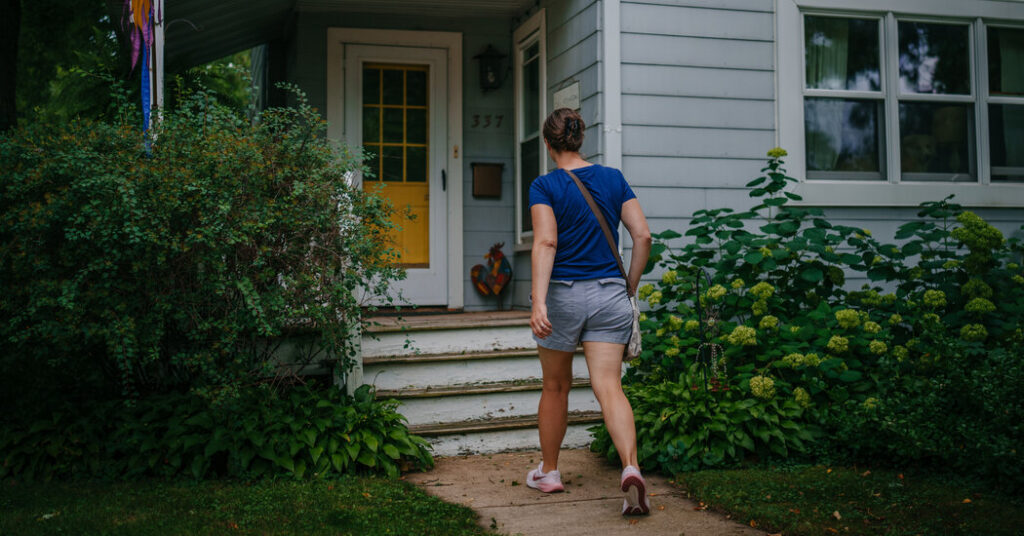
Canvassing in Oregon, Wis., her hometown, Ms. Jacobson, 44, listened to constituents worried about the cost of living, “stopping Trump” and data centers.
Ms. Jacobson sought to regulate data centers’ water use and shield ratepayers, but the bill died. If Democrats win, she told Sue Capelle, a retired educator, “we can actually do some things that we just haven’t had leadership do recently.”
“Wouldn’t that be great?” Ms. Capelle sighed.
Mr. Marklein, 71, is campaigning frantically, too, after cruising to victory by as much as 20 points under the old maps. In Wiota and Monroe, Wis., he distributed a flier that repeated the word “rural” eight times.
Steve and Ron Buholzer, whose family has owned the Klondike Cheese Factory for generations, credited Mr. Marklein for easing regulations and improving rural roads for their trucks.
“Howard’s been a huge advocate,” Steve Buholzer said.
Mr. Marklein, a former accountant who grew up on a dairy farm in Spring Green — home to Frank Lloyd Wright’s Wisconsin refuge Taliesin — doesn’t always get his way. His proposal this year to spend the state’s surplus was torpedoed by Senate Democrats and conservative Republicans over structural deficit concerns. His proposal had been backed by Governor Evers, Ms. Jacobson and Mr. Doyle, all Democrats.
“You tell me I’m not bipartisan,” he said.
The surplus is now at $3 billion, and Mr. Marklein said he worried about Democratic control.
“I think it’s frightening,” he said after cooking steaks at an annual event supporting beef producers. “The fear that several people have is that we’ll become Minnesota.”
To Wisconsin Republicans, Democratic Minnesota is nothing to emulate, and not just because of the Vikings.
The post With a Gerrymander Vanquished, Wisconsin Democrats Aim for Control appeared first on New York Times.