More than 100 million people in the United States today were not alive on the morning the twin towers fell. Millions more were just learning to walk or starting preschool that day.
For them, Sept. 11 exists only in other people’s telling. And if the adults in their lives can vividly recall the way life halted at 8:46 a.m., interviews with nearly three dozen teenagers and adults under 26 revealed a far less singular experience of growing up in the years that followed.
There were 20-year-olds whose worldview was shaped by scenes of death and rubble in Iraq, Iran and Afghanistan. Teenagers who struggled to see Sept. 11 as monumental having grown up amid mass shootings and a pandemic that killed more than 1.2 million Americans.
And college students — from Lower Manhattan to 2,500 miles from ground zero — who described a profound heartache at the scale and breadth of loss that day, even without their own connection it.
Annika Heegaard, 25, has lived her life in the shadow of the attacks. To her, the day feels like something foggy, but looming; always there, but just out of reach.
Trying to connect to Sept. 11, has become something of an obsession for Ms. Heegaard, who now lives on the Upper West Side of Manhattan and considers her identity as a New Yorker a defining characteristic.
Every September, she immerses herself in whatever primary sources she can find: a shaky video of the first plane careening into the steel building. A list of companies headquartered at 1 World Trade. Testimony from emergency workers. Building floor plans. Photographs. Obituaries.
“I can wrap my head around it,” Ms. Heegaard said. “But it doesn’t entirely make sense.”
A Fading Story
Today, history teachers in their first year at a middle school might have learned about Sept. 11 as history themselves.
The youngest candidates for Congress never knew airports without security lines.
And if students were taught about Sept. 11 at all, it was often a brief mention in the fall.
So many of them learned outside the classroom: in stories from their siblings and Twitch streamers, podcasts, the Broadway musical “Come From Away,” Instagram memes and photographs of relatives posing before mountains of rubble.
“It’s sort of like when someone you love has someone they love die. Their grief, you just feel it, and you want to support them and you want to be there for them. But at the same time, you didn’t lose somebody.”
Julie Frey, 26, who splits her time between New York City and New Haven while she pursues a joint degree in law and environmental management
Julie Frey, 26, whose father was a New York police officer on Sept. 11, often wondered what that day had been like for him. But her father, who retired from the force in 2011 and later served in the Navy, refused to talk about it. She remembers him taking a trip every September to avoid the anniversary and the memories that accompany it.
“He doesn’t want to even be reminded of it in any type of capacity,” Ms. Frey said.
She has struggled to understand her parents’ feelings about the attacks.
JD Moussally, a 14-year-old from Flushing, Queens, said hearing about Sept. 11 felt like taking in decades-old sports highlights.
His father talks about classic Knicks, Mets and Rangers games like they happened yesterday — recalling the players, the scores, the emotions of everyone he watched alongside. “I can look up the stats,” Mr. Moussally said. “But that is not the same as remembering the game.”
“Grown-ups remember a skyline I’ve never seen in real life. Sometimes, I think they still see what is missing, even when the rest of us just see what is there.”
JD Moussally, 14, a student at St. Francis Preparatory School who lives in the Queens neighborhood of Flushing
For others, the holes in their generation’s memory became more apparent as they grew older.
Elizabeth Cavanagh, 20, a student who was raised on Long Island’s South Shore and whose mother worked at the World Trade Center in 1993 when a van bomb exploded, recalled reciting the Hail Mary with her Catholic school classmates throughout every Sept. 11 anniversary.
But when she went to college at the University of Pittsburgh, only an hour and a half from where Flight 93 had crashed, the anniversary passed unceremoniously.
She wondered: What about the strangers who comforted each other on the streets? What about the firefighters and police officers who risked their lives?
“It’s a story of New York that you see in so many different ways — and that we’re losing over time,” Ms. Cavanagh said.
She and others lamented that the only account they have heard of their country coming together was during one of its worst tragedies — and before they were even born. Today, many said, the country is too divided and our politics too fractured.
“We lost something that day that can’t be measured,” said Joseph Smith, 22, who lives in Northern Virginia and whose older sister joined the Marines after Sept. 11. He believes the attacks made Americans more distrustful and divided.
“We as a country didn’t heal — and we still haven’t healed — from all the things that have happened since 2000.”
Childhood Amid a National Tragedy
Young people across the country have watched their parents and teachers turn stony and quiet year after year on Sept. 11. Still, for them, the day feels more like a chapter of history than a part of their lives, the way they imagine Pearl Harbor or the Vietnam War must have felt for the generations before them.
Life, they said, has been defined by more recent chapters, like Donald Trump’s presidency or the Hamas attack on Oct. 7, along with the tragedies pinging incessantly on their phones, on social media and on the news.
“I honestly feel like a lot of people my age may have just kind of gotten numb to seeing horrible things in the news,” said MK Peters, 23, who lives in Milwaukee.
She described how active shooter drills became a normalized part of school days, and how a global pandemic interrupted her teenage years — and forced her and her friends into extended lockdown.
Jessica Hall, 25, who lives in St. Paul, and whose college years were sundered by the coronavirus pandemic, doesn’t remember Sept. 11. But she knows where she was when 20 first graders and six adults were killed in Sandy Hook, Conn. — and when 14 high school students and three staff members were gunned down in Parkland, Fla.
“That was all a defining thing for me more than 9/11,” she said.
For some young adults, however, Sept. 11 evokes something deeply personal, and painful.
Mai Quddus, 23, lives near Princeton, N.J. and said her father stopped using his given name, Mohammed, amid a rise in Islamophobia after the attacks. “I haven’t been able to feel that way because of the way others made us feel,” she said.
Loulou Marmalade Toledano, 17, grew up on the Lower East Side of Manhattan, just over a mile from ground zero. But as the child of immigrant parents — her mother from the Philippines and her father from England — the fear and alienation that permeated immigrant communities after the attacks have shaped her own memories.
“My mom sort of understood that if it had been a different group that had hit the towers that day, then you know, that sort of oppression and alienation that came toward Arab Americans and also Muslim Americans could have easily been any other group,” Ms. Toledano said.
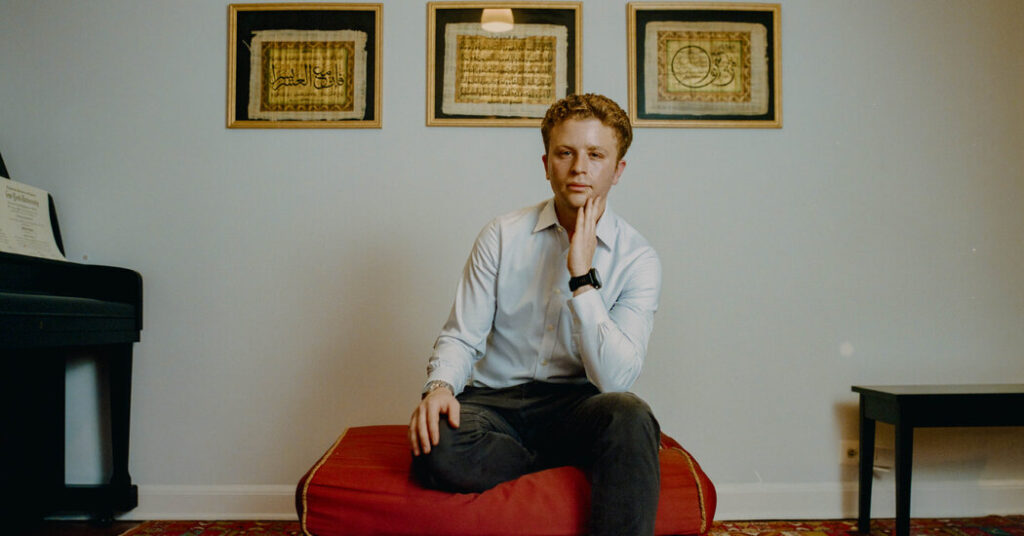
Khalid El-Halabi, 24, who was raised in a Muslim household in the Queens neighborhood of Jackson Heights, was a high school track athlete and often ran to the reflecting pools at the World Trade Center site.
“I would just always be hit by this concept of how many people have lost their lives,” he said. “If that day had not happened, maybe I could have been fully American.”
He was named after his great-grandfather, but his grade school classmates mocked him for sharing a first name with Khalid Shaikh Mohammed, the man accused of plotting the attacks. He was pulled for extra screening at U.S. airports starting at age 2.
And he said he spent his life in the city feeling “almost like a second-class citizen,” seeing the normalization of suspicion and hate against Muslims.
“Even 25 years later, is there really a future where my identity can be fully seen as a New Yorker? Or will it always be questioned?”
Khalid El-Halabi, 24, who grew up in Queens and works at a biotech company
He remains drawn to ground zero, a symbol of the potential to rebuild.
A Generation’s Disillusionment
Berkley Pelletier was ready to sign up for the army.
He was only a child, but listening to the phone calls of flight passengers on a trip to the memorial museum in New York moved him that deeply. And as he grew up in Ohio, he said the legacy of Sept. 11 was filtered through a lens of nationalism: “This horrible thing was done to us.”
Then in middle school, he dug deeper into history himself.
“I realized we were doing really horrible things to other people in the name of justice,” Mr. Pelletier, now 23 and working at an international trade consultancy in Washington, D.C., said.
Like Mr. Pelletier, many young adults said the 25th anniversary reminds them most of the country’s shortcomings.
Life after Sept. 11, to them, has brought a drumbeat of costly and damaging policies in which they, only newly of voting age, have had no voice. While facing a warming planet and rising housing costs, they look back and see trillions spent on war and counterterrorism efforts.
“Growing up, it felt understood that American imperialism was almost like a right.”
Liberty Wilson, 19, a first-year college student from Westchester County, N.Y.
Liberty Wilson, 19, shared much of her worldview with her mother, who was working in Lower Manhattan when the towers collapsed. But as a teenager, Ms. Wilson learned online about covert C.I.A. operations in the Middle East before Sept. 11 and re-evaluated the country’s entire history of intervention.
Ms. Wilson said her mother believes fighting back against terrorism remains urgent. To Ms. Wilson, the takeaway is more complicated.
“It’s important to always carry the memory,” she said. “But there are also greater lessons to take away from it: We were the cause of so much destruction and instability.”
For Aiden Burrus, 18, who grew up in Connecticut, that tension is top of mind.
Mr. Burrus just started college at George Washington University in Washington, three miles from where Flight 77 hit the Pentagon. As the 25th anniversary approaches, he said he feels called to mourn. For what exactly, though, he isn’t sure.
“I remember the people who’ve passed away. I remember the consequences afterward and everyone else that died because of 9/11,” Mr. Burrus said. “We cannot forget this. I know that I cannot forget this.”
He paused for several seconds.
“But I don’t entirely know what that even means because I wasn’t there. I don’t remember it to begin with.”
The post Sept. 11 Shaped Their Lives, but They Don’t Remember It. appeared first on New York Times.