When the screen devours the world, when generative texts and images fill our eyes and clog our ears, a great work of art delivers a summons: look again, look harder, look past the surface, look to the substance.
“What is real is not the external form but the essence of things,” said Constantin Brancusi. His search for a truth beyond representation has taken on new force in our time of prompt-based deception. “Brancusi: The Artist and His Studio,” opening Oct. 25, will fill the galleries of the Museum of Modern Art with the Romanian sculptor’s metamorphoses of lovers and animals into polished bronzes and chiseled limestone. The old conventions get sanded down, pared away. Illusions give way to the fundamentals: shape, line, mass, balance.
Brancusi had a revolutionary approach to sculpture called taille directe: Rather than first making a model and then having assistants produce a cast, from his crowded Paris studio he took his chisel and mallet directly to his final materials. The atelier’s contents now belong to the Centre Pompidou — but with that museum currently closed for renovations, New Yorkers have their first chance in decades to discover the Brancusi studio alongside MoMA’s own rich holdings. The “Bird in Space” of tapering bronze, the “Fish” distilled to flat glaucous marble: These aren’t representations of the visible world, which any old app can quickly generate, but new forms that reveal what we cannot see. “It is impossible for anyone to express anything essentially real,” as Brancusi told us, “by imitating its exterior surface.”
More than 400 years before Brancusi, artists in central Italy took a different but no less direct path to truth in material, by reinventing the classical bronze as an expression of a new humanism. “Siena: The Art of Bronze, 1450—1500,” opening at the Frick Collection on Oct. 15, brings together more than three dozen examples — religious or secular, left rough-hewn or polished to gleam — of sculpture that revived, and then surpassed, the monuments and medals of their Roman forebears. More European magnificence will be on offer up the road, at the Metropolitan Museum of Art, where “A King’s Carpet: Louis XIV and the Savonnerie” (from Sept. 8) will fill the plush Wrightsman Galleries for French Decorative Arts with segments of the largest carpet ever woven, jam-packed with flowers and fleurs-de-lis.
Tuscany in the Renaissance, Paris under the Sun King. … Is there anywhere, on our interconnected globe, with the same teeming artistic invention? If the 21st century has a cultural capital, it can only be Seoul — and this fall, American museums are overflowing with Korean art of both new and traditional media. Among them: the sublimely spare paintings of Ha Chong-hyun, at the Asian Art Museum in San Francisco (from Sept. 25); a nonlinear intervention from Koo Jeong-a, one of the most perplexing and poetic of contemporary artists, at the Aspen Art Museum (from Dec. 11); and a major new commission from Haegue Yang, incorporating who knows how many customized venetian blinds, that will span both levels of Dia Beacon in the Hudson Valley (from Oct. 10).
The epicenter of the K-craze will be the San Francisco Museum of Modern Art: “RM x SFMOMA: Between You and Me,” beginning Oct. 3, intermingles the museum’s holdings with the collection of the lead singer of the unquantifiably popular band BTS. (Imagine John Lennon curating a show in 1965 and you might get half the scale of the mania.)
Want to really see what technological upheaval means for culture? Put down your phone and look into the blast furnaces. This season, a pair of exhibitions trains the spotlight on British painting and the Industrial Revolution. In Los Angeles, the Getty will present the shadowy art of Joseph Wright of Derby, who brought a nocturnal drama to roaring Midlands forges and laboratories lit by candlelight (from Nov. 24). In New Haven, the Yale Center for British Art offers a 250th-birthday outing of John Constable, whose Romantic landscapes of cornfields and hay wains appear as a disavowed response to industrial capitalism and its dark satanic mills (from Sept. 3).
As Constable knew, some new technologies are too pernicious to look at directly. Of all artistic media, the one most endangered by A.I. would seem to be photography — and this season, with the return of two of the most powerful large-scale photo essays of the 20th century, museum-goers can rediscover the authority of the camera-image in the face of history.
The Wallach Art Gallery, at Columbia University, will present a rare full outing of Allan Sekula’s “Fish Story,” a seven-year, nine-chapter, globe-spanning exploration of industrial shipping that is as oceanic as the industry it surveys (from Oct. 2). And the Museum of Fine Arts in Boston, from Oct. 24, will display Kikuji Kawada’s “The Map (Chizu),” an unfathomably powerful examination of the A-Bomb Dome in Hiroshima, Japan, that filters Japanese imperialism and American occupation to the starkest black and white. (The Met also turns to photography after Hiroshima in “A Long Shadow: Postwar Japan Through the Lens,” starting Nov. 12.)
Two institutions devoted to still and moving pictures — one three-quarters of a century old, the other as new as an iPhone 18 — are opening permanent homes in New York. Aperture, the photography foundation and magazine established in 1952, opens its long-awaited galleries on the Upper West Side on Sept. 18, where Diane Arbus and Robert Frank will intermingle with today’s newest camera artists. (There will even be a photo booth.)
In the new year, the Lower East Side will greet the all-new art center Canyon, with its 40,000 square feet devoted to video art, sound works, performance, and other durational media, by artists who put the screen at the heart of their inquiries. Both Aperture and Canyon are opening with large group shows; they will reaffirm, I hope, that a proper reckoning with changing media conditions only begins when you leave your apartment.
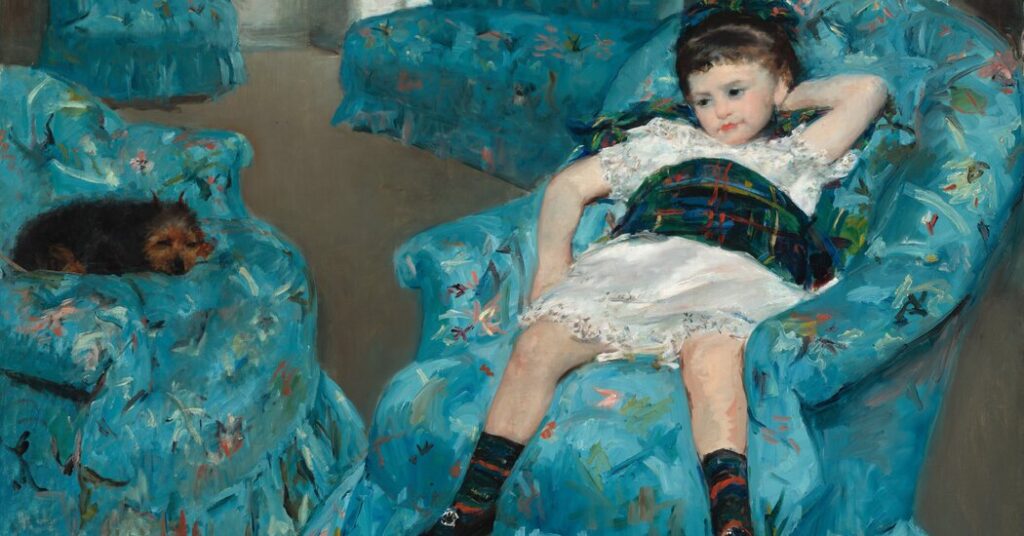
Autumn in Paris is a season for Americans (and one Canadian!), with no fewer than eight major museum presentations, most timed to Art Basel’s spinoff fair in Paris, by artists from our side of the Atlantic. The Musée d’Orsay has a cruel-and-tender pairing: a full-dress retrospective of the Pennsylvania-born pastelist and printmaker Mary Cassatt (from Oct. 6, and touring to Boston in 2027), with projections byJenny Holzer on the museum’s Seine-side facade (starting Oct. 20). Kerry James Marshall and Vija Celmins face off with the European tradition; his color-soaked history paintings fill the Musée d’Art Moderne de Paris from Sept. 18, her color-sapped drawings of stars and spider webs appear at the Orangerie, alongside Monet’s water lilies, from Sept. 30.
The Maison Européenne de la Photographie offers a full survey of the fashion photographerIrving Penn (from Sept. 30); Stan Douglas will enjoy a rewind of his videos and photography at the Jeu de Paume (starting Oct. 20); while Barbara Kruger will fill the Bourse du Commerce with her blaring red slogans (debuting Oct. 7). The most fun American show will be at the Château de Versailles, to which Sofia Coppola is returning two decades after her purple-Converse-shod “Marie Antoinette” (starting Sept. 22).
Other shows worth traveling for include “Van Eyck: The Portraits,” at the National Gallery in London: a rare assembly of all nine surviving portraits of the Flemish master, so perfect, so diamond-hard, that you might think no human could have painted them (starting Nov. 21). The Städel in Frankfurt, on Sept. 17, opens with the very intriguing “Mary Magdalene: Sin. Pray. Love,” which will mix old and new paintings of the Bible’s beautiful sinner. One of the titans of Abstract Expressionism will get a Dutch homecoming in “Willem de Kooning at Work,” opening at the Rijksmuseum in Amsterdam on Oct. 9.
The biggest unknown is in the Gulf, where the Guggenheim Abu Dhabi will, at long last, open its doors on Dec. 11. Artistically, geopolitically, climatically too, the world looks nothing like it did when the Guggenheim announced this project 20 years ago. Allegations of labor abuse hounded the museum’s local construction for years. Its architect, Frank Gehry, died last December. Now, as President Trump’s war in Iran has plunged the United Arab Emirates into a regional conflict, the Guggenheim is closer to the frontline than it ever expected. How all this will play out under Gehry’s titanium will be revealed at season’s end, but the future is never what we presuppose.
The post 25 Global Art Openings Worth Making an Excursion For appeared first on New York Times.