The statistics are sobering — so sobering that Defense Department officials refuse to confirm, deny or discuss them.
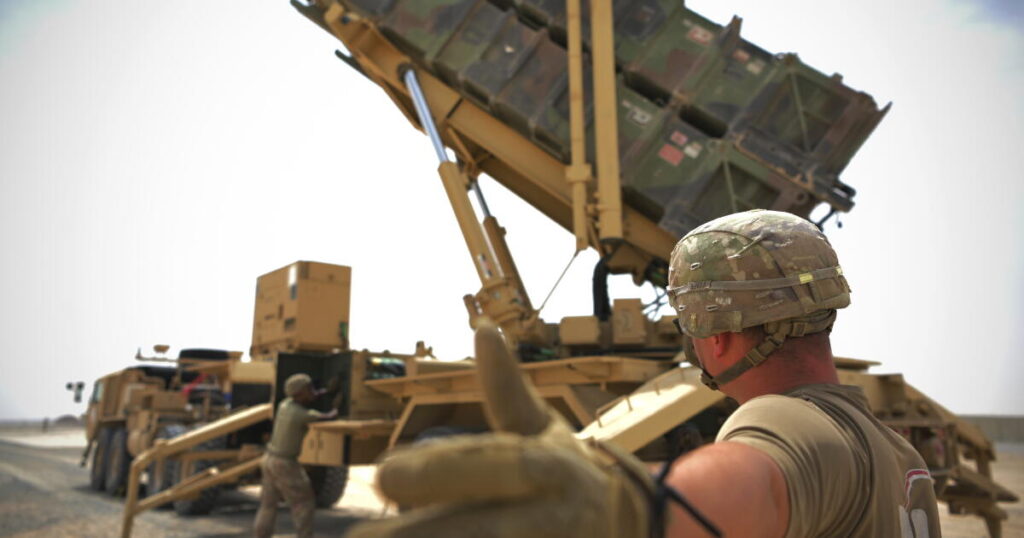
From Feb. 28 through July, the first five months of the war with Iraq, U.S. forces burned through almost 60% of the nation’s advanced defensive missiles — the Patriot and THAAD interceptors that protect American troops.
When the war began, the Pentagon had almost 2,800 Patriot and THAAD missiles in its worldwide inventory, according to a study by the Center for Strategic and International Studies, an independent think tank. By the end of July, that number had dropped to about 1,100, CSIS reported. Almost two-thirds of the Patriots and almost 40% of the longer-range THAAD were gone.
“This is a generational annihilation of our theater missile defense capability,” said Tom Karako, director of CSIS’s Missile Defense Project. “There’s no way you can look at this and not see it’s a setback.”
The White House and the Pentagon have not challenged the CSIS figures, although they have issued sweeping denials that any shortage exists.
“We have far more munitions than anyone in the world, and far more than we need,” President Trump said in July.
That’s true, but misleading. The U.S. military still holds vast inventories of short-range offensive missiles. But the sophisticated defensive missiles that protect U.S. troops no longer are abundant — as even Trump has acknowledged.
“We have certain types of munitions [of which] we have unlimited, virtual unlimited supply,” he said last month. “We have others where it’s a little bit tighter.”
The result is a squeeze that has prompted U.S. commanders to husband Patriot and THAAD interceptors as scarce assets.
For much of August, when a frayed de facto ceasefire was in effect, U.S. forces did not respond with high-end missiles when Iran attacked oil tankers in the Strait of Hormuz.
But when Iran launched rockets against U.S. bases in Jordan last week, Patriots reportedly were used to knock the incoming missiles down. (The Pentagon has declined to confirm or deny those reports.)
The U.S. weapons arsenal “no longer has the capacity to deter a Chinese attack against Taiwan,” the Council on Foreign Relations warned in a report last month. Defense planners share the same concern over a potential Russian assault on the Baltic states.
The conservative Heritage Foundation has forecast that the Pentagon’s inventory of missiles would run out “within the first week of a Taiwan conflict.”
In Europe, a U.S. defense official told the Associated Press last month that the shortfall was “beyond critical.” If Russia attacked a NATO country, the official said, U.S. forces in the area would “take punch after punch in the mouth.”
The core question is whether the United States has so few missiles that it cannot credibly deter China or Russia from attacking their neighbors.
“You’ve got to be strong enough to send a clear message that our enemies should not try anything because we’re a credible force,” said Leon Panetta, President Obama’s former defense secretary. “Now we’re losing a lot of that credibility — and that’s dangerous.”
Knowing that U.S. forces have been left without thousands of weapons needed to deter conflict, Karako said, could in itself be provocative. “It could tempt an aggressor to do something, knowing that we have fewer [missiles] to thwart them.”
The obvious remedy is to build more interceptors — a process Trump and Defense Secretary Pete Hegseth ordered even before the war began. But ramping up missile production won’t immediately replenish the stockpile.
Before the Iran war, defense contractors were producing only about 620 Patriots and 96 THAAD each year — fewer than half the number expended during a few weeks this spring.
At current production rates, it will take at least three years to return the Patriot inventory to its prewar level, and at least four years for THAAD, CSIS reported.
Defense experts warn that the stocks need to be even larger than they were before the war to credibly deter China or Russia.
Mark Cancian, a retired Marine colonel and principal author of the CSIS estimates, says most analysts believe it will take years after replenishing the stocks expended in the Persian Gulf to build a credible deterrent against China.
The Pentagon has enough munitions, both offensive and defensive, to continue fighting the campaign against Iran, he added — but some of those less-sophisticated weapons can be used only at shorter ranges, which means placing more troops in harm’s way.
Cancian said the CSIS figures were based on publicly available Pentagon budget and acquisition documents, updated in some cases from recent press reports — but not from leaks of classified information.
The roots of the missile shortage began long before the war with Iran. Trump and Hegseth are not the only ones to blame, although their belief that Iran would quickly capitulate appears to have been a major factor.
Nor did former President Biden cause the shortage, as Trump has claimed Biden gave several hundred Patriots to Ukraine, but the shortfall is far larger than that.
The underlying problem, defense experts say, is that the United States designed its missile defense programs for a world in which only a few major powers like China and Russia posed serious threats.
But the landscape of military technology has changed. Missiles and drones have become cheaper and easier to acquire, and countries like Iran can strike targets at great distances without making a huge investment in weaponry.
That’s a transformational change — and the Pentagon has been behind the curve, argues Michael C. Horowitz, a senior fellow at the Council on Foreign Relations. “This is the kind of situation in which great-power militaries like the United States struggle,” he said.
So the Trump administration faces several challenges. It needs to replenish its depleted stores of advanced defensive missiles — a process that has only just begun, and which Congress has not yet funded. Meanwhile, Horowitz and others argue, it also needs to build less expensive missile and drone systems to fill the multiyear gap before Patriot and THAAD inventories can be restored.
The Pentagon has begun that process, deploying several relatively inexpensive anti-drone missile systems.
Trump’s One Big Beautiful Bill Act last year included $7.7 billion for low-cost missile and drone programs, but 13 months later, more than 90% of the money remains unspent, Horowitz said.
The post U.S. is running low on advanced defensive missiles — and it could take years to recover appeared first on Los Angeles Times.