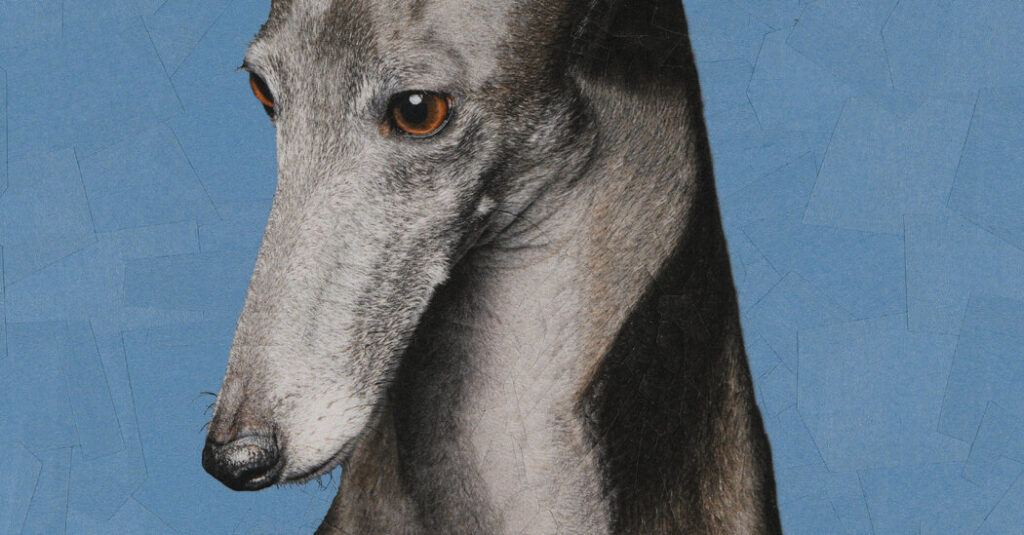
LIVING WITH FREDDIE: How a Dog Taught Me to Be Human, by Anna Heyward
Every dog memoir has one big thing going for it right out of the gate, which is a dog. Having a dog’s personality described to you is a great joy, and one might argue that all pups deserve a short biography — an unending series of chapbooks to give each canine individual attention. But in a dog memoir, the animal, however lovingly observed, largely exists to teach the author some profound and much-needed lesson: how to live in the moment; how to emotionally heal; how to love unconditionally; how to accept death. The subtitle of Anna Heyward’s “Living With Freddie” suggests that Freddie, an Italian greyhound with a nervous system permanently set to spin, taught Heyward “to be human.”
It’s quite a large thing to have to learn, but in fairness to Heyward, it seems more accurate to say that she had to learn how to be a dog’s guardian. And that’s plenty challenging enough.
Freddie was “around 8 years old” and skeletal when he entered Heyward’s life. (A quick image search shows skeletal to be status quo for the breed.) The initial email she received about him from the rescue group made “some mention of behavior and medical problems,” but it was “all a little vague,” she writes. “I didn’t worry much, in part because I was excited, and in part because I thought having a dog would be easy.”
Eight-year-old adopted dogs are rarely easy. They’re relatively old, for starters, and sometimes come with experiences that have left them emotionally damaged and behaviorally intractable. It very quickly became clear that Freddie suffered from a severe form of separation anxiety. The first time Heyward’s boyfriend, Aaron, left her apartment after the adoption, Freddie exhibited great distress, howling, scratching, even hurting himself by biting his tail. From that moment on, Heyward’s life became consumed by the effort to make sure Freddie was never unattended, and to work on improving his reaction so that he could be safely alone.
Had Heyward focused her account only on Freddie’s anxiety and her anxiety about his anxiety, it might have grown unbearably tense. But she is a sure-footed writer, varying the mood with frequent contextual detours into science and the occasional glimpse of a happier Freddie.
She dispenses diverting facts (Darwin’s “On the Origin of Species” was published in the same year, 1859, as the “earliest properly documented dog show” was staged, in England); summarizes key figures and discoveries in the history of behaviorism; and beautifully describes a moment when Freddie chased deer into a forest and seemed to fully, confidently inhabit himself. Less satisfying is the subplot of her increasingly vexed relationship with Aaron, exacerbated but hardly caused by Freddie’s needs.
Heartbreak of more than one kind arrives in this memoir, and you end up feeling sorry for everyone at some point. One element of that heartbreak, Heyward’s upbringing, is only briefly rendered, but its effect powerfully lingers. She is candid about the harrowing way her family treated her childhood dog, Sammy, a small mutt who lived entirely in a “small square of yard” outside their Australian home, “day and night, alone.” Sammy “barked constantly,” and when neighbors complained, a man wearing a “Bark Busters” shirt came to the house to teach them to throw “short lengths of chain” at Sammy to quiet her. Equally troubling is the strict way in which Heyward’s parents judged and punished the author herself.
“When I was a child, love and obedience were hopelessly mixed up in my mind,” she writes. “Punishment had to be unpleasant because it had to address your own inner badness, the cause of the bad behavior.” She goes on to list punishments that included “being hit, being confined to a locked room” and “being disallowed from interacting with siblings or friends, being shouted at, being told we were bad or selfish or irritating.” In one poignant moment she writes that, with Freddie, “I was still figuring out what love looked like when pain wasn’t a part of it.”
Heyward often comes across as an A student trying to impose her sheer industriousness on tightly knotted emotional problems. “I believed most matters of feeling and being could be solved,” she writes, “and if they couldn’t, it was because I wasn’t working hard enough on them.”
Despite such admissions, it isn’t entirely clear how much Heyward connects certain dots about her own emotional response systems. But then part of her ultimate point is that when it comes to animals, we’re at best highly suspect narrators and can even unwittingly become antiheroes. What she learned about pets could be applied to any ostensibly loving relationship, including those between humans: “It was actually very difficult to be worthy of a dog.”
LIVING WITH FREDDIE: How a Dog Taught Me to Be Human | By Anna Heyward | Random House | 267 pp. | $29
The post The Dog Isn’t the Only One Rescued in This Memoir appeared first on New York Times.