In 1988, when I met her, Yayoi Kusama had been living in a psychiatric hospital in Tokyo for over a decade, and was nearly forgotten by the art world in New York. As a graduate student researching postwar Japanese art, I had been invited to curate the opening exhibition at a new institution in New York, the Center for International Contemporary Arts (CICA). I chose Ms. Kusama, with the ambition to wrest her from obscurity.
When she died last month, 37 years later, Ms. Kusama — in her life and her art — was obscured, paradoxically, by too much fame.
There has been an outpouring of tributes to her after her death, at 97, in Tokyo. Everyone notes how she had a role in the Minimalism and Pop Art movements of the 1960s avant-garde when she lived in New York City before moving back to Tokyo in 1973. And they mention her late-in-life career revival, with record-smashing auction prices as a female artist, the crowds lined up at her mirrored immersive installations and the signature range of polka-dot luxury goods she designed — twice — for Louis Vuitton.
Ms. Kusama’s madness is part of her legend, but mental illness is not artistry and its outcome is not always art. Writings on Ms. Kusama — including my own — see her work through the lens of a psychological distortion. This is fair, but it is not the distortion that made the artist.
The fame of Ms. Kusama’s later decades has eclipsed our appreciation of the fierce rage and the original genius that drove her to make incessant art — and to make it incessantly. It ignores how, from her early days, male artists commandeered her ideas. Her work seemed to have inspired Claes Oldenburg’s bulbous, sewn-and-stuffed sculptures, Andy Warhol’s repeating images as wallpaper and Lucas Samaras’s interactive mirrored chamber.
I first met Ms. Kusama in a coffee shop in Tokyo. I had come with CICA’s director, Bhupendra Karia, and its research head, Reiko Tomii. Ms. Kusama walked fast and a little stooped, like a penguin. Her eyes were intense; she wore heavy lipstick, a bit of eyeliner, some rouge. Her brow was deeply furrowed. She leaned forward as she spoke, her rapid-fire English skipping verbs and tenses as she recited stories, betrayals, triumphs, beliefs. Occasionally, she would look up at us and smile as if a bird had alighted in her view. In these flashes, I would see her beauty. Her Japanese was equally staccato. It was barely conversational. But she always spoke with absolute conviction.
We were the first scholars to open the door of the studio near the psychiatric hospital where she had voluntarily lived since 1977. The place was packed with suitcases stickered with Pan Am logos and painted with polka dots. There were hatboxes and shoeboxes crowded onto every shelf, and racks of paintings, many of them rolled, just as they may have arrived from New York years before. What we found in the boxes became the source of the portraits, artwork and performance photographs of the global Kusama mania ever since — including files from her 1966 trip to the 33rd Venice Biennale, where she staged “Narcissus Garden,” an unauthorized protest of the commercialization of the art market. Dressed in a gold kimono, she set 1,500 mirrored plastic balls on the lawns and advertised them for sale at $2 a piece. (The authorities asked her to leave.)
Since then, major museums have organized bigger and bigger retrospectives, and her work has been included in hundreds of group shows, including some of my own.
But something got lost along the way: where she came from. What drove her.
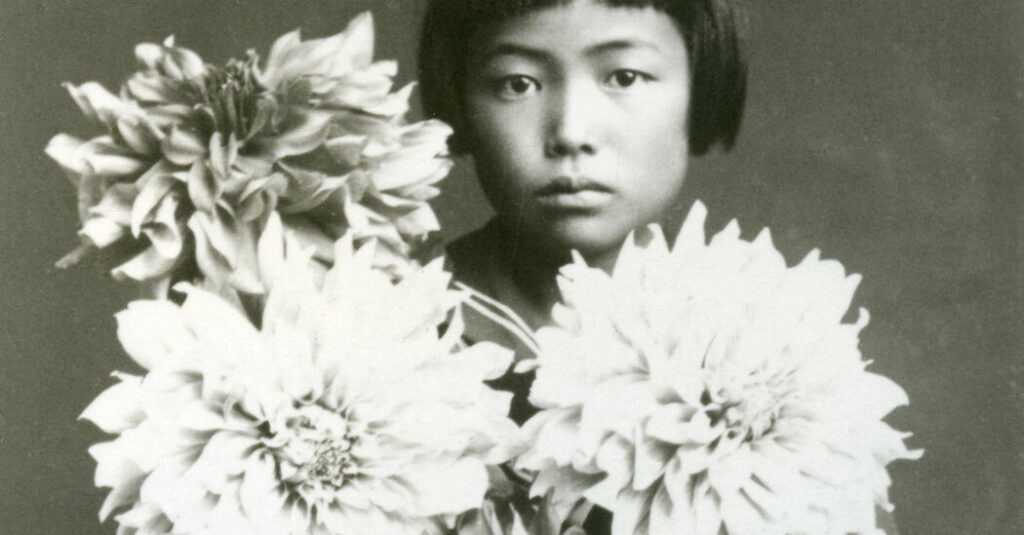
Ms. Kusama grew up in a conservative family during the military regime of wartime Japan. Her mother was so opposed to her art-making that she would sneak up from behind and snatch her sketches away. In the background, there was a philandering father and early sexual trauma. Her family cultivated flowers for its wholesale seed business. A swirling mass of florets is among the sources for Ms. Kusama’s obsession with “nets” of proliferating dots.
Starting in the early 1950s, when a Japanese psychiatrist introduced Ms. Kusama as a “genius woman artist with schizophrenic tendency,” she described the effects of her visual and auditory hallucinations as “self-obliteration” — a dissolution into nothingness. Making things in the thousands saved her from total despair and probable suicide.
Ms. Kusama arrived in New York when she was 29 years old, in 1958 — just 16 years after Pearl Harbor and 13 since Hiroshima. Newspapers still called her compatriots “Japs.” Never married, she had left Japan to get away from its “shackles, the conventions, the prejudice,” claiming it was “too small, too servile, too feudalistic, too scornful of women” for an artist to thrive.
Ms. Kusama’s drive for recognition came from rage against the obstacles of patriarchy, militarism, conformity and, when she came to America, an art world dominated by male artists. In 1968, she competed with Andy Warhol for publicity. She won. It wasn’t Mr. Warhol she wanted to beat — it was the system she wanted to rebel against. Her anti-Vietnam War happenings with nude hippies she painted with polka dots to symbolize cosmic love were about the obliteration of ego, not exhibitionism. “Let’s forget ourselves, dearest Richard, and become one with the Absolute, all together in the altogether,” she wrote in an open letter to Richard Nixon when he was elected president in 1968.
After she returned to Tokyo in 1973, Ms. Kusama became an idol of the youth culture. Within Japan, Ms. Kusama is among the most culturally influential women in modern history.
Globally, Ms. Kusama’s most iconic series is the Infinity Mirror Rooms. She first staged them in 1965, and returned to this theme in the 1990s, fabricating ever-larger kaleidoscopic environments that visitors enter one at a time. These “immersive artworks” have become art-world fun houses. There is often a line of people waiting to enter them, but few are there to consider the artist’s original vision, to create a semblance of her mental terrors, to make you see your own reflection splintered into endlessness. Instead, they take a selfie.
If Yoko Ono was, as John Lennon said, “the world’s most famous unknown artist,” then Yayoi Kusama has become the world’s most unknown famous artist.
People ask me: Did she ever love anyone? In those storage boxes, we found a trove of love letters, collaged with butterflies and drawings, from the artist Joseph Cornell to “Yayoi.”
She told me about the mornings he would call, and how she’d say, exasperated, “Joseph, I need to go get some coffee.”
“I’ll wait,” he’d say. And she would wander down the streets of Manhattan and forget all about his call — until she came back home to find the phone still lying where she had left it. “Yayoi?”
On a recent visit to Tokyo, I wanted to visit Ms. Kusama. She was already too frail. Akira Tatehata, a trusted friend of hers who leads the Yayoi Kusama Museum, told me that on most days, she had on her lap a square canvas sized precisely to the reach of her arms. She chose to stay alone in her psychiatric-ward bed: beloved, but too consumed by her ferocious imagination to care much about love, or fame.
Alexandra Munroe is a senior curator at the Guggenheim Museum and organized Yayoi Kusama’s first retrospective exhibition.
The Times is committed to publishing a diversity of letters to the editor. We’d like to hear what you think about this or any of our articles. Here are some tips. And here’s our email: [email protected].
Follow the New York Times Opinion section on Facebook, Instagram, TikTok, Bluesky, WhatsApp and Threads.
The post She Changed the World From an Asylum in Tokyo appeared first on New York Times.