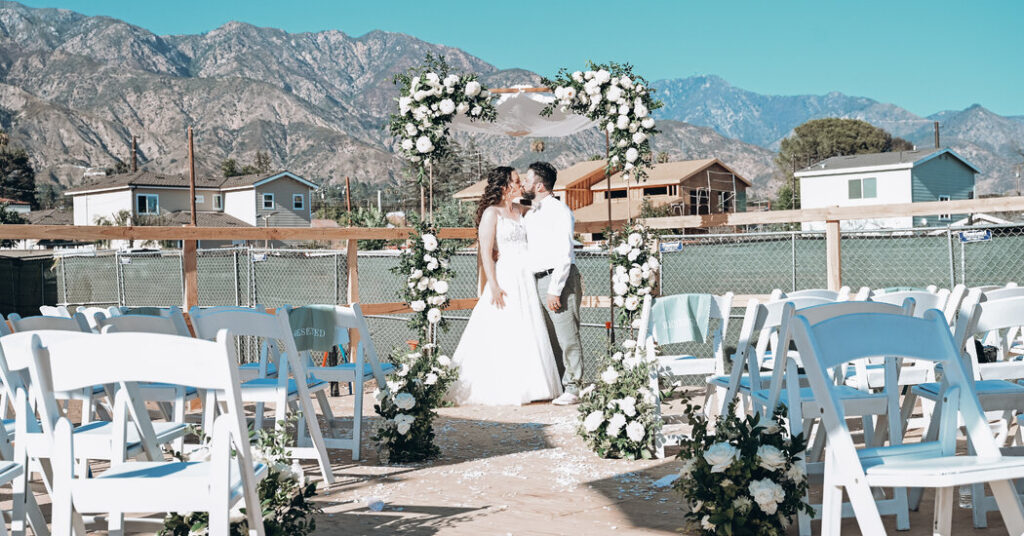
Morgan Soloway and Kenneth Rotter might have been forgiven for indulging themselves with an extra-long celebration on July 5, when they married before a crowd of 130 in Altadena, Calif.
Eighteen months before, their house burned down in the Eaton Fire that destroyed much of their town, along with their plans for a wedding after a yearlong engagement. But Soloway, 39, and Rotter, 41, had reason to keep their outdoor ceremony to 30 minutes.
“It was real hot,” Rotter said. The couple — whose wedding venue attracted a local TV crew because they married at the construction site where their home is being rebuilt — distributed hand-held fans and kept a car idling nearby with air-conditioning for anyone who needed it. “I was very worried,” Soloway said.
The summer of 2026 is careening toward the finish line, leaving a trail of wildfires, heat domes, flash floods and tornadoes in its wake. Such weather is impacting all aspects of life, including major events like weddings, which raises the question: How prepared for catastrophe should a couple be?
Jenna Armand of Something New Wedding Planning in Calgary, Alberta, said the first thing many couples ask when looking for a planner is “‘What’s the best wedding you’ve ever done?’” But because calamitous unknowns are becoming a new normal, she would encourage them to ask, “‘What’s the hardest, most challenging situation you’ve ever been in?’” (Her answer: a train derailment, a venue fire, road closures and hailstorms.)
Jessi Miller and Wade Clar, of Victor, N.Y., can’t deny their disappointment over how their backyard wedding unfolded on July 18. Minutes before the ceremony, a violent hailstorm roared in, toppling trees and terrifying several of the 70 guests mingling under a tent outside.
By the time the soaked guests filed into their living room for an impromptu indoor ceremony, Miller, 32, and Clar, 60, were racked with regret. The bride “felt terrible,” she said, that at least one guest’s windshield was smashed, and that their caterer’s tent had been destroyed.
Miller also felt robbed of the first dance to Lana Del Rey that she and Clar envisioned in their yard on a warm summer’s night. “I had nightmares” after the wedding, she said. A plan to invite guests back to watch the first dance the following weekend fizzled with their exhaustion.
Of course, wedding day disasters are not always natural or climate-related. Lisa Perigo, 66, and Chris Foster, 62, of Woodland, Wash., planned to marry May 16 in Battle Ground, Wash. Four days earlier, a suspicious fire destroyed the historic pavilion at Lewisville Regional Park they had reserved eight months earlier.
The park had been their dream venue for a couple of reasons. For Perigo, who grew up nearby, there was sentimental value: “It was such a big part of my youth.” And its price tag, at less than $200 for a full day, also appealed. Twenty-one of their 120 guests had flown in for the occasion, some from the East Coast, others from Canada and Europe, so “we couldn’t just change wedding days,” Foster said.
Instead, they married in the cultural hall of a nearby Church of Latter-day Saints. It didn’t afford the views of towering evergreens and rivers the couple hoped out-of-town friends would enjoy. But “we’re believers that blessings can come out of unfortunate events,” said Foster of the church hall opening to them. (The couple are not Mormon.)
Kaity Bucaro and Robbie Morris of Chicago had been planning a Feb. 27 wedding in Guadalajara, Mexico. When cartel violence broke out in the streets on Feb. 22, two days before they were to fly down, their plans were thrown into jeopardy. “Our vendors down there, the people on the ground, weren’t sure what was going on,” Morris said.
A friend who lives in Guadalajara leveled with them. “He was like, ‘I’m not going to lie to you guys,’” Morris said. “This is bad.”
Bucaro and Morris, both 31, had been writing their vows the morning they decided to change course. “We took turns crying all day,” she said. But by that evening, they had committed to moving their wedding to Chicago.
The couple had already drained their budget on vendors and their venue in Mexico, so they took to Instagram. “We wanted to see if anyone could help,” Bucaro said. An initial post describing the fiasco went up the morning of Feb. 23. Hours later, Chicago news outlets were asking for interviews.
“So many generous people heard the story and were like, ‘I’m free, what can I do, let me help you,’” Morris said. That night, the couple holed up in the kitchen at Bucaro’s parents’ house. “We were all on our computers, pulling offers, watching ourselves on ABC News Chicago,” Bucaro said.
On Feb. 27, 150 guests gathered at the Alston, a Chicago restaurant whose owners had offered a deep discount, to watch them marry. Local vendors, including a florist, glam team and content creator, had stepped up to donate their services. (Their original photographer and videographer traveled to Chicago from Guadalajara.)
Weeks after the wedding, the couple took to Instagram again, this time with an offer to donate the $11,000 in wedding services they had to abandon in Mexico to another couple. The couple they selected will marry there in October.
Theirs, both said, was a happy ending. And they have advice for couples who worry as planning becomes increasingly unpredictable, due to climate or global events: “Just ask for help,” Bucaro said. “You never know where it might come from.”
The post Saying ‘I Do’ Amid Heat, Hail and Fires appeared first on New York Times.