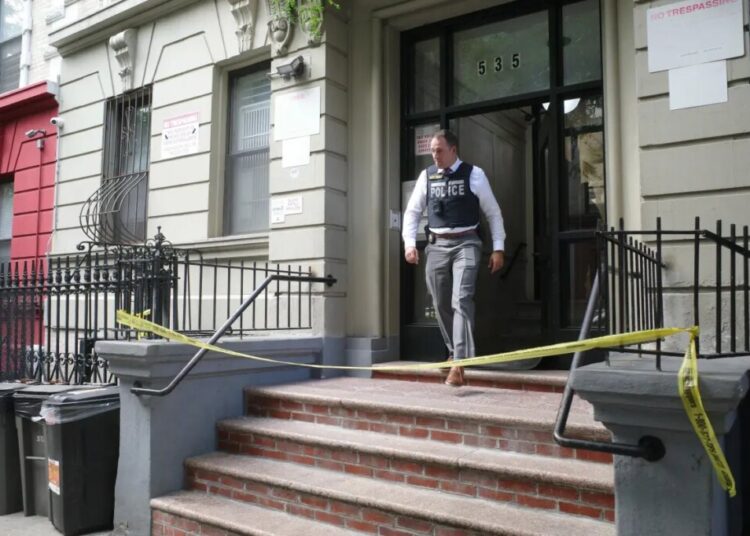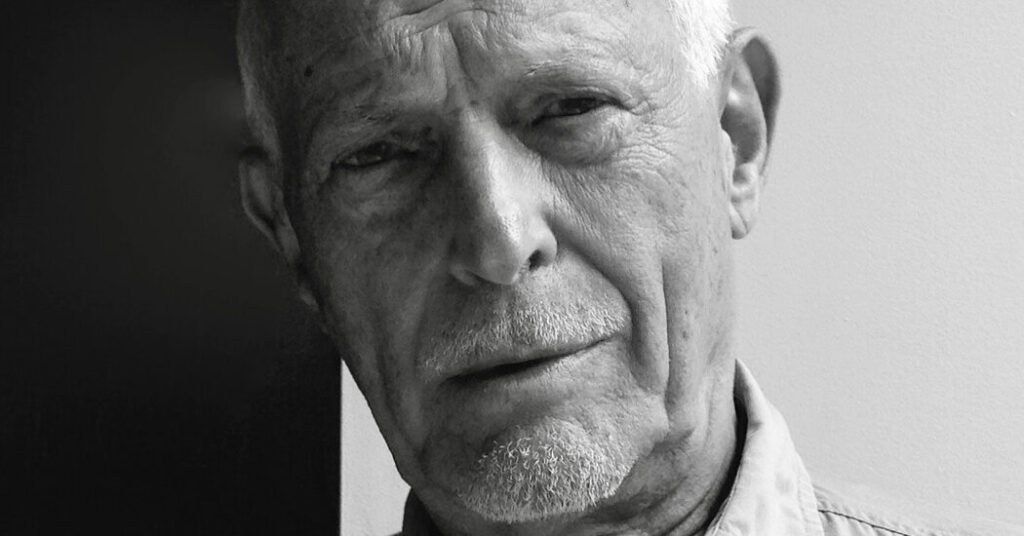
Edward Field, one of the most accomplished American poets of the postwar era, whose award-winning work — characterized by everyday language and an openly gay landscape — was forged by nearly a century of living in bohemian New York, died on Sunday at his home in the West Village section of Manhattan. He was 102.
The death was confirmed by Roger Netzer, his close friend for several decades.
Mr. Field found his calling by happenstance. As a newly enlisted soldier boarding a troop train during World War II, he was handed a bag by a Red Cross worker. It contained a toothbrush, a comb, a candy bar and an anthology of poetry.
“I was on that train for three days,” he said in a 2022 interview for this obituary. “I read it over and over. I knew immediately that I was going to be a poet.”
He was just 18 and had never read a book of poetry or written a line. But he would go on to write 12 books of poetry and edit two anthologies, “A Geography of Poets” (1979) and “A New Geography of Poets” (1992), and receive, among other honors, the Prix de Rome, the Lambda Literary Award, the Shelley Memorial Award and the W.H. Auden Prize.
Diana Athill, the renowned British editor and writer, published “Letters to a Friend,” an epistolary chronicle of her 30-year friendship with Mr. Field, in 2011.
“The whole point of poetry for me is subject matter,” he told Ms. Athill. “Saying what I have to say, saying what has never been said before, what’s not polite to say.”
During the war, as an Army Air Corps navigator at the Grafton Underwood base in the English Midlands, Mr. Field met Coman Leavenworth, the first published poet he had encountered. Mr. Leavenworth introduced him to the work of contemporary poets who were writing about same-sex desire at a time when homosexuality was illegal on both sides of the Atlantic and most gay writing was coded or underground. Mr. Field, who had concealed his own homosexuality from his family and in his own writing, was shocked and thrilled.
By the time he published his debut collection, “Stand Up, Friend, With Me” (1963), he was a writer openly embracing his own sexuality.
In the poem “Unwanted,” he wrote:
It is perfectly obvious that he was not popular at school
No good at baseball, and wet his bed.
His aliases tell his history: Dumbbell, Good-for-nothing,
Jewboy, Fieldinsky, Skinny, Fierce Face, Greaseball, Sissy.
Warning: This man is not dangerous, answers to any name,
Responds to love, don’t call him or he will come.
Edward Field was born in Brooklyn on June 7, 1924, one of six children of Eastern European Jewish parents who were among a wave of immigrants in the early 20th century.
After five years in the Bensonhurst neighborhood, Edward moved with his family to the Long Island town of Lynbrook in Nassau County, then a center for the pro-Nazi German-American Bund, a political organization for Americans of German descent that supported the rise of Hitler in the mid-1930s.
“I was beaten up every day after school,” Mr. Field said in 2022. His father, Louis Felscher, changed the family name to Field in an attempt to avoid antisemitism.
Home life was not easy either. Mr. Field described Louis, a commercial artist who designed movie posters for MGM, as tyrannical. But Mr. Field’s mother, Hilda (Taubman) Field, was musical with a streak of nonconformism, believing in the health benefits of nudism and eurhythmic dancing exercise.
All the children took music lessons. Edward, who played the cello, performed regularly with two of his siblings on a local radio show called “The Field Family Trio and Their Romantic Melodies.” The first in his family to go to college, Edward studied marketing at New York University at his father’s insistence but left in 1943 to enlist in the Army.
He was a decorated first lieutenant who navigated B-17 bombers, the aircraft known as the Flying Fortress, in 27 raids over Germany. He nearly died in February 1945, when his plane was hit by enemy fire and crash landed into the North Sea.
His poem about his survival, “World War II,” was made into an award-winning short animated film, “Minor Accident of War,” in 2019, by Mr. Field’s niece, Diane Weis, and Piotr Kabat, with Mr. Field narrating the text.
After the war, he returned to New York University on the G.I. Bill and met other ambitious young writers including Susan Sontag, Cynthia Ozick, and Alfred Chester, a literary critic and novelist whose meteoric rise and tragic end had a profound effect on Mr. Field’s own life and work.
Mr. Chester had struggled with depression, leading to drug-fueled psychotic breaks after he moved to Morocco to join the writer and composer Paul Bowles. After Mr. Chester died under mysterious circumstances in 1971, Mr. Field became the keeper of his legacy.
Mr. Field successfully lobbied publishers to reprint Mr. Chester’s work. He edited a collection of his short fiction called “Head of a Sad Angel: Stories 1953-1966” (1990) as well as a collection of his Moroccan letters, “Voyage to Destruction” (2021).
He also paid homage to Mr. Chester in his own memoir of life in literary Greenwich Village, “The Man Who Would Marry Susan Sontag and Other Intimate Portraits of the Bohemian Era” (2005); the title story about a would-be Sontag spouse referred to Mr. Chester.
Mr. Field left N.Y.U. before graduating, and headed for Paris in 1948. There, he met other expatriate American writers, including James Baldwin and Robert Friend, and published work regularly in literary magazines. He eventually worked his way back to New York in 1950 as a deckhand on a freighter.
But America then was a chilly place for a young gay poet. The House Un-American Activities Committee swept up a broad swath of artists, many of them Jews and gay people.
Then, in the mid-1950s, Mr. Field met the poet Frank O’Hara. Their brief love affair altered the course of Mr. Field’s life and work.
“Frank O’Hara showed me the way,” Mr. Field wrote for outhistory.org. Mr. O’Hara’s ability to write easily and unselfconsciously as a gay man gave Mr. Field the courage to follow his instincts and loosen up with his own writing. The result was a breakthrough in his poetry.
“Stand Up, Friend, With Me” (1963) received the Lamont Poetry Prize from the Academy of American Poets, though the book had been turned down by 24 publishers. Mr. Field’s colloquial language, emotionality and openly gay topics brought him widespread praise and a fellowship from the Guggenheim Foundation.
As Mr. Field burst on the scene, the poet William Carlos Williams wrote: “I don’t know how the hell old you are or anything about you but I’m certain you’ve got the stuff: clean, straight writing that knows (or you know) what a poem could be made of. I am impressed.”
Mr. Field was hired by Johnson and Johnson, the pharmaceutical giant, to write the narration for a film at the company’s pavilion at the 1964-65 New York World’s Fair. The film won an Academy Award for best documentary short in 1966.
By the early 1970s, Mr. Field became that rare creature: a successful poet, able to support himself through public readings and freelance writing.
The love of his life was Neil Derrick, a novelist who published bodice-rippers such as “Sticky Fingers” (1970) under the pseudonyms Eleanor Bartlett and Bruce Elliot. They met in 1959, while they were both working in a typing pool at an advertising agency. “We started a nonstop conversation that led the supervisor to switch him to another typewriter, rows away from me,” Mr. Field recalled.
But in 1971, Mr. Derrick was diagnosed with a brain tumor, which left him blind. Mr. Field became his caregiver.
They continued to travel to Europe and collaborated on several Bruce Elliot novels, including “The Potency Clinic” (1978) and “Village” (published in 1982 and republished as “The Villagers” in 1999), which became an unexpected best seller.
The two were married in 2017. Mr. Derrick died the following year. Mr. Field leaves no immediate survivors.
A longtime resident of Westbeth Artists Housing, a community for artists and arts organizations in Greenwich Village, Mr. Field continued to write and publish throughout his ninth decade. An anachronistic bohemian to the end, he shared an excerpt from one of his poems on NPR’s “Weekend Edition” in 2006:
I am of another era, like the grizzled poet
who slept in Village doorways
and shows up at the Poetry Society
with his life work in a shopping bag
and read his poem, ‘Crows’:
Caw-caw, he cried as he jumped
off a table, flapping his arms.
Alex Traub contributed reporting.
The post Edward Field, Bohemian New York Poet, Dies at 102 appeared first on New York Times.