Dozens of deportees are arriving in the Haitian city of Cap Haitien weekly as the Trump administration pushes to remove Haitians who lack legal immigration status in the United States, and some are now marooned in an unfamiliar place.
More than 80 people were returned last week, often with only the U.S. government-issued sweatpants and T-shirts, and with immigration court documents stuffed in their pockets. Many returned broke, saying their valuables had disappeared during the trip and they now lacked the cash to get home.
The road out of Cap Haitien, on Haiti’s northern coast, is controlled by gangs that extract tolls from drivers and kidnap travelers. Five police officers who tried the trip by bus recently were murdered.
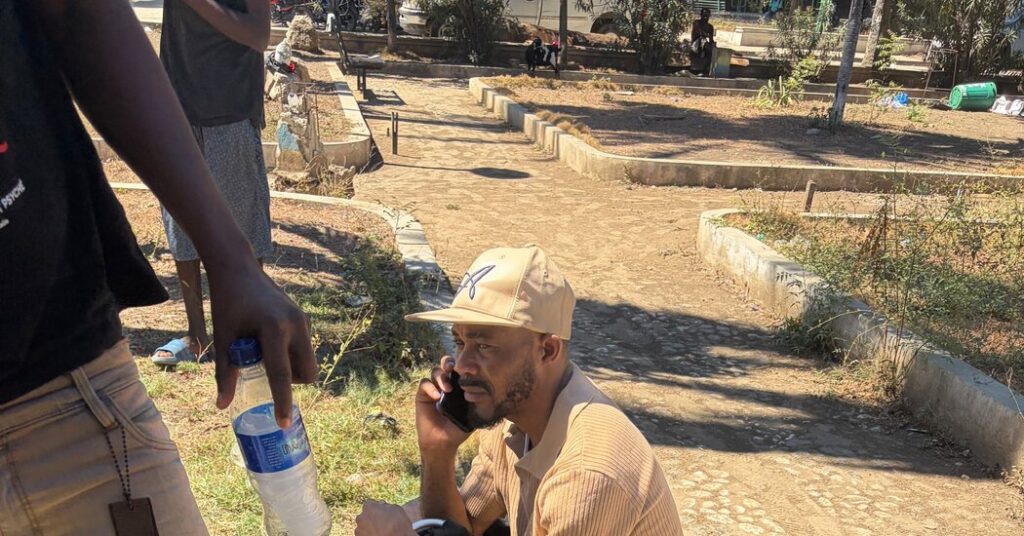
A day after being deported, Reginald Dorvilma, 36, sat stranded on Friday outside the Cap Haitien police station, making phone calls. He needed to find his way through gang territory to Les Cayes, his hometown on the other side of the country.
The Haitian immigration authorities had given him and the other adults who arrived on the latest deportation flight 10,000 Haitian gourdes — the equivalent of about 80 U.S. dollars. On his first night back, he said, he had spent about $20 at a low-end hotel and then bought a change of clothes. He had less than $40 left.
“I don’t have the money to go,” Mr. Dorvilma said.
In June, the U.S. Supreme Court allowed the Trump administration to terminate the Temporary Protected Status program that had shielded 330,000 Haitians nationwide from deportation. Under T.P.S., people already in the United States were granted permission to live and work legally there if they came from countries considered too dangerous to return to. The program had been repeatedly extended because of the turmoil in Haiti, resulting from natural disasters and extreme gang violence.
With the end of T.P.S. in July, the Trump administration increased the number of deportation flights to Haiti from one a month to one a week. More than 450 people were returned in the past four flights, including some who had entered the United States legally through a program created by the Biden administration.
The plight of people like Mr. Dorvilma is among the challenges facing the Haitian government as it grapples with the arrival in Cap Haitien every Thursday of returning citizens, including people who are penniless, a few who do not speak the local language, Creole, and others with criminal histories.
Haitian officials acknowledge they are overwhelmed, and that some deportees are likely to become homeless in northern Haiti.
“Some are outside,” said Luz-Kénez Surfin, the head of the judicial police in Cap Haitien. “They don’t know where to go.”
The mayor of Cap Haitien, Michel Saint-Croix, said the Haitian authorities needed more time to prepare for the wave of deportees. “I would have requested a delay of four to six months to get better prepared,” he said.
Human rights advocates say the deportations are inhumane, noting that the gang crisis has made Haiti so perilous that the State Department warns Americans against traveling there. Some 3,000 people were killed in the first six months of the year, many of them in gang-related violence.
As a result of these safety concerns, the Federal Aviation Administration prohibits U.S. aircraft from landing at the airport in the capital, Port-au-Prince, the original home of most of the deportees, and about 125 miles from Cap Haitien.
The Department of Homeland Security said in a statement that “Temporary Protected Status is exactly that — temporary,” and that “for too long, T.P.S. has been allowed to function as a de facto amnesty program despite Congress never intending it to be permanent.”
The department added, “What we would say now is: It’s closing time, which means you don’t have to go home, but you can’t stay here.”
Mr. Dorvilma was deported to Haiti on Thursday after being arrested in Orlando, Fla., in July after a fight with his roommate, records show. He had money in the bank, but said he had given his banking password to a friend to help him hire a lawyer, and the friend and the money had vanished.
The trip home, Mr. Dorvilma reckoned, would cost about $220 for the bus ride to to Port-au-Prince and a motorbike taxi from the bus station to the seaport, where he could catch a ferry to evade another gang checkpoint. And that did not include, he said, extra cash to pay off a potential gang “toll.”
Dikenson Gerard, 29, was from Gressier, about an hour west of the capital, where conditions had become so volatile that his family had fled to Léogane, another half-hour west. He needed to find his way there but was afraid of being killed along the way.
“I am looking for a place to stay, because there’s no way I can go back to Gressier,” he said.
Some of the recent deportees had serious criminal histories, according to a document the Haitian police received from American officials. Others were detained after attending immigration court hearings or being arrested for minor infractions.
Natacha Antoine, 42, a former nurse’s aide who lived for four years in Indianapolis, was furious.
“They didn’t give me back my passport, and my passport cost me $600!” she shouted. “I have no problem that they want to send us home. Send us home! But treat us like human beings.”
Ms. Antoine said she was detained after officials accused her of being in a sham marriage with a U.S. citizen, which she denies. She said that she and others aboard the Immigration and Customs Enforcement flight to Haiti on Thursday were shackled, even though she and several others had volunteered to be deported once it was clear they had no legal options remaining.
“I did more for the United States than the United States did for me,” Ms. Antoine said in fluent English, noting that she had looked after 10 patients at a care facility.
The Department of Homeland Security did not immediately respond to a request for comment about whether deportees had been shackled, but the U.S. has long defended the practice as a standard safety protocol necessary to protect both the detainees and the officers accompanying them.
The department’s statement said the deportees’ personal property had been removed and secured while they were in custody and was returned upon arrival at Cap Haitien. Haitian immigration officials did not respond to a request for comment.
But several people who arrived on Thursday’s flight said their phones, jewelry and even a $150 pair of sandals were gone.
“They stole my stuff. I came back with nothing,” said Ribeneks Dorvil, 29, who had lived in Indianapolis for five years before being detained at an immigration court hearing in October 2025.
When his property was returned to him upon arrival in Cap Haitien, he said his iPhone 13 Pro Max, which cost him up to $2,000 with interest, was missing. “I came looking for a better life, but they didn’t want to give it to me,” Mr. Dorvil said. “Just give me back my property.”
Nathalye Cotrino, a senior researcher for the Americas division of Human Rights Watch, witnessed the arrival of two previous deportation flights in August. She said tensions soared when Haitian immigration officials distributed sealed white bags that contained the deportees’ belongings.
“People were screaming: ‘Where’s my phone?! Where are my documents?’” Ms. Cotrino said.
Bruno Chery, 34, said he had more than $6,000 on him when he was arrested at a court hearing in Massachusetts. Immigration authorities had put the money in an account, he said, but upon his release after being moved among several detention facilities, he did not receive a debit card with the balance.
“I lost everything,” Mr. Chery said. “If a president decided to let us enter and then another president decided we can’t, then I have to go. But I believe this is a violation of my rights.”
Miriam Jordan contributed reporting from Los Angeles, André Paultre from Cap Haitien and Hamed Aleaziz from Washington.
The post Deported From the U.S., Some Haitians Are Left Broke and Stranded appeared first on New York Times.