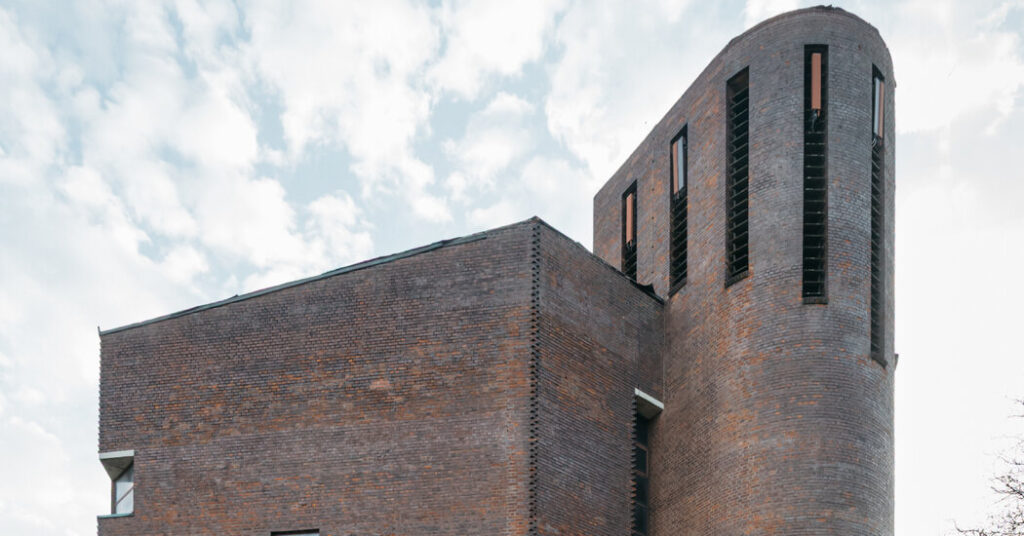
The St. Marien Church is a mid-20th-century Brutalist landmark in northern Essen, Germany, with a dark brick facade and handmade stained-glass window that lets in a soft, diffuse light.
Since June, tens of thousands of art lovers have flocked to St. Marien for an exhibition featuring a performance-art piece in which two Korean singers translate bird song for the human voice; a sculpture made of overturned plastic shopping carts; and a video installation by the Danish group Superflex titled “Sleeping Jesus.”
The exhibition, which is part of the biennial Manifesta 16 Ruhr, is likely to be the church’s last hurrah. When Manifesta closes in October, St. Marien is slated for demolition.
It is one of more than 20,000 churches across Germany that is expected to be abandoned in the next five to 10 years, said Hedwig Fijen, the director of Manifesta. And further thousands of churches across Western Europe are expected to become vacant in the coming years as their societies’ connection to Christianity wanes.
There is no central plan for what to do with the buildings, but secular cultural organizations, artists, preservationists and city planners are looking for ways to repurpose them for the benefit of their cities and towns — whether as health care centers, bookstores or spaces for the arts.
“Every day, another church is sold,” said Lilian Grootswagers-Theuns, the president of the advisory board for Future for Religious Heritage, a Belgium-based nonprofit network that focuses on empty religious buildings. “This is happening everywhere in Europe — in Germany, Sweden, Spain and Italy.”
“It’s already going very fast,” she said. “But now we’re going fast-forward. Now, there’s a tsunami coming.”
Churches, once central to European cultural life, were typically situated in the heart of a city and built to last. “Before you even had the nations, you had a European tradition going back to the fourth century of having a church for each city, each village,” said Barbara Welzel, a professor of art history and cultural education at the TU Dortmund University in Germany.
Church attendance has been steadily dropping since the mid-20th century because of changing social norms, scandals that drove congregants away and demographic shifts on the continent. (A Pew Research Center report issued last year found that about two-thirds of Europeans identified as Christian in 2020, a drop of about 9 percent from a decade earlier. Many Europeans who said they had been raised Christian also described themselves as “religiously unaffiliated.”)
These days, parishes may merge or unused churches be sold for private use, like homes or hotels. Sometimes communities rally to save their local church buildings and use them as tourist sites, cultural venues or health care centers.
Some priests simply walk away. “In some churches, they really throw away the key,” Fijen said. “I’ve found sacred objects in the garbage bin.”
Although many Europeans no longer regularly attend church, communities often want to retain the buildings, which are ornate, spacious and durable, for other shared activities.
“These buildings have been places that provide a sense of social security — people are helping each other, visiting elderly people, offering support to the poor and immigrants,” said Grootswagers-Theuns, a founding member of Future for Religious Heritage. She took up the issue in 2005, when her local church in the southern Netherlands was about to be shuttered.
“They are related to the livability of a society,” she added.
Manifesta is a roving art biennale that typically develops a program of cultural activities and exhibitions with a single city. This year, the curators and collaborators created projects this year in abandoned or decommissioned churches throughout the Ruhr region of western Germany, a former mining and industrial area. So far, about 117,000 visitors have attended.
Most of the churches were rebuilt after World War II to help promote a form of community life called “the 15-minute city,” built around a central hub that included a church, a kindergarten, a school and a retirement home. But since 1950, church attendance among West Germans has plummeted — from more than 90 percent back then to 50 percent today, according to Manifesta.
The biennial’s curators proposed various options for converting these deconsecrated churches, including art and musical installations, a tea garden, an indoor beach and even a basketball court. The idea, Fijen said, was to make the buildings once again relevant to their communities, where people feel increasingly cut off from one another and may need communal spaces to meet. Most of the repurposings came about through collaboration with locals.
“We have a loneliness problem in the younger generations, and people want to find ways to connect,” Fijen said. “The need for communal space is more and more urgent, so the discussion about what to do with those spaces all over Europe is also increasingly urgent.”
In some ways, the Netherlands is ahead of the trend, with many religious buildings there having been converted into cultural venues during a wave of secularization in the 1960s and ’70s. (Of about 7,000 churches in the country, about 1,700 have already been closed or sold, Grootswagens-Theuns said, and she expects a sharp surge in that number in coming years.)
In Amsterdam, they became nightclubs, breweries and exhibition halls. In Grootswagers-Theuns’s community, when locals mounted an effort to save the church building, it ultimately became a health care center. In Maastricht, a centuries-old Dominican church was converted into a bookstore in 2006.
In Scandinavian countries, many church properties are owned by the state, which maintains the buildings and ensures that they stay open, said Henrik Lindblad, a heritage researcher affiliated with Uppsala University in Sweden — even as some are operating with few congregants.
“I call them zombie churches,” Lindblad said in an interview, adding that the goal was to “transform them into living heritage by transforming them into public, community spaces.”
Even Southern European countries like Italy, Portugal and Spain, which have traditionally had stronger ties to the Roman Catholic Church, are not immune to the changes, said Rolando Volzone, an Italian architect and researcher at Institute of Medieval Studies in Portugal.
In Portugal, when the state dissolved the Catholic religious orders in the 19th century, most monasteries and convents were emptied, the properties sold and repurposed as hospitals or schools or divided into private residences, Volzone said. Today, however, there is a an effort among disparate groups to try to find additional public reuse for such structures.
“If we look at these spaces not just as containers but as a way to congregate,” Volzone said, “we can come up with good solutions that still maintain the spirit of the place.”
The post What to Do With Europe’s ‘Zombie Churches’? These Artists Have Some Ideas. appeared first on New York Times.