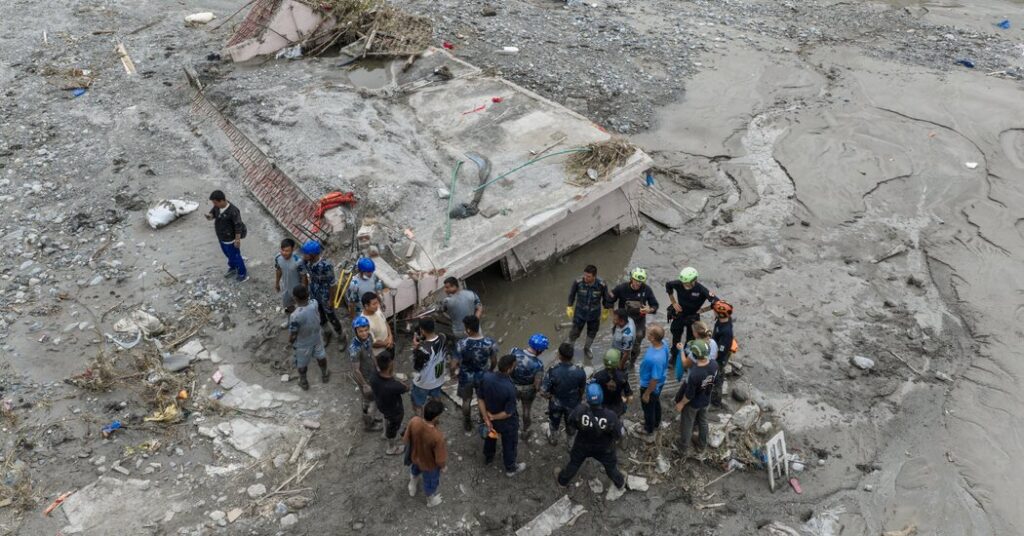
Rescue workers in Nepal recovered two flood survivors on Saturday in separate operations, 10 days after a catastrophic deluge tore through the country’s northern river systems.
The two people, a Chinese man who was buried in a hydropower tunnel where he’d been working and a Nepali woman stranded in a ravaged house, managed to stay alive well beyond the 72-hour window after which rescuers say the chances of surviving a natural disaster usually drop off.
At least 1,200 people were killed in the floods last week, when a glacial collapse in the Himalayas sent tsunami-like waves through valleys along the border of Nepal and the Tibet region of China. Another 5,000 people are missing.
Rescue efforts in recent days have become focused on the hundreds of men who were working underground at the time of the disaster, building the power stations that form the basis of Nepal’s budding hydropower industry. The country’s army said that an international rescue team had pulled the Chinese worker saved on Saturday from inside a 740-foot tunnel in the Upper Trishuli-1 hydropower project.
“His health is currently being assessed, and further search and rescue operations are continuing,” the army said in a statement. It did not immediately confirm the man’s name.
A spokesman from South Korea’s foreign ministry said the 44-member Korea Disaster Relief Team was involved in the operation. The team’s very first lifesaving operation was also conducted in Nepal, after terrible earthquakes in 2015.
Emergency workers have focused their efforts on power stations in part because the trapped workers may have been better able to shelter from the force of the floods than the thousands of people living alongside the rivers, who bore the brunt of the deluge’s force.
Chandika Shrestha, the woman saved on Saturday, defied those odds.
Ms. Shrestha, 64, was found unconscious, but alive, at a house in Betrawati, a town that was almost entirely swept away in the torrent. Ms. Shrestha’s family had come to check the house and called the authorities when they heard a noise, said Indraprasad Gotame, a member of the provincial council who observed the rescue by the Nepali Army.
About two-thirds of the house was buried in sludge. It had been lifted from its foundation and washed about 200 meters downstream, Mr. Gotame said. Only the upper half of a top-floor window was still visible above the muck and grime. Ashish Shrestha, Ms. Shrestha’s son, said in an interview with The New York Times that his mother was being taken for surgery.
The little town center near where Ms. Shrestha was found is almost entirely wiped out. There is no trace of the bazaar that once comprised about 200 shops on either side of the river. There is nothing of the two bridges that connected both sides. The two-story building that once housed the police station was, similarly to Ms. Shrestha’s house, ripped from its roots and deposited on its side. Ms. Shrestha’s husband is still missing, the authorities said.
In the two wards that straddle the river, nearly 300 people are missing, officials said. Ganesh Kumar Nepal, a ward chair, said that workers had been stationed in the area of Ms. Shrestha’s house for search and rescue. They had visited the house earlier but had not found her, perhaps because they did not check properly, he said.
The improbable rescues on Saturday came a day after two Nepali workers were found alive in a tunnel below the Upper Trishuli 3A hydropower project, downriver from the site of Saturday’s rescue. One of the workers, Sanjay Sah, estimated that there were 40 or 50 others at his work site when the disaster struck. He knew of no others who might still be living, he said.
In February, the deputy director of the labor ministry in Nepal told local media outlets that about 1,600 Chinese citizens were living in Nepal on work permits. That made China the biggest source of foreign workers in Nepal — not counting India, which sends its citizens back and forth across the Nepali border freely.
Chinese engineers are especially visible at Nepal’s hydropower and other infrastructure projects. The man saved on Saturday emerged from the tunnel wearing a uniform with the logo of Power China, a state-owned company.
Chinese government media reported that the man had seen the lights of search and rescue teams several times in the days before he was found. He was silent when their lights finally hit his face, he told them, because he had already given up hope.
Alexandra Stevenson contributed reporting.
The post Two Survivors Rescued in Nepal 10 Days After Floods appeared first on New York Times.