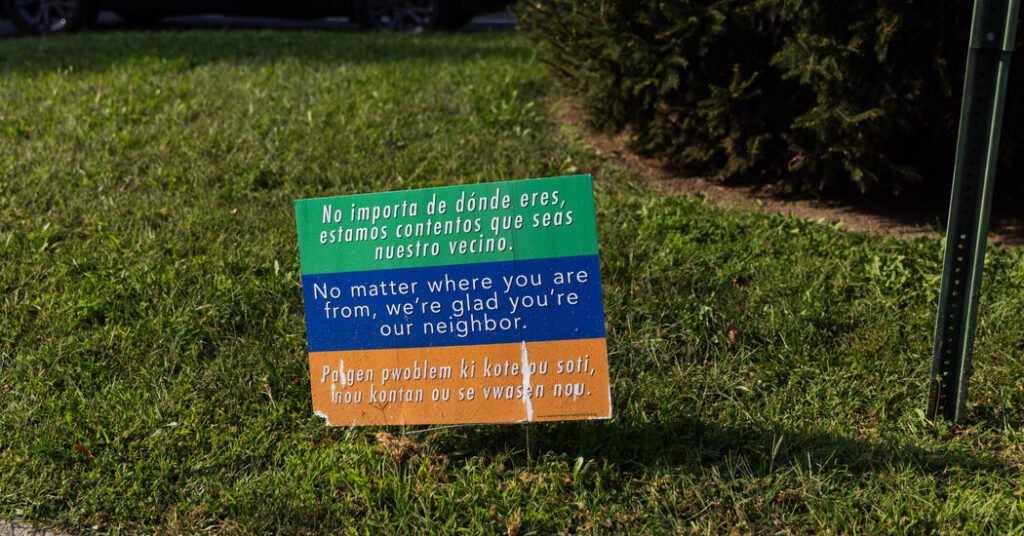
Pierre Damas Bel wanted to be a doctor.
He came to the United States in 2024 to reunite with his parents, who had fled Haiti three years earlier fearing for their lives. Living in Springfield, Ohio, he had temporary protected status and a pending asylum case. Bel took quickly to life in the United States. He was a member of the Marine Corps Junior Reserve Officer Training Corps. He played soccer. He graduated from high school with honors and recently started as a freshman at Wright State University, just a half-hour drive from his home.
Not too long after Pierre Damas Bel arrived in the United States, Ohio’s junior senator, JD Vance — then running to be vice president of the United States — accused the Haitian community in Springfield of stealing and eating the pets of their neighbors. “Reports now show that people have had their pets abducted and eaten by people who shouldn’t be in this country,” he said on X. These “reports” were false but, as Vance would explain later, they were useful: “If I have to create stories so that the American media actually pays attention to the suffering of the American people, then that’s what I’m going to do.”
After Vance created his story, Donald Trump amplified the charge to a prime-time audience of 67 million people during his debate with Kamala Harris. “They’re eating the dogs, the people that came in, they’re eating the cats.”
The conservative media apparatus then went to work. Fox News broadcast the smear far and wide. Christopher Rufo of the Manhattan Institute, a professional provocateur and propagandist known for his gleeful race baiting, offered a “$5,000 cash bounty” to anyone who had evidence that Haitian immigrants were eating pets in Springfield. He later posted a video purporting to show just that. It was a lie; the people in the video were eating chicken.
Building on the frenzy, Trump spun a new tale. “Twenty thousand illegal Haitian immigrants have descended on a town of 58,000 people, destroying their way of life,” he said at a rally in Tucson, Ariz. “Residents are reporting that the migrants are walking off with the town’s geese. They’re taking the geese. You know where the geese are, in the park. And even walking off with their pets.”
Trump had long disparaged Haiti as a country that is “filthy, dirty” and “disgusting.” He has said that Haitians “probably have AIDS” and that Haitian immigration is “like a death wish for our country.” If elected president again, he promised, he would start his mass deportations in Springfield.
In July, the Trump administration revoked the temporary protected status of hundreds of thousands of Haitians, including Pierre Damas Bel. Bel was ordered, like many others, to a local ICE office to receive an ankle monitor, which is one way the agency tracks immigrants it seeks to remove from the country.
Ankle monitors are heavy and uncomfortable. They constrict movement and wearing one can be painful. They’re also easy to see — a visible stigma and a mark that, in the eyes of the government, you are a suspect person.
Bel felt that stigma. Hobbled by the monitor, he could not play soccer as he used to. His peers mocked him. When his R.O.T.C. instructor handed students their uniforms, he did not receive one. His father, Pierre Ronal Bel, believes it was because of the device. On Instagram, Bel shared a picture of the ankle monitor. “I came to this country to pursue my education. I didn’t come here to commit a crime or hurt anyone,” he wrote. “Yet now I’m walking through the streets of the United States with a GPS monitor on my leg, carrying a feeling of shame and humiliation that I never imagined I would experience.”
On Monday morning, Pierre Damas Bel called his father. “I’m not feeling OK,” he said. His father told him to come home so they could talk.
That afternoon, Vice President Vance was in Michigan to campaign for Mike Rogers, the Republican candidate running for Senate. During his speech, Vance accused Abdul El-Sayed, Rogers’s Democratic opponent, of dividing the country. “If you look at his politics, it is all about saying, ‘This group of people is good, this ethnicity is bad, and I’m going to fight to give from the bad group of people to the good group of people.’ I think that’s a despicable way to think about your fellow Americans.”
Vance is right: This is a despicable way to think about your fellow Americans. But then the vice president has a narrow view of what it means to be an American. For him, it is defined by blood, soil and heritage. It does not apply, for example, to the Haitians of Springfield. They can be smeared and libeled and hounded and hunted. They can be treated as less than human. They can live under a miasma of hate brought on by him, his boss and their enablers.
Sometime before 8:45 a.m., but after the call to his father, Pierre parked his car on the shoulder of the Interstate in Springfield. Hours later, police officers arrived at Pierre Ronal Bel’s home to tell him that his son “threw himself under a truck.” He was pronounced dead at the scene.
Pierre Damas Bel was just 20 years old.
What I Wrote
This week, I wrote about the distinct possibility that the president of the United States is delusional.
One wants to believe that the president of the United States, cloaked in immense power, would understand the difference between reality and fantasy. One would hope, given the terrible stakes of his decision-making, that he had the capacity to understand and internalize objective reality, even if he did not like it.
I was on the “Strict Scrutiny” podcast with Kate Shaw talking Supreme Court reform. I was also on the “This Guy Sucked” podcast talking George B. McClellan with Claire Aubin. And in the latest episode of my podcast with John Ganz, we talked about the 1998 “X-Files” movie.
Now Reading
Omer Bartov on antisemitism for The New York Review of Books.
Bryce Covert on Trump’s war on fair housing for The American Prospect.
Jane Kramer on Gloria Steinem for The New Yorker.
Angelica Jade Bastién on “Coyote vs. Acme” for New York.
Corey Atad on “The Odyssey,” “Planet of the Apes” and Christopher Nolan for his Substack newsletter.
Photo of the Week
The Baha’i House of Worship in Wilmette, Ill. I took this earlier this year during a trip to Northwestern.
Now Eating: Frijoles Charros
Every week I make two pots of beans. And almost every week one of those pots of beans is a pot of frijoles charros, my absolute favorite bean dish (next to a Greek gigantes plaki). You should take this recipe as a recommendation more than a command. If you want to omit the bacon, go for it. If you want to bulk up on garlic and chiles (I like to add a chipotle chile), go for it. If you want to make it more substantial with chorizo and greens, go for it. This is a versatile dish that you can easily make your own. Serve with rice or cornbread or fresh tortillas (corn or flour, your choice!). Recipe comes from Serious Eats.
Ingredients
-
1 pound dried pinto beans
-
6 cups homemade or store-bought chicken stock
-
2 bay leaves
-
2 sprigs epazote
-
12 ounces diced bacon
-
1 medium white or yellow onion, diced
-
2 serrano chiles or 1 jalapeño, minced
-
3 medium cloves garlic, minced
-
2 14-ounce cans diced fire-roasted tomatoes (see note)
-
Large handful chopped fresh cilantro leaves and fine stems
Directions
Place beans in a large bowl and fill with enough cold water to cover by at least four inches. Let soak 8 to 12 hours. Drain and rinse.
In a large Dutch oven, add beans, stock, bay leaves, 2 teaspoons kosher salt, and epazote (if using). Bring to a boil over high heat, reduce to a bare simmer, cover, and cook until beans are just tender, about 45 minutes.
Meanwhile, heat bacon in a 12-inch stainless steel or cast iron skillet over medium-high heat. Cook, stirring constantly, until fat is rendered and bacon is just starting to brown around the edges, about 5 minutes. Add onion and chiles and cook, stirring, until softened and just starting to brown, about 4 minutes. Add garlic and cook, stirring, until fragrant, about 30 seconds. Add tomatoes and cook, stirring and scraping up browned bits from the bottom of the pan, until the liquid is thick and the mixture begins to sizzle, about 3 minutes.
Remove lid from Dutch oven, add bacon-tomato mixture, and continue cooking, stirring occasionally, until beans are completely creamy and liquid has thickened into a rich, creamy broth, about 20 minutes. Season to taste with salt. Discard bay leaves, stir in cilantro, and serve. Beans can be stored in the refrigerator for up to 1 week.
The post This Is No Way to Think of Our Fellow Americans appeared first on New York Times.