New York City has joined the push to reopen a pathway that cuts through Columbia University, nearly three years after the school closed the walkway to the public at the onset of campus protests over the war in Gaza.
Mayor Zohran Mamdani’s administration said it supports reopening Columbia University’s campus, according to a Sept. 3 court filing in New York State Supreme Court. The support is a change of course for the city; Mayor Eric Adams’s administration had previously not taken a position on the matter.
Some of the university’s students and neighbors sued the school in 2025, arguing that the closure violated a 1953 agreement between the school and the city government that made the walkway, known as College Walk, public space. The campus is in the Morningside Heights neighborhood, where residents, many of whom are seniors, have complained that their activities were curtailed by the lack of access to the campus grounds.
“On a daily basis, I am embarrassed by seeing visitors from the neighborhood and around the world turned away at the gates of a university I love,” said Toby Glick, the lawyer representing the parties in the lawsuit, and a Columbia alumna. “I am very pleased that New York City has now — as it did when it first gave a public street to Columbia to create College Walk — agreed with us that the gates should be reopened to the public.”
A spokeswoman for Columbia University said that the school would not comment on pending litigation. In previous statements, Columbia has said that it is focused on ensuring that its students feel welcomed and safe and balances that with the desire for an open campus.
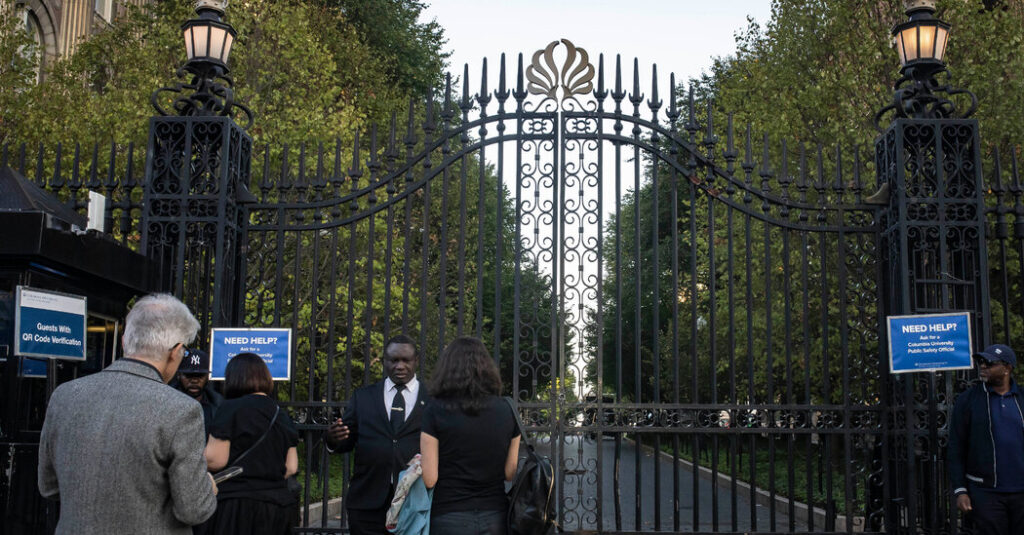
The iron gates at the entrance of the school were an $89,000 gift from the philanthropist George Delacorte and remained largely decorative up until they were locked shut on Oct. 12, 2023, days after Hamas attacked Israel, killing about 1,200 people and capturing roughly 250 hostages. Israel responded with a yearslong bombardment of Gaza which has resulted in the deaths of at least 70,000 Palestinians. In the months following the initial attack, protests erupted at Columbia and colleges across the country, grinding normal student life to a halt.
Students must enter campus through a barricade, showing student identification cards. The closure of the campus, which stretches from 114th Street to 120th Street between Broadway and Amsterdam Avenue, shut off College Walk, a cut-through on 116th Street, which took pedestrians through the school grounds. Without the path, they must instead walk around the campus to get between the avenues.
In a statement on Saturday, Dave Robinson, the president of the Morningside Heights Community Coalition, said that the city’s support for reopening the campus was “a welcome development.”
“This shift in position by the mayor will provide needed momentum to the growing movement of students, faculty and neighbors to open the gates,” Mr. Robinson said.
The coalition has a rally planned for Sept. 8, the first day of fall semester classes at Columbia.
Beyond irritation, the issue of closing the campus also had ramifications for the role college campuses have played as town squares across the country. Campuses and public streets have long been gathering areas for protesting, but after the pro-Palestinian encampments popped up on campuses nationwide in 2023 and 2024, institutions moved to seize greater control of their grounds in order to reign in demonstrations. However, not all colleges had the ability to simply close their gates.
A spokesman for the mayor’s office did not provide comment on Saturday beyond what was stated in the court documents.
Sharon Otterman and Anna Kodé contributed reporting.
The post New York City Supports Push to Reopen Columbia Pathway to the Public appeared first on New York Times.