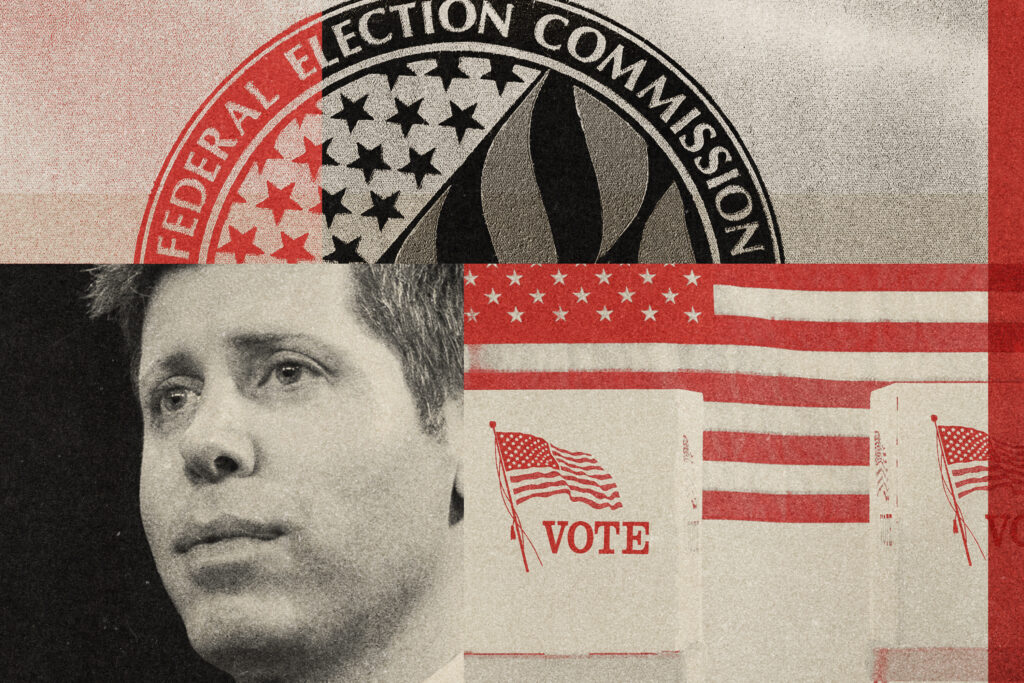
Artificial intelligence has subtly entered the machinery of the 2026 midterms, with major-party candidates acknowledging in campaign filings and website fine print that they are using the technology to court voters — despite limits imposed by leading AI companies to protect elections from the technology’s risks.
A Washington Post analysis of campaign finance disclosures found that 39 congressional candidates reported paying for an OpenAI subscription this election cycle. Two said explicitly in filings that they had used the subscription for advertising, even though the company’s policies prohibit candidates from using their tools to generate ads.
Another candidate disclosed using AI to draft and personalize political messages or create synthetic media, though they did not specify which software they were using.
Rep. Mike Lawler (R), who is running for reelection in a suburban New York district, was the candidate who reported spending the most money on OpenAI since 2025, paying around $3,260 for ChatGPT, according to the Post analysis. (The Post has a content partnership with OpenAI, which owns ChatGPT.)
“We are running the most organized and sophisticated congressional campaign in the country, and we utilize every legitimate tool that helps our team improve productivity. Any campaign that doesn’t would be foolish,” said Lawler’s spokesperson, Ciro Riccardi. But the campaign will “spend more money on pizza for volunteers” than it will on AI tools, Riccardi noted.
Around 30 PACs and parties have reported payments to OpenAI, with the Republican National Committee ranking as the company’s largest political spender at roughly $9,700, the analysis found. Representatives for the RNC did not immediately respond to a request for comment.
Political consultants say the disclosures understate how many candidates are using ChatGPT and other AI tools to craft messages for voters. Candidates have little incentive to disclose that they’re using AI tools at a time when voters are increasingly critical of the technology.
“We know it’s happening, but no one is talking about it,” said Eric Wilson, a Republican digital strategist who has advised campaigns on AI. “For the most part, people are using it to write their emails, write their ad copy, write their scripts. But no one is going to go around saying, ‘I’m using AI.’”
The lack of transparency from campaigns reflects a paradox facing politicians: Generative AI is growing ubiquitous, and candidates could be at a disadvantage if they’re not using the tools. But voters are less likely to trust messages they know were generated with AI, studies have found, making campaigns loath to disclose using it.
Political consultants expect that as Election Day approaches, more campaigns will outsource AI-generated ads and materials to super PACs, much as they do now with negative ads. Katie Harbath, CEO of the tech policy consulting firm Anchor Change and a former Meta executive, said there are many parallels between negative campaign ads and AI: Voters say they find such ads distasteful, but politicians keep using them because they work.
“Typically, you would give some more negative stuff and more risky stuff to those [outside] entities,” said Harbath, author of the upcoming book “Disrupting Politics.”
Republicans have been more willing to embrace AI to date, as President Donald Trump and the White House frequently share memes and videos that were clearly AI-generated. But Democrats are increasingly willing to use the tools.
“You’re starting to see the tension on the left about using it, where they’re saying, ‘If the right is using it, why aren’t we?” Harbath said. “It can be a huge disadvantage if you’re not using this in voter-facing materials.”
Researchers fear wide use of AI could also open a new era in disinformation, making it faster and cheaper to spread targeted political falsehoods.
Facebook, which is now called Meta, faced backlash in 2018 after news that Cambridge Analytica, a data firm, had harvested information from more than 87 million Facebook users to build profiles that political campaigns used to target their ads.
Tech executives and researchers have worried that AI could supercharge this kind of microtargeting, allowing campaigns to send millions of different, personalized messages to individual voters.
AI companies have developed policies to prevent targeted disinformation. But a Post analysis found that OpenAI unevenly enforces its restrictions, making it possible for campaigns to circumvent its election rules.
In late July and early August, The Post prompted ChatGPT to generate targeted campaign messages. When asked to craft fundraising text messages targeting moms on behalf of a female veteran running for office, ChatGPT produced multiple tailored texts in an apparent violation of company policies. But when given the same prompt this week, the chatbot declined to produce the messages. “I can help with general campaign fundraising language, but I can’t draft political persuasion or fundraising messages specifically targeted at a demographic group such as moms,” the app responded.
The chatbot also inconsistently enforced rules that prohibit campaigns from using its tools to write emails to voters. In tests this week, the chatbot at times complied and wrote an email soliciting donations on behalf of a specific candidate. But given the same prompt later on the same day, it denied the request.
OpenAI says it is constantly making updates to its products to ensure they comply with its policies. A refusal to carry out a prompt is only one of the ways it is preventing its tools from being abused by campaigns, the company said.
“We are clear about how campaigns can use our tools: for responsible, human-directed work that helps make routine internal tasks more efficient, such as research, planning, administration, and budgeting. Our policies outline prohibited uses and apply to everyone,” OpenAI spokesman Nate Evans said in a statement.
Wilson, the Republican political consultant, said OpenAI should get more feedback from political consultants and campaigns on its policies, because the rules can at times seem arbitrary or contradictory. It doesn’t make sense, for example, that a campaign can use ChatGPT to develop its policy on early-childhood education but not to create a social media post promoting that policy, he said.
Political consultants are primarily using AI for internal tasks, a survey earlier this year from the American Association of Political Consultants found. Fifty-seven percent of the consultants surveyed reported using AI for their work on a daily basis, up from 34 percent a year earlier.
Researchers, policymakers and even some tech workers have warned of the potential for a “deepfake election,” in which an AI-generated image or video could falsely portray a candidate’s behavior and sway an election.
So far, election-related deepfakes have been quickly debunked or gained little traction in U.S. elections. The most prominent instance was a robocall in the 2024 election that purported to be President Joe Biden. It was swiftly identified and prompted fines from regulators.
More than 30 states have created a patchwork of laws limiting how politicians can use deepfakes in campaigns, but states often have limited resources to enforce the laws, and some have been challenged as unconstitutional.
“We’re going to be less and less concerned about the ability of these tools to generate an image,” said Julie Sweet, director of advocacy and industry relations at the American Association of Political Consultants. “The more interesting question down the road is going to be like, what happens when this becomes the way that we gather and learn and become informed citizens?”
The post ChatGPT bans campaigns from using AI to make ads. They’re doing it anyway. appeared first on Washington Post.