Timothy Carney, a diplomat who relished difficult assignments in war-torn countries and pushed against bureaucratic restrictions, died on Aug. 10 at his home in Cambridge, Mass. He was 82.
His death, from cancer, was confirmed by his wife, Victoria Butler.
In a State Department career that took him from Saigon and Phnom Penh during the Vietnam War, to South Africa during the final years of apartheid, to ambassadorships in Sudan and Haiti as those countries disintegrated, to Iraq after the U.S. invasion, Mr. Carney proved willing to challenge conventional thinking and to go places other diplomats avoided.
He foresaw the looming menace of the Khmer Rouge dictatorship in Cambodia in the mid-1970s, and engaged with Afrikaners in the mid-1980s, convinced they were opening up to the idea of majority rule in South Africa. He opposed closing the U.S. embassy in Khartoum, the capital of Sudan, in 1996 while Osama Bin Laden established himself there — the closure deprived America of a valuable listening post. He was skeptical of the former Haiti president Jean-Bertrand Aristide, seen by many in Washington as a valuable ally, as Mr. Aristide prepared to retake power. In Iraq, Mr. Carney was publicly disgusted with the absence of American planning.
Colleagues said he didn’t hesitate to engage with U.S. foes, believing that to be the diplomats’ best role. “He wasn’t afraid of anybody,” the former U.S. ambassador Robin Raphel, who knew Mr. Carney for decades, said in an interview.
“You don’t make deals with your friends, you make deals with your enemies,” Ms. Raphel said, describing Mr. Carney as “pro-engagement in a way that makes perfect sense.” She added: “Serious people paid attention to him.”
Unusually for a diplomat, Mr. Carney insisted on seeing things for himself, even at the cost of incurring the wrath of his superiors.
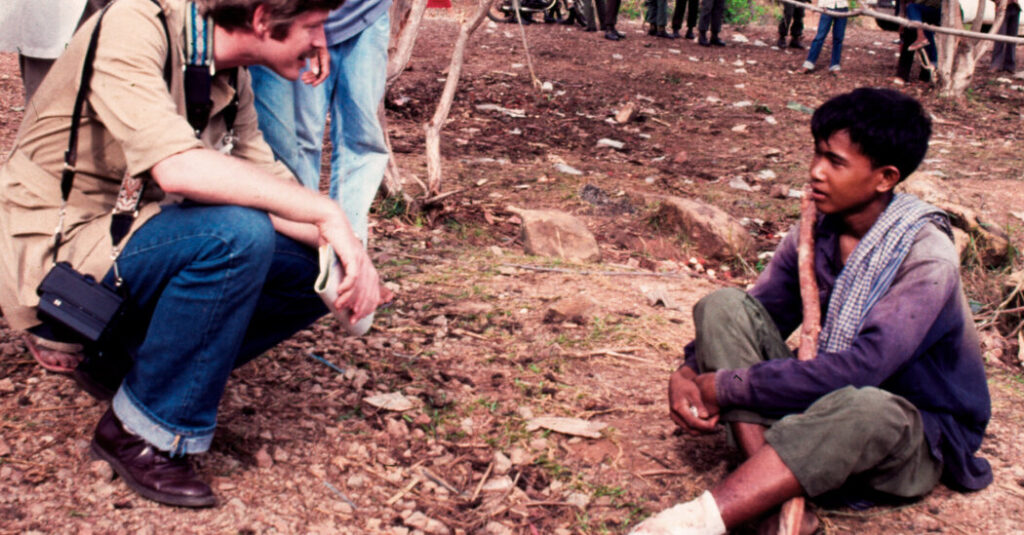
As Phnom Penh, the capital of Cambodia, was being rocketed by rebels in 1972, Mr. Carney — then a junior official in the U.S. embassy — jumped into a car with a Cambodian journalist and soon found “a little kid” who “had been chopped up by a chunk of casing from this 122 mm rocket, and was dead,” Mr. Carney told an interviewer in 2002 for a State Department oral history project.
Undeterred, “we heard a lot of automatic weapons fire from further south,” he said, “and we drove down there to see what was going on.”
The next day, he reported all of it to his bosses at the embassy. They were horrified.
“One didn’t do that,” Mr. Carney told the interviewer in 2002. “You weren’t supposed to put yourself at risk, which struck me as a very bizarre way to do foreign affairs reporting in a war. You have to get out, meet people, and be out of the embassy as much as you possibly could.”
That approach — leaving the embassy — was, and remains, untypical for State Department officials. In an era of heightened security concerns, American diplomats typically stay behind the embassy’s Marine-guarded walls, venturing out only for official events
“He was where no other foreign service officer would be,” Elizabeth Becker, a journalist with extensive reporting experience in Cambodia, said in an interview. “He treated Cambodians with a kind of dignity I did not see from others.”
In April 1975, with the murderous Khmer Rouge closing in, he drove to the prime minister’s house to urge government ministers to evacuate via helicopter. “Nope,” he recalled. “Only one went with us.”
He followed the same path 10 years later in South Africa, where as a political counselor at the U.S. embassy in Pretoria, he went to parties with Afrikaners, some of whom defended apartheid, while meeting others who were “serious, engaging, ruthless, but they had the real interest” in ending it, unlike more outwardly liberal South Africans who he believed paid lip service to change.
“No matter how unstable the political environment and how tense relations could be, Tim always maintained the highest level of professionalism and tenacity,” former President Bill Clinton, who appointed Mr. Carney as ambassador in Sudan and Haiti, wrote on Facebook after his death. Mr. Clinton added that Mr. Carney “always believed that diplomacy was the essential key to reducing instability and promoting peace and prosperity.”
When Mr. Clinton sent Mr. Carney to Sudan in 1995, the country was a safe harbor for Islamist terrorists, and boiling with insurgency. Bin Laden had found refuge there after leaving Saudi Arabia in 1991. For Mr. Carney it was an ideal spot from which to gauge the terrorist threat ahead.
But officials in Washington, led by Susan Rice, the National Security Council senior director for African Affairs at the time, were nervous about threats to the diplomats in Khartoum, and moved them to Nairobi early in 1996.
For Mr. Carney, it was a big mistake. He had been keeping an eye on Mr. Bin Laden but could no longer do so. “We took our eye off the ball,” he later told Roger Cohen of The New York Times. “We did not know what was happening in Khartoum, a center of extremist Islam.”
The same bluntness characterized his response to the chaos of Haiti, where he arrived as ambassador in January 1998 — “no trees except at the embassy residence” he said in the State Department oral history interview — and quickly took the measure of Mr. Aristide, who was regarded with indulgence on Capitol Hill.
“He was more of the same,” Mr. Carney told the state department interviewer. “He himself certainly tolerates corruption as a way of manipulating people. Interesting.”
Timothy Michael Carney was born on July 12, 1944, in St. Joseph, Mo., one of three children of Col. Clement Carney, a career army officer who was a judge in the Judge Advocate General Corps, and Jane (Byrne) Carney, an English teacher. The family moved often when Mr. Carney was growing up, and two of those years were spent in Taipei.
He graduated from Christian Brothers High School in St. Joseph in 1962, and from the Massachusetts Institute of Technology with a Bachelor of Science in 1996.
His first foreign service job came the following year with a junior posting at the embassy in Vietnam, and from 1969 to 1971 he was posted to the embassy in Lesotho.
After his tour in Cambodia ended in 1975, Mr. Carney studied at Cornell University, served in Washington on the State Department’s Vietnam, Laos and Cambodia desk, and was appointed to the U.S. mission in Thailand from 1979 to 1983.
During the 1990s, Mr. Carney undertook several missions for the United Nations, including as adviser to the U.N. representative in Somalia in 1993.
Mr. Carney retired from the State Department in December 1999. He returned to government service for several months in 2003 as a member of the Office of Reconstruction and Humanitarian Assistance, the agency established under the Department of Defense to help reconstruct Iraq.
He left Baghdad after two months, frustrated by what the writer David Rieff called a “dialogue of the deaf between ORHA officials and the U.S. military on the ground in Iraq.” He returned to Iraq for several months in 2007, and assisted the State Department in Kabul in 2009.
In addition to his wife, a journalist and writer, whom he married in 1983, Mr. Carney is survived by his sister, Sheri Carney; his daughter, Anne Carney, from his previous marriage with Demaz Tep Baker; and two grandchildren.
“Tim was very deeply committed everywhere he served,” Ms. Bolton said in an interview. “Everywhere we went he got to know the people where we lived. He believed very strongly in soft power versus hard power. He was an old school kind of diplomat.”
Sheelagh McNeill contributed research.
The post Timothy Carney, Diplomat Who Went Places Others Avoided, Dies at 82 appeared first on New York Times.