The Tetris Company, the company that owns the rights to the classic video game, denounced a clone of the game produced by the Trump administration that has the player block space aliens and zombies from crossing the U.S.-Mexican border.
It was the latest incident in which an owner of a creative work objected to the Trump administration’s use of it.
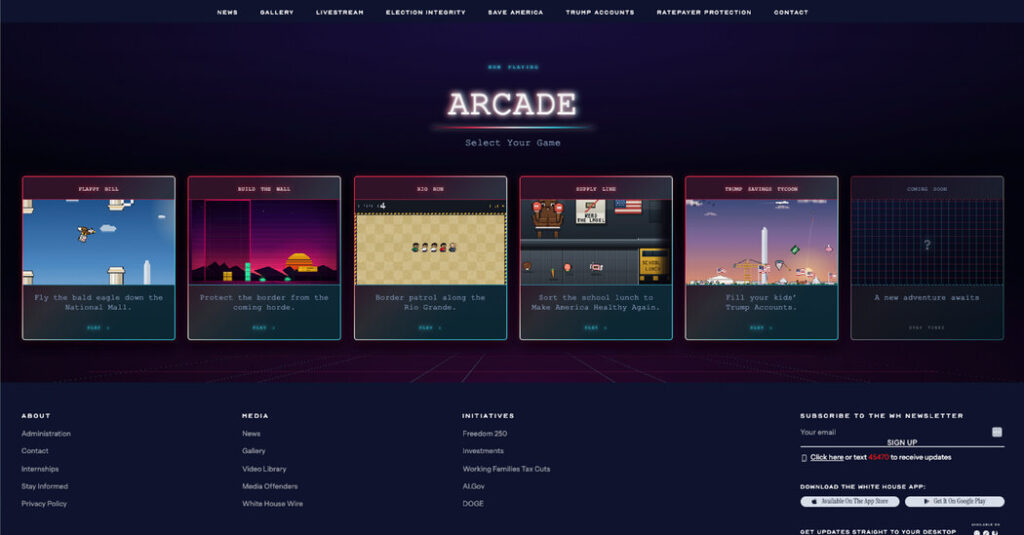
Build the Wall, the White House version of Tetris, urges the player to “protect the border from the incoming horde,” which is rhetoric that President Trump and members of his administration often use about immigrants.
“The Tetris Company was not involved in the creation of ‘Build the Wall,’” the company said in a statement on social media, adding that “at Tetris we believe in the power of connection and bringing people together, not dividing them. To our fans everywhere: we love you, we see you, and we’re grateful to have you in our community.”
On Thursday, the White House shared a page on its official government website that featured five simple video games that promoted Trump administration policies. They are clones of existing games, and the Tetris clone is called Build the Wall with the subtitle Zombie Border Siege.” Another game called Rio Run is a clone of the Snake game, where players catch and imprison an increasingly long line of immigrants on the southern border.
Tetris is a puzzle game. Blocks of different shapes fall down the screen and must be sorted into complete lines as they fill up the screen, gradually accelerating. The game was created by Alexey Pajitnov, a Soviet software engineer, in 1984. The Tetris Company continues to license many variants of the game, some of which are marketed to children with Nintendo cartoon characters like Mario, Kirby and Donkey Kong.
Build the Wall has those blocks take the form of the southern border wall, physically blocking aliens and zombies that explode when they collide with the wall.
In its statement, the Tetris Company added, “P.P.S. We take copyright infringement very seriously.”
The Tetris Company won a significant copyright case in 2012 against a company that made a Tetris clone, a ruling that reinforced that the owner of a video game could protect the “look and feel” of the game under copyright law.
A social media video accompanying the White House games also invoked Sega, the creators of Sonic the Hedgehog. The intro to the video includes an image mimicking the company’s logo, a recording of the company’s name being sung and a copyrighted song from the Sonic games.
A long list of musicians have denounced Mr. Trump using their music at his rallies, and some have taken legal action to protect their copyrighted material. In November, the musician Olivia Rodrigo, who is Filipino American, condemned the use of her music in a post by the Department of Homeland Security promoting the Trump administration’s mass deportation effort, writing underneath the post: “don’t ever use my songs to promote your racist, hateful propaganda.”
Trump administration social media posts have sometimes sought to appeal specifically to gamers, especially young men who voted for Mr. Trump in 2024.
One noteworthy post in October by the Department of Homeland Security equated immigrants to the flesh-eating aliens known as “the Flood” in the Halo video game series. The post, which featured an image from the game of a machine-gun armed vehicle, included the caption: “destroy the Flood” with a link to the recruiting website for Immigration and Customs Enforcement.
Microsoft, which owns Halo, said in a statement at the time that the company “does not have anything to share on this matter.”
The post Tetris Owner Denounces Trump White House Clone of Game appeared first on New York Times.