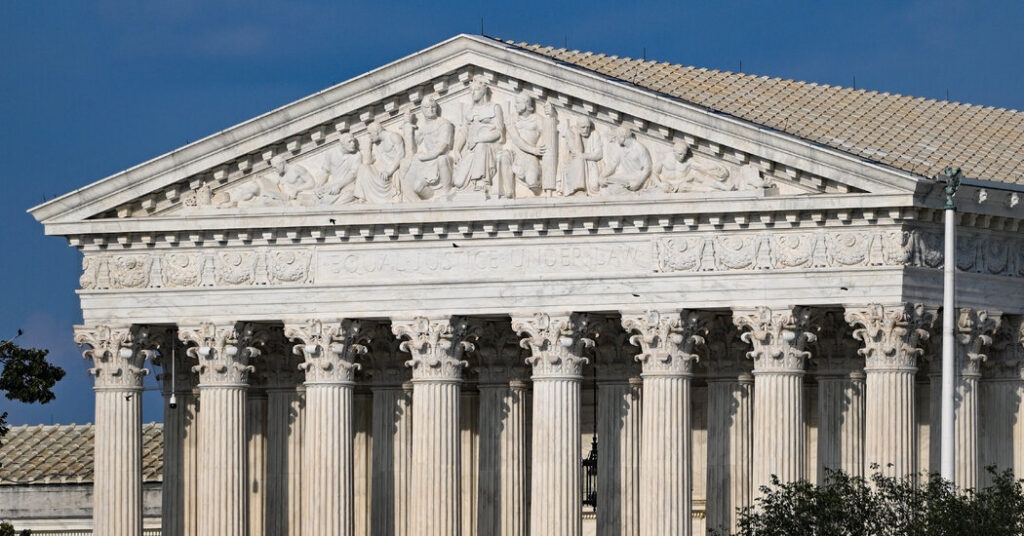
In a victory for Republicans in the run-up to the midterms, the Supreme Court on Friday found that political parties are entitled to the same low-cost TV ad rates as candidates.
The ruling focused on an obscure but crucial part of political campaign funding that has given Democrats an advantage in recent years.
The court’s majority found that Republican Party committees were likely to suffer “irreparable harm” unless the justices cleared the way for them to receive the low-cost ad rates, finding that requiring party committees to pay more for advertising would hamper “their efforts to reach the electorate in the critical weeks leading up to the midterms.”
The majority added that such an injury “implicates their First Amendment rights to speak and coordinate their political activities freely.”
As is typical in such emergency applications, the order did not include a vote count. Justice Ketanji Brown Jackson, one of the court’s liberals, dissented.
The dispute focuses on the 1971 Federal Election Campaign Act, which set out rules for how broadcasting stations must interact with political candidates during election seasons.
The federal law requires broadcasters to give political candidates low rates to buy TV ad time in the weeks before an election — a key way to reach voters. But the law does not extend that same requirement to political committees. The legal distinction had traditionally benefited Democrats, whose candidates tend to raise more money than their committees. The opposite is true for Republicans.
Republicans have pushed for ways to undo this advantage, notably in a Supreme Court case last term in which Republican groups successfully argued to lift coordinated spending limits between political parties and candidates.
In late June, in a 6-to-3 decision split along ideological lines, the justices sided with Republicans.
With a decision in their favor, Republicans had planned to coordinate with candidates to buy up TV ad time under the lower rates.
But four Democratic candidates from the battleground states of Georgia, Michigan, North Carolina and Ohio brought a separate but related legal challenge to the lower ad rates.
Senator Jon Ossoff of Georgia, former Senator Sherrod Brown of Ohio, former Gov. Roy Cooper of North Carolina and Representative Kristen McDonald Rivet of Michigan together challenged a notice by the Federal Communications Commission, the government agency that regulates broadcasters, that had alerted political parties and committees that they would now be entitled to the low rates.
On Aug. 25, a divided three-judge panel from the U.S. Court of Appeals for the Fourth Circuit sided with the Democratic challengers. Judge Robert B. King, an appointee of President Bill Clinton, wrote for the majority that the statute was “unambiguous” that only political candidates, not parties, are entitled to the low advertising rates. He added that the F.C.C. notice represented a “significant and unilateral expansion” of the rule.
In dissent, Judge J. Harvie Wilkinson III, an appointee of President Ronald Reagan, wrote that the appeals court’s decision represented “nothing less than an upending of settled campaign finance ground rules right in the middle of an election season.”
National Republican groups then filed an emergency application to the Supreme Court asking the justices to step in and clear the way for them to get the lower ad rates. The Republican challengers argued that the lower court judges had — “in the midst of election season” — rewritten “longstanding rules about preferential broadcast rates for political ads.”
Lawyers for the Trump administration joined them, asking the court to immediately overturn the lower court’s ruling. Solicitor General D. John Sauer asserted that despite the Democratic candidates’ claims that the new F.C.C. guideline would harm them, the new notice in fact did not favor candidates of either party.
In response, lawyers for the Democratic candidates argued that the federal agency action meant they were “facing imminent, irreparable harm.”
The post Supreme Court Sides With Republicans in TV Ad Fight appeared first on New York Times.