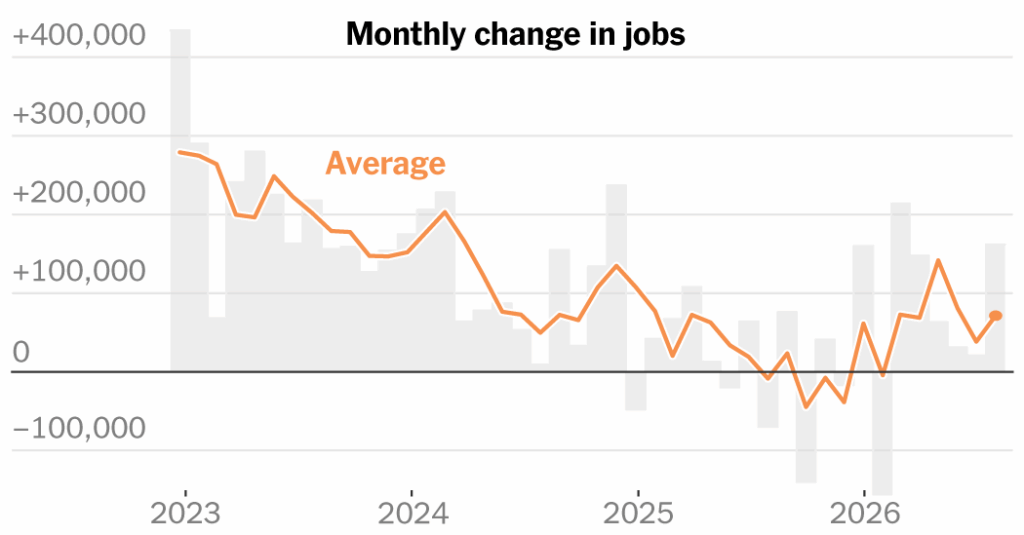
Businesses in August shook off uncertainty related to higher gas prices, tariffs and artificial intelligence, unleashing an unexpected wave of hiring that affirmed the labor market’s health.
Employers added 162,000 jobs on a seasonally adjusted basis last month, the Labor Department reported on Friday, and the unemployment rate held steady at 4.1 percent. Job gains for June and July were revised upward by 55,000, bringing the average increase over the past three months to just over 70,000. And while the health care sector fueled much of the employment growth last year, last month’s gains touched even sectors that had appeared troubled, evidence of strength in the broader economy.
Puncturing the rosy notes was wage growth, which continued to cool in August. Growth in average hourly earnings fell to 3.1 percent over past year, the slowest pace since the depths of the pandemic and lower than the inflation rate.
The tepid wage growth supports the Federal Reserve’s view that the labor market is not a source of inflationary pressure and reinforces its focus on stamping out inflation when Fed officials consider whether to raise rates later this month.
The zesty employment figures come at a time of broader economic resilience, marked by strong corporate profits and vigorous capital investments spurred by A.I. Consumer spending, buoyed by a roaring stock market, has stayed resilient despite higher gas prices brought on by the war in Iran. The manufacturing and services sectors are expanding at a moderate pace.
“It’s a very good report; I can’t emphasize that enough,” said Blerina Uruci, the chief U.S. economist at T. Rowe Price. “And it perhaps shows that financial conditions more broadly are not that tight.”
Much of the data in the report flashed similarly encouraging signals. The share of people working or looking for work ticked up, reversing a monthslong skid. A separate measure that takes into account people who have been discouraged from looking for jobs or want more hours also fell to its lowest level in more than a year, indicating that many people were able to find at least some work. The average workweek lengthened slightly to 34.4 hours, as employers stretched workers to meet demand.
But it is still the case that job seekers, especially new entrants to the labor market and those who have been on the sidelines for a long time, are finding limited opportunities. Although layoffs are exceedingly low, the number of workers who have been unemployed for 27 weeks or more has swelled.
The report was one of the last snapshots of the labor market before the hotly contested midterm elections, and President Trump took to social media to trumpet the “great jobs number.”
“You haven’t seen anything yet!” Mr. Trump wrote, before calling on the Fed to cut interest rates.
One of the more surprising drivers of growth last month was leisure and hospitality, which added 62,000 jobs following months of weakness as gas prices surged. Previous declines in the local government education sector, which may have attributable to some extent to seasonal adjustment quirks, also partially reversed, with the sector adding 42,000 jobs.
Other industries posted respectable gains as well. Construction, powered by the insatiable appetite for data centers, added 22,000 jobs. Professional and business services continued to trend upward after a prolonged slide.
After an abysmal 2025, manufacturing companies have also resumed hiring. The sector added 16,000 jobs last month and has gained 58,000 jobs since December.
“Businesses seem to have become accustomed to operating in a bit of the unknown,” said Dawn Fay, operational president at Robert Half, a staffing firm. “Everybody is paying attention to what’s going on, but there isn’t this kind of pullback and pause like we used to see.”
Nirel Inman is the president and co-owner of Chicago Glue & Machine, an adhesives manufacturer in Itasca, Ill. She paused permanent hiring for a time in response to uncertainty around tariffs, instead relying on contracts workers and paying for overtime to keep up with shifting orders.
Lately, though, demand for her company’s booger glue, adhesive machines and technical services has been high. Aiming to grow “a little,” she is focusing on making her company more efficient. She hopes to hire a technician and a sales representative, which would bring her head count to 30.
This year “is solid; it’s good,” she said. “There are no indicators that anything is slowing down or changing.”
Pockets of weakness remain, however. Job losses are piling up in the information and financial activities sectors, potentially owing to the adoption of increasingly powerful A.I. technology.
Employers are also contending with an aging population and restrictive immigration policies. Hundreds of thousands of people from Haiti and other countries have also lost their ability to work legally after the Trump administration ended their temporary protected status.
And many economists cautioned that one month’s data does not make a trend, particularly in light of the labor market’s recent volatility.
More broadly, the steadiness in the labor market does not refect how many Americans are feeling about the economy. Consumer sentiment, particularly among those on the lower end of the income spectrum, has curdled as wages fail to keep up with inflation and high gas and grocery prices weigh on wallets. The unemployment rate for recent college graduates has climbed, and many are working in jobs that do not require degrees.
“Even though the aggregate statistics look good, they mask that undercurrent that many are feeling about the labor market,” said Diane Swonk, the chief economist at KPMG. “It’s a hard reality for too many.”
Since graduating from college in 2023, Adam Moldover, 25, has been looking for a job that can put his degree in geography to good use. He estimated that he applied to more than 100 jobs but landed only a handful of interviews, including one this week that was a two-and-a-half hour drive away.
He has been living at home with his parents in Sterling, Va., earning money driving for Uber and Amazon. He is pursuing a geographic skills certificate at a local community college. Even for entry-level jobs, he said, employers seem to want applicants with more experience.
“They are looking for the perfect candidate,” he said.
The post Robust Hiring Reinforces Strength of the U.S. Economy appeared first on New York Times.